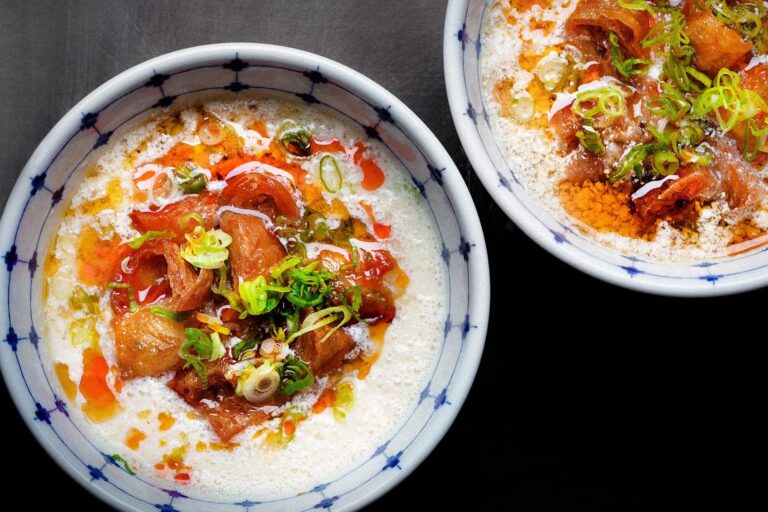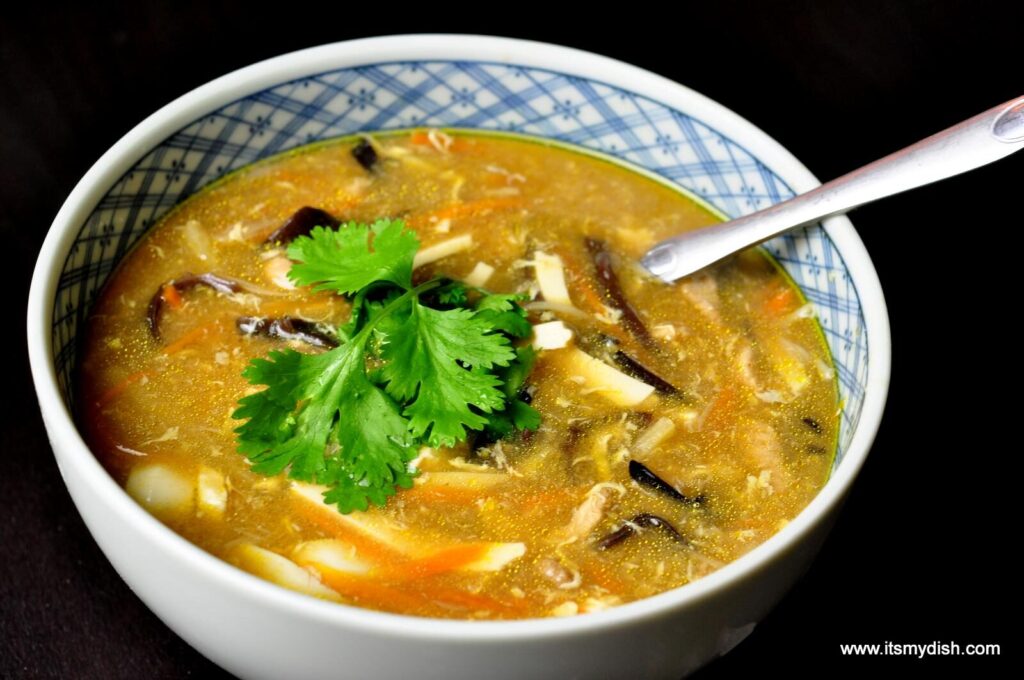
At dumpling shops across Taiwan, suan la tang often arrives as the same cloudy bowl: tofu, bamboo shoots, wood ear mushrooms, and other narrow strips suspended in a gently sour broth. The differences are easy to miss until the ingredients either scatter in the mouth or move together as one texture.
When I enter a dumpling shop in Taiwan,
suan la tang is almost always listed near the top of the menu.
It is not clear.
It is cloudy.
Many ingredients are cut into thin strips
and sink into a soup thickened just enough to hold them.
As the name suggests,
sourness and heat arrive together.
But there is no aggression,
nothing like Sichuan spice.
The heat comes mainly from white pepper,
and the sourness rests on the rounded edge of black vinegar.
Taiwanese suan la tang is gentle.
A soup born from daily life
Its origins are often traced to northern Chinese home cooking.
After the war, it was brought to Taiwan by people later called waishengren.
Failed tofu curds.
Leftover vegetables.
Odd ends.
They were sliced thin
and gathered into a single pot.
Suan la tang was not designed as a finished dish from the start.
It was shaped
and adjusted within daily life.
The feeling of sameness
I drink suan la tang across Taiwan.
In many places,
the ingredients look familiar.
Tofu.
Bamboo shoots.
Wood ear mushrooms.
Carrots.
Pig’s blood.
Everything is cut into narrow strips.
At first,
it feels the same everywhere.
But as I keep eating,
differences begin to appear.

The boundary is integration
In chain restaurants,
each ingredient exists on its own.
They simply float
in the soup.
In better shops,
this changes.
The ingredients move
as a single flow.
They merge with the thickened broth
and do not scatter
the moment they enter the mouth.
Here, suan la tang shifts
from a collection of leftovers
to a designed texture.
Those who defined the standard
In Taiwan,
the broadest shared version of suan la tang
was shaped by large chains
such as Bafang Yunji
and Sihai Youlong.
They paired dumplings with suan la tang.
Through this pairing,
the flavor became infrastructure.
The dignity of a true specialist
begins beyond that point.
Knife work and timing
In good shops,
the knife work is different.
Tofu and wood ear mushrooms
are cut as thin as needles.
Because they share the same width,
they blend completely with the thickened soup.
Vinegar and white pepper
are not boiled in.
They are added just before serving.
This makes the sourness layered
and allows the pepper
to pass through the nose.
At the end,
beaten egg is poured in.
It sets into fine threads
and forms a cloudy layer.
This small step
moves an inexpensive soup
closer to craft.
A supporting role
Suan la tang does not stand alone.
It washes away the oil of dumplings
and calls for the next bite.
It is complete
as a supporting role
that allows the main dish to function.
Because the structure is simple,
knife work and heat
create differences
with unforgiving clarity.
— Detour —
a little further to walk