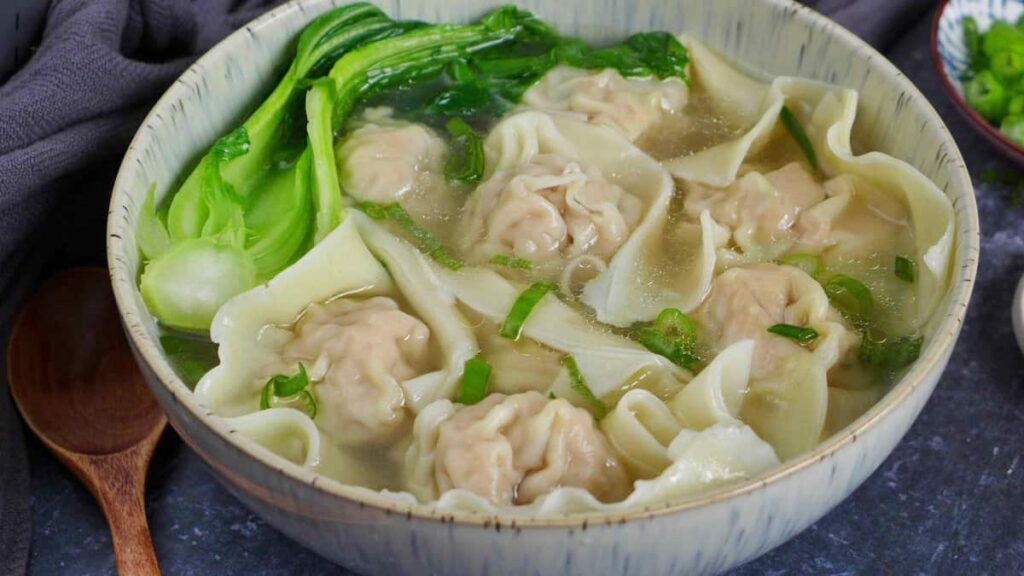
In a Taiwanese wonton soup, the first thing to rise from the broth may be a white membrane with no firm outline. Lift it with chopsticks and the wrapper trails back into the bowl, wavering between something to eat and something to drink.
When I look into the bowl, a white membrane drifts without a clear shape.
Its outline is vague.
It is hard to tell whether it belongs to the solid world or the liquid one.
I lift it with chopsticks.
A thin sheet trails downward and sways in the hot water.
It looks like the tail of a goldfish moving inside a tank.
What is called wonton soup in Taiwan feels less like eating something
and more like scooping up a piece of scenery.
A myth carried in the name
The word wonton originally referred to chaos.
In Chinese mythology, it described the state before heaven and earth were divided.
A condition that was murky, wrapped, and without openings.
It is said that a form fully enclosing its filling with thin skin
came to evoke this idea of chaos.
There was also a custom of eating wontons at the winter solstice.
By taking chaos into the body, one was thought to generate new energy.
Sipping this white soup in the morning, half awake,
may be a quiet remnant of that older ritual.

The skin is the main character
The main element here is not the meat.
It is the skin.
Taiwanese wonton wrappers are so thin that light passes through them.
Chewing is almost unnecessary.
Once in the mouth,
they slide across the tongue
and fall toward the throat without resistance.
This is not a dish built around chewing.
It is a structure designed to maximize the pleasure of swallowing.
The meat inside serves mainly as a weight to give the skin form.
Factions within the bowl
The most basic wonton is an old-style version meant for drinking the skin.
But in Taiwan, several clear variations exist.
Fresh pork wontons, often associated with Wenzhou style,
feature oversized meat fillings.
Here, the skin acts only as a container.
The dish becomes closer to a meat soup.
Shrimp wontons hide a whole shrimp inside minced pork.
The softness of the skin, the juiciness of the meat,
and the crisp snap of the shrimp
cross paths for a brief moment in the mouth.
Vegetable and pork wontons mix greens such as bok choy or shepherd’s purse.
A fibrous crunch enters the texture,
and the sense of guilt fades slightly.
A white soup held together by aroma
What supports these mild wontons is a familiar Taiwanese arrangement of aromas.
The green sharpness of celery.
The burnt sweetness of fried shallots.
White pepper added at the end, piercing the nasal passage.
Many shops also add a small bundle of bok choy.
In the soft white world of the soup,
this vegetable alone offers a realistic bite,
pulling the body briefly back to the present.
A bowl close to being a drink
Taiwanese wonton soup does not quite fit the idea of a light meal.
It is closer to a drink.
It carries little weight as it settles in the stomach.
On tired days, or mornings without appetite,
it enters the body without resistance.
White, vague, and without clear boundaries,
this bowl floats through daily life in Taiwan
like a small cloud.
— Detour —
a little further to walk
- Notes on Red Oil Wontons Beside Xiao Long Bao in Taiwan
- Notes on Lao Hu Jiang Wenzhou Giant Wontons in Taiwan
- Notes on Xiaolongbao in Taiwan