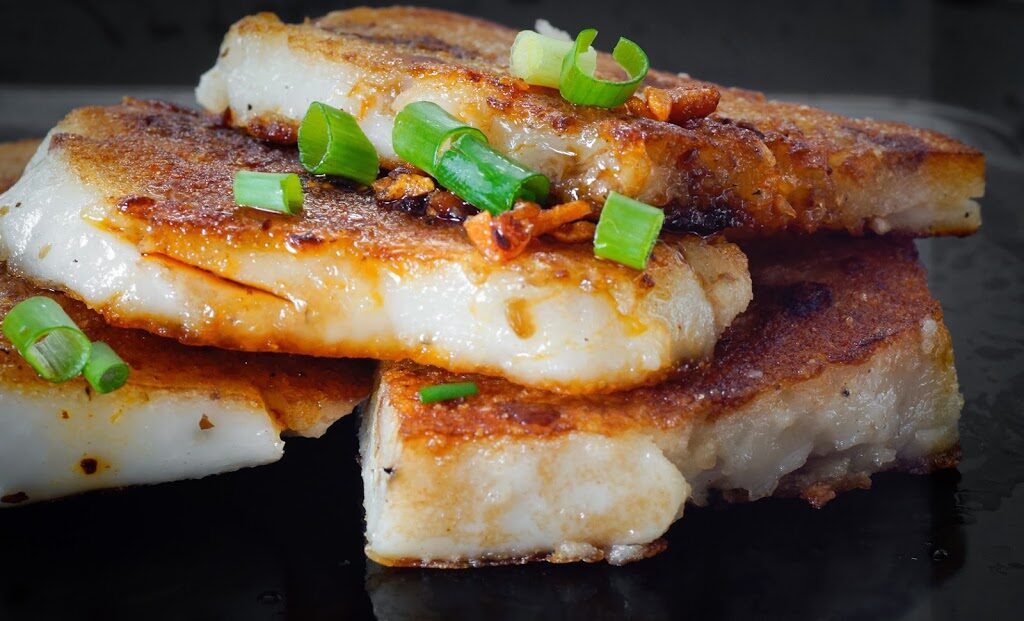
Before it reaches the griddle, Taiwanese radish cake looks less like breakfast than a construction offcut: a plain, rigid white block with almost no smell. A few minutes in oil turn the surface gold while the center stays soft, changing the dish’s entire character.
Taiwanese radish cake, known locally as luobo gao, is eaten in the morning.
It is made by mixing grated white radish with rice flour and pan-frying the mixture.
Despite the name, it is not a glutinous rice cake.
The English name often found on menus, Turnip Cake, is the first trap.
What sits on the plate is not turnip, but a thick, white radish.
In Taiwanese markets, these radishes are larger and wetter than those I knew in Japan.
The skin is thick. The cut surface is rough.
It is not obvious that this vegetable will become a square, cake-like block.
Before frying, the cake is not attractive.
White. Expressionless. A rigid rectangular solid.
Only faint marks of steaming remain on the surface, and the smell is weak.
It could be mistaken for soap, or a piece of construction material left on the ground.
When a knife goes in, the blade slides through easily, but not perfectly smooth.
Finely chopped radish fibers push back with slight resistance.
At this stage, it is hard to imagine flavor.
That changes on the griddle.
As oil is absorbed and browning appears, the judgment reverses.
The white mass turns gold.
Oil and sugars react, and a toasted aroma rises.
Pressed with a spatula, the surface yields slightly, then springs back.
The rebound shows that the inside is still soft.
It is not flipped until the color settles evenly.
For many people, the Taiwanese morning begins here.
A history built on sound
Radish cake holds a special place in the Chinese-speaking world for reasons beyond taste.
The key is sound.
The word gao used for cake shares its pronunciation with the word meaning “to rise.”
To go higher. To advance.
Through this chain of homophones, the dish came to symbolize promotion and growth.
It was originally eaten during Lunar New Year.
Steaming, cutting, and frying are sometimes said to mirror the idea of rising in stages.
In Taiwan, this symbolism was quickly repurposed for daily life.
If something is auspicious, it is better eaten every day.
The cake descended from festival food to breakfast staple without resistance.
Zen and ornament
The same dish reflects different ideas depending on place.
In Hong Kong dim sum halls, it is dense with additions.
Chinese sausage. Dried shrimp. Mushrooms.
Red and brown fragments scatter across the cut surface.
This is a version defined by what goes into it.
In Taiwanese breakfast shops, the opposite appears.
Almost entirely white.
Even when cut, no obvious ingredients announce themselves.
This is not omission.
It is a choice.
Sweetness from rice and radish alone.
Everything unnecessary removed.
Only browning and texture remain.
The restraint feels almost Zen.
Browning decides everything
Success here depends on the Maillard reaction.
The surface must be firm and crisp.
When touched with chopsticks, it gives off a faint sound.
Inside, it loosens with heat.
Radish moisture stays trapped, binding with the starch into a single mass.
When bitten, the crust breaks first.
Immediately after, the interior collapses.
Without this contrast, it is not radish cake.
A white cake without browning is only a warm paste.
Frying is what gives it meaning.
Adding an egg
At Taiwanese breakfast counters, a short phrase is often spoken.
“Add an egg.”
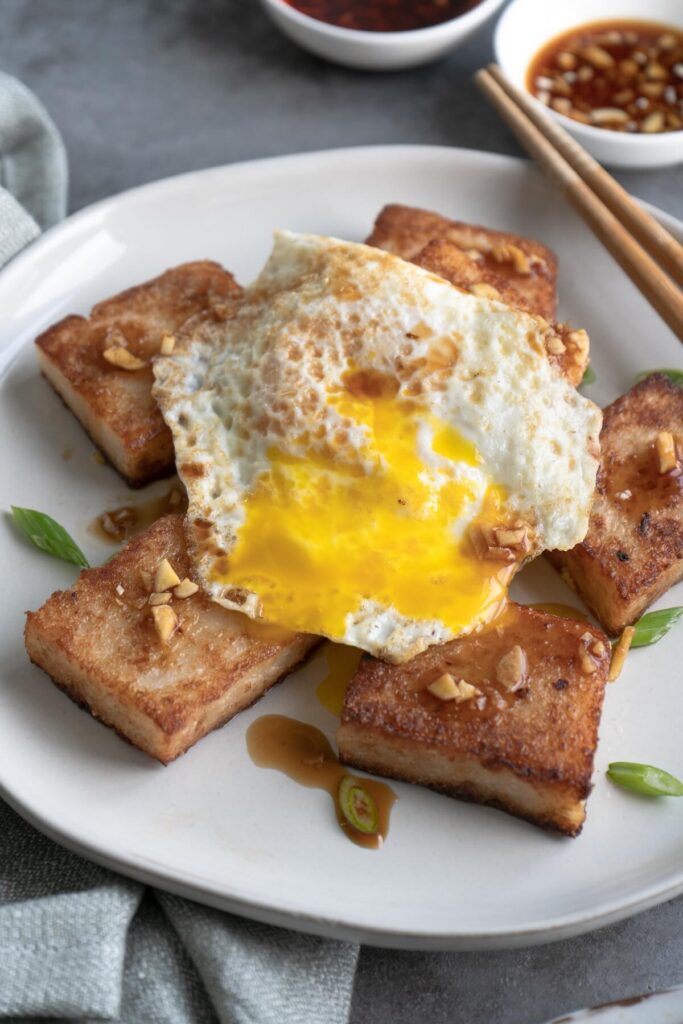
When this is said, the cook cracks an egg onto the griddle.
Before it fully sets, the finished cake is pressed into it.
The white block wraps itself in a thin blanket of egg.
The color deepens into complete gold.
Oil from the egg and new browning add weight to what was previously austere.
A small, worldly richness enters.
Five or ten dollars.
A modest cost for a reliable morning lift.
Supporting roles
On its own, the Taiwanese version is incomplete.
Sweet, thick soy paste is poured over the surface.
It flows along the ridges left by frying.
Add garlic sauce, and the scene changes again.
The sharpness of chopped garlic gives the mild radish a clearer outline.
Nothing overwhelms the main body.
The flavor is simply raised one level.
This is the ideal distance for a supporting role.
A small daily rise
Once, this dish was eaten with the hope of rising higher.
Now it is fried simply to fill the stomach.
Still, standing by the griddle,
hearing the crackle,
seeing the gold placed on a plate,
mood rises slightly, along with blood sugar.
Taiwanese radish cake has stopped being an auspicious symbol.
Instead, it has become a way to set the morning in motion.
— Detour —
a little further to walk
- Notes on Taiwanese Scallion Pancakes
- Notes on Youtiao and the Structure of the Taiwanese Morning
- Notes on Fan Tuan in the Taiwanese Morning