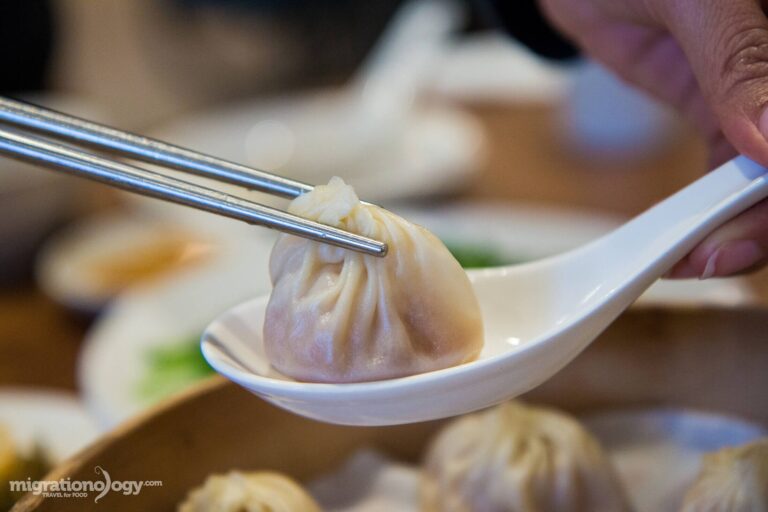
At a Taipei street stall, the lid lifts on a row of xiaolongbao whose pleats are close enough to look uniform, but not quite identical. By the time the sauce arrives, the steam has already begun to disappear and the wrappers have changed.
Xiaolongbao, the soup dumpling, appears to finish itself inside a bamboo steamer.
I stood in front of a street stall and waited for it to rise.
Thin white steam slipped through the gaps.
Steam tends to blur most things.
On the corner of Yongkang Street, and again at Raohe Night Market, the smell repeats.
Pork fat, ginger heat, and wheat dampened by vapor.
I watched it without urgency, and a thought arrived.
What shape will this be, in the future.
If the city keeps changing, food will change with it.
Or perhaps this is one of the things people want to keep unchanged.
I waited for the lid to open.
A point of divergence
For a long time, this was a dish of technique.
Thin skin. A fixed number of pleats. Balance between juice and flour.
The numbers often associated with Din Tai Fung—five grams of wrapper, sixteen grams of filling, eighteen folds—were not only a preference.
They were a specification that could travel.
But in the last decade, the axis of evaluation has started to move.
Social media made appearance into a form of power.
Sometimes the first thing at the entrance is not the menu, but a place to take photos.
When the steamer arrives, a light turns on.
The white of the spoon reads cleanly on a screen.
The wrapper is pushed thinner.
The liquid is pushed larger.
The new standard is the one that trembles.
At the same time, older shops remain.
A slightly thicker skin with a fermented scent.
Less overflow, but a quiet release when you bite.
For a while, these forms will coexist.
Over a longer horizon, the balance may not hold.
The world outside keeps shifting.
Pressure from outside the kitchen
The population is shrinking, and young hands are fewer.
A business built on wrapping by hand becomes harder to maintain.
In a morning market, a small rise in pork price moves the cost of each piece.
If scallions arrive late, the flavor changes.
Outside the shop, the city is in a hurry.
Visitors increase, and the need is speed and clarity.
Waiting is no longer only waiting.
A ticket number. A QR code. A notification.
The experience begins before the seat.
Robot arms have become precise.
Their pace is steadier than a human hand.
There are systems that judge steaming time automatically.
Pressure and temperature leave logs, and taste becomes managed.
Customers split in two directions.
Some want work with a story.
Others want the same result, every time.
Some people pack chilled dumplings into a suitcase.
Others sit near the steamer and watch the pleats.
Mark Twain said history does not repeat, but it often rhymes.
The future of this dish may follow a similar pattern.
One future: a return to handwork
Coffee moved toward lighter roasts and detailed origins.
A similar return can be imagined here.
A counter begins to display not only price, but provenance.
Pork from Hualien. Scallions from Yilan.
Ratios of filling. Hydration of dough.
Old starter dough appears again.
A shop values the smell at the moment the lid opens.
A slightly uneven pleat becomes variation, not defect.
A glass-walled kitchen changes meaning.
Not only proof of cleanliness, but proof that humans are doing it.
People tired of optimized sameness sit down and wait.
They buy the time it takes for steam to build.
That future is easy to picture.

Another future: full automation
This is a future conveyor-belt sushi has already practiced.
Central kitchens produce in volume.
Wrapper and filling become fixed by specification.
Steam is controlled by sensors and software.
Wherever you eat, the deviation is small.
A shop no longer needs to keep craftsmen.
It needs operations, cleaning, and refilling steamers.
In the underground mall at Taipei Main Station, or in the food court at Taoyuan Airport, the same tray arrives.
The same heat. The same speed.
People who value low cost and quick service will choose it.
Consistency becomes the strongest virtue.
A third future: the runaway broth
In the age of short video, liquid has authority.
If that logic continues, the next step is excess.
As certain ramen styles broke the old baseline of “normal,” this dish may also move toward exaggeration.
The filling becomes paste.
The liquid merges with it.
The wrapper turns into a membrane too weak for chopsticks.
A holder or tray arrives as part of the design.
The oversized version that is sipped through a straw already exists in tourist districts.
It could become the main stream, not the side show.
Authenticity will not matter much.
Only whether it photographs well.
A shop sells the image more than the taste.
Not steam, but spill.
Not temperature, but wobble.

These futures are already lined up
Taiwan rarely chooses a single future.
The return, the machine, the excess.
This is less prediction than a process already running in parallel.
In the morning, a quick automated shop.
A ticket machine and a number.
Steaming time displayed. Seats turning over.
Heat and flavor kept uniform.
At noon, a visit for the liquid.
Does it tremble like the video.
Does it flood when pierced.
This dish looks most theatrical in daylight.
At night, a return to the shop that still wraps by hand.
The pleats are not identical.
The skin is not perfectly even.
But the smell rises from the closest distance when the lid opens.
Three forms can stand within one street.
In Taipei, it does not look unusual.
Old and new mix, and evolution happens in parallel.
There may be futures that do not fit any of these categories.
A shop that treats freshness as absolute and serves something close to half-cooked.
A shop that uses low-temperature methods to hold meat in a rare state.
As hamburg steaks and tonkatsu have taken on their own forms of excess, steaming might be pulled in that direction too.
It may not happen.
This is a dish completed by heat.
Without steam, it becomes another food.
The speed of disappearing steam
The lid opened, and steam rose.
I had not prepared the sauce, so I stood up to fetch it.
When I returned, the dumplings had settled slightly.
The wrapper tightened by a small degree.
Still, the steam remained.
Whatever the future becomes,
the speed at which steam disappears may not change.


— Detour —
a little further to walk
- Notes on Xiaolongbao and the History Taiwan Inherited
- Notes on the Entertainment of Xiaolongbao
- Notes on the Fluffy Xiaolongbao of Taiwan’s Breakfast Shops