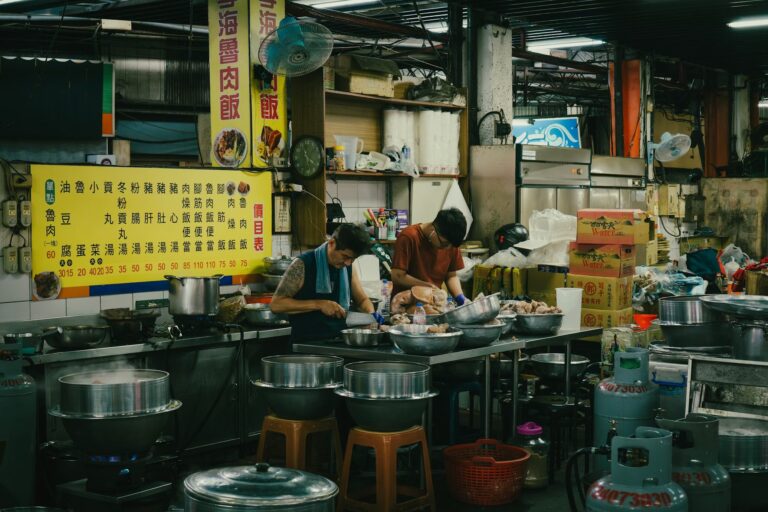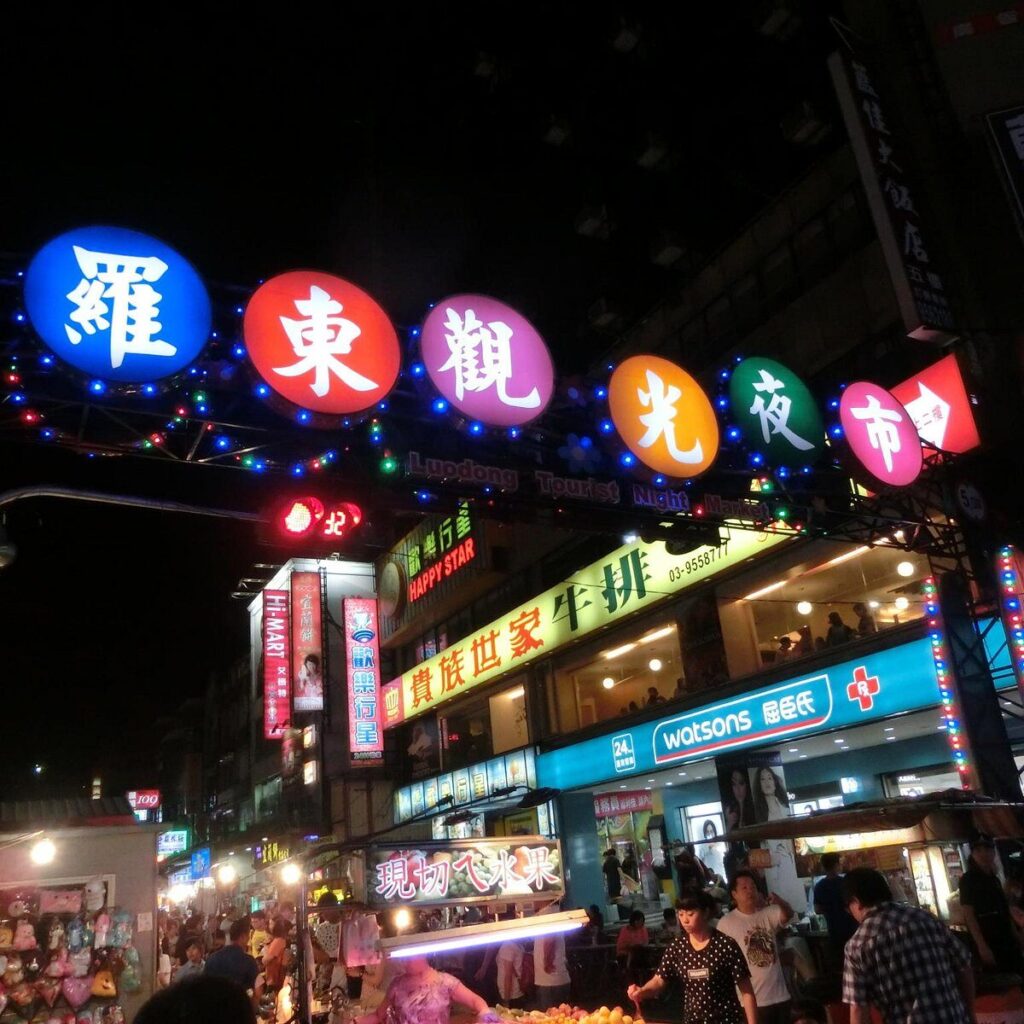
In Yilan markets, scallions are hard to miss: green bundles fill the stalls, while breads, pancakes, and noodle bowls are built around them rather than merely garnished. In supermarkets, the Sanxing bundles look ordinary at a glance, but their price does not.
In Yilan markets, scallions enter the eye too easily.
Before meat or fish, green bundles occupy the view.
Scallions are usually a garnish.
A supporting role that sharpens the outline of a dish.
In Yilan, that order weakens.
There is bread built around them.
There are pies made to carry them.
There are bowls of noodles covered with them.
Even in Taiwanese supermarkets, Sanxing scallions are expensive.
The bundles look similar,
but the price tag belongs to a different world.
Why does a scallion gain brand value.
The answer seems buried not only in taste,
but in the conditions of the land.
A rainy county where scallions still grow
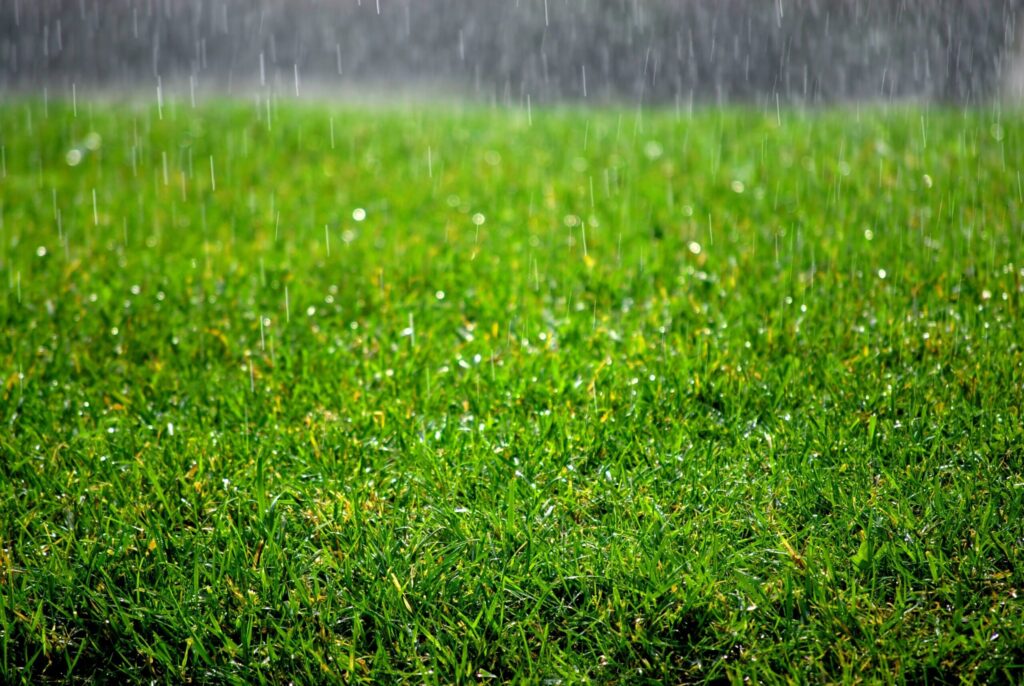
Yilan is known for rain.
People mention it whenever the weather is discussed.
It is said that it can rain for more than two hundred days a year.
Even by feeling alone, the air stays wet.
Normally, this would be a disadvantage.
Long humidity damages roots.
Fields invite disease.
And yet the scallions grow here.
More than that, the ones grown here are valued.
Rain is heavy, but the plants do not rot.
That contradiction becomes the entrance.
Stony soil that does not hold water
When I imagine farmland in Sanxing,
I picture heavy black clay.
The reality is different.
Gravel and sand carried by the Lanyang River
mix into the soil.
The grains are coarse.
Drainage is fast.
Even when rain falls in volume,
the fields do not stay submerged.
Water passes through.
Rain is abundant,
but it does not stagnate.
Roots do not drown.
They are washed again and again.
A large amount falls,
and then it leaves.
This environment acts like a factory.
The land itself resembles a natural filter.
The whiteness that reaches fifteen centimeters
Sanxing scallions are easy to recognize.
The white part is long.
In many scallions, the white section is around ten centimeters.
Here it can pass fifteen, even twenty.
The lower half of the bundle
looks almost entirely white.
This did not happen by itself.
Farmers keep covering the base with soil
as the plant grows.
The light is blocked.
Photosynthesis is reduced.
A soft white section extends upward.
The principle is similar to white asparagus.
Here it is repeated across entire fields.
It takes labor.
That labor becomes the price.
The whiteness is not decoration.
It is proof of softness and sweetness.
The shock of not being sharp
I used to think scallions were valued
for strong aroma,
or for bite.
Sanxing scallions behave differently.
When eaten raw, the sting is weak.
There is less burn through the nose.
Sweetness arrives first.
The fibers feel fine.
They do not remain in the mouth.
Sometimes a clear stickiness appears
on the cut surface.
Calling it mucus sounds too direct,
but it becomes a sign of quality.
There is moisture.
And the aroma is not pointed.
A scallion stops being a garnish
and begins to stand as an ingredient.
In Yilan, that seems to be the first reason
it can become the main thing.
Dishes that let the scallion remain itself
The value here is not only aroma.
Weak sharpness and high moisture
create a different function inside food.
In Yilan, there are dishes
that do not simply add scallions.
They are built to hold them.
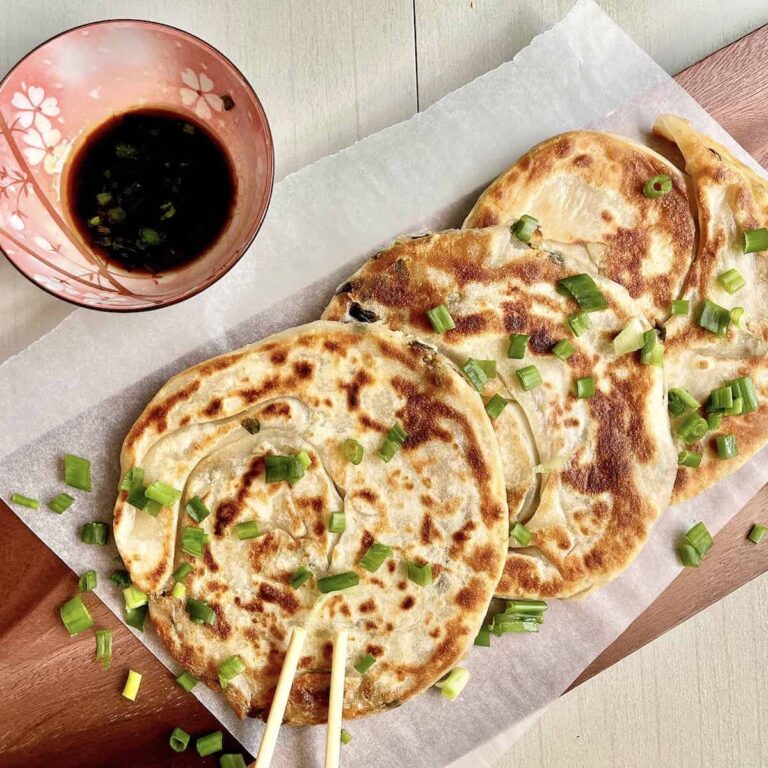
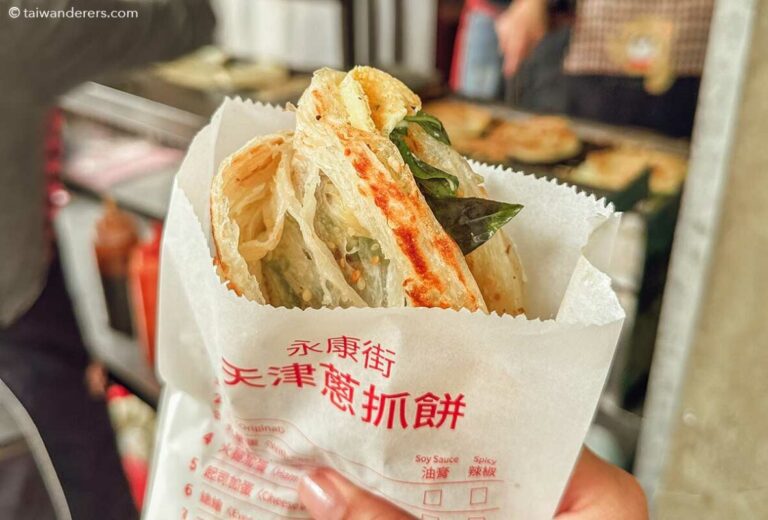
Scallion pancakes between steam and oil
In scallion pancakes, the difference appears quickly.
It is not only a stronger fragrance.
There is more steam.
Moisture trapped inside the scallions heats up
and pushes outward from within the dough.
Layers form.
They lift.
With the same flour and the same oil,
a different scallion changes the result.
It becomes less a recipe problem
and more a behavior of ingredients.
Scallion twisted pancakes sit in the same family.
Thin layers loosen,
and sweetness stays behind.
With sharper scallions,
oil can clash with the bite.
Here the edges are softer.
The oil’s smell is not interrupted.
When people say Yilan scallion pancakes taste good,
it is not only technique.
Moisture made by rain and stones
returns at the end as texture.

Beef stir-fried with scallions and the sweetness that blends
Over high heat, scallions act like a switch.
Beef stir-fried with scallions is a clear example.
Even when cooked,
the sharpness does not come forward.
Just before scorching,
a sweet smell rises first.
Then satay sauce enters.
Dried shrimp.
Seafood depth.
Garlic.
Heavy oil.
Against that thick seasoning,
the scallions do not fight.
They do not compete.
They brighten the surface slightly.
Inside fat and sauce,
they remain as something that can still be eaten,
not only smelled.
Oyster omelets and scallions that do not disturb the sea
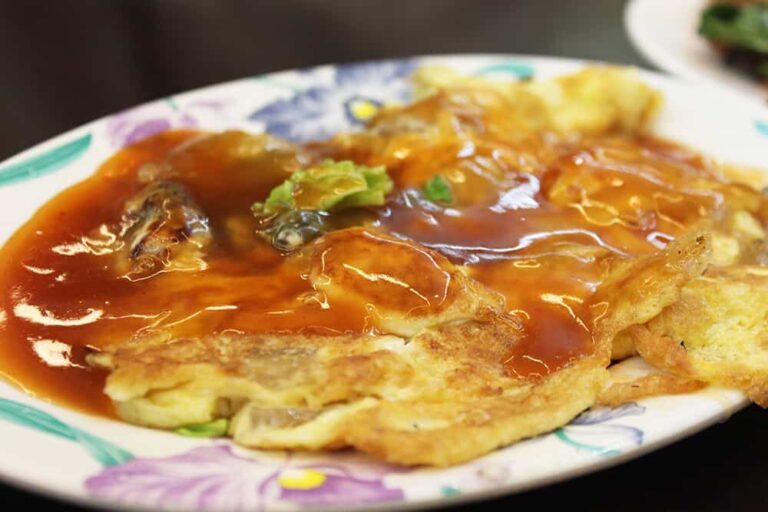
Oyster omelets are delicate in structure.
The smell of oysters is strong,
but the taste itself can be light.
If sharp scallions are added,
the scallion can rise before the oyster.
Sanxing scallions are mild.
They do not break the outline of seafood.
Because they hold moisture,
they release steam inside the batter when heated.
The surface browns,
but the inside stays soft.
The contrast becomes slightly larger.
Here, scallions are not decoration.
They act as a regulator
for aroma and moisture.
The moment a crop becomes a brand
Sanxing scallions were not special from the start.
They were just scallions.
The turning point is often placed in the 2000s.
Imported vegetables increased after WTO membership.
Consumer taste changed.
Low price alone could not survive.
In that atmosphere,
the Sanxing farmers’ association moved into branding.
A story was attached to a crop.
The place name was pushed forward.
Quality control was tightened.
The product was shaped into something that could be explained outside.
There is even a museum-like facility.
It is called the Green Onion Culture Center.
I find myself thinking,
they went that far.
But that excess may have drawn the outline of the brand.
When famous restaurants in Taipei began writing
“Sanxing scallions used,”
the crop became a sign, not only an ingredient.
Turning hardship into an asset
There is heavy rain.
There are stones in the soil.
For farming, these can look like trouble.
In Sanxing, they became value.
A large amount falls,
but it drains immediately.
That contradiction produced freshness.
Soil is piled again and again
to extend the white part.
That labor created softness.
Scallions could have stayed as garnish.
Yilan still pushed them into the center.
I finish a scallion pancake
and look at the oil stain on the paper bag.
Behind the smell of oil,
a memory of wet land
seems to remain.

— Detour —
a little further to walk
- Notes on Taiwanese Scallion Pancakes
- Notes on Chishang Rice in Eastern Taiwan
- Notes on Sweet Potatoes in Taiwan