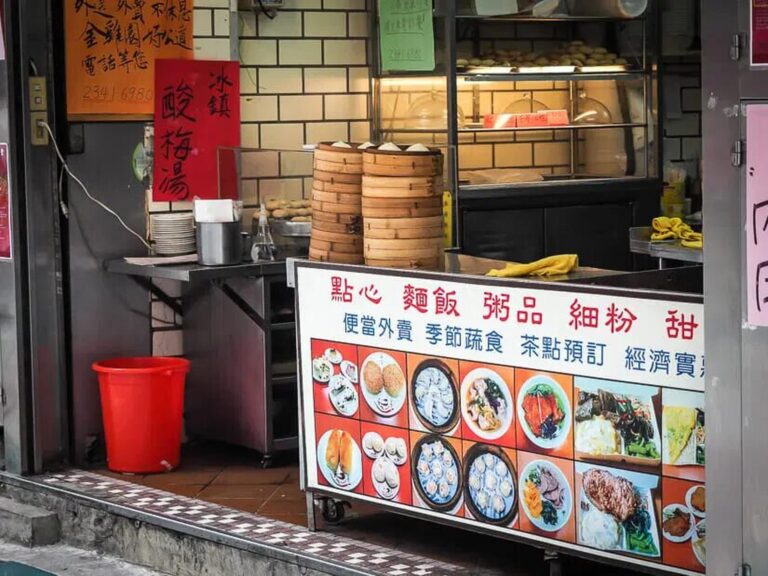
A Taiwan breakfast can place soy milk and a layered shaobing beside rice balls, while the same streets later fill with beef noodles, dumplings, and steamed buns. Foods associated with far-flung regions of China have become ordinary fixtures of one island’s daily meals.
Taiwan’s streets offer a wide range of food. In the morning there are doujiang (豆漿, soy milk) and shaobing (燒餅, a baked, layered flatbread), and at lunch there are beef noodles (牛肉麵). In the evening there are shops selling shuijiao (水餃, dumplings), and xiaolongbao (小籠包) and mantou (饅頭, steamed buns) are common too. Alongside rice dishes such as lu rou fan (魯肉飯, braised pork rice) and rice balls (飯糰), noodles, dumplings, and other foods made with wheat wrappers are a deep part of daily life.
Trace these foods back and they lead to different places: noodle dishes tied to Shandong and northern China, snacks from Jiangnan, and flavors tied to Sichuan and other inland regions. Food from regions far apart now sits side by side on the same streets in Taiwan.
Why has one island gathered so many different kinds of food? One major event behind this scene was the movement of people around 1949.
The One Million Who Crossed to Taiwan
In 1949, the Chinese Civil War was all but decided, and the Republic of China government moved its base to Taiwan.
It was not only the government that moved. Government agencies and troops, officials, soldiers’ families, merchants, cooks, and ordinary citizens all crossed the sea. The movement was not limited to 1949. It had been going on since 1945, when Japanese rule ended, as the civil war continued.
A recent study that recalculated the numbers using declassified records estimates that, as of 1956, 1,024,233 mainland soldiers and civilians had moved to Taiwan, Kinmen, and Matsu after the war. They are known as waishengren (外省人), those who had come from the mainland after the war. There were about 375 men for every 100 women. The figure reflects how many soldiers crossed alone.
These more than one million people brought the habits of their home regions with them, along with the food they ate every day.
Food from Across China
Not Just Northerners
The people who crossed to Taiwan after the war did not form a single group. They came not only from northern provinces such as Shandong but in large numbers from coastal provinces such as Fujian, Guangdong, Zhejiang, and Jiangsu, and from Sichuan, Hunan, and other parts of China. Some came from regions where people ate a lot of wheat, others from regions centered on rice, and each brought different dishes and eating habits.
Nor did the million spread evenly across the island. Mainland civilians were concentrated around Taipei, and juancun (眷村, military dependents’ villages), where soldiers and their families lived, were built in areas with military facilities. Zuoying in Kaohsiung was one of them.
A Distance Shrunk to One Town
On the mainland, Shandong and Sichuan, or Jiangsu and Hunan, are far apart. In Taiwan, people from these places came to live in the same towns and settlements.
When families from different regions lived next door to each other, the smell of a dish from someone else’s home region probably drifted over from time to time. People must also have seen other regions’ seasonings and dishes far more often than before.
The cuisines did not mix right away. Still, food cultures that had been hundreds or thousands of kilometers apart on the mainland were now brought within a single town or juancun.
The Restaurants That Kept Home Flavors Alive
Regional Cooking in Postwar Taipei
The change showed up in the city’s restaurants too.
When the writer Tang Lusun (唐魯孫) arrived in Taiwan in 1946, Taipei had grand restaurants dating from Japanese rule, such as Penglaige (蓬萊閣), and others such as Xinzhonghua (新中華) and Xiaochunyuan (小春園) lined Yanping North Road. Apart from these grand restaurants, he later recalled, there were still few ordinary places to sit down for a meal.
As more people arrived from the mainland, restaurants advertising Beiping, Jiangsu-Zhejiang, Hunan, Sichuan, and other regional cooking multiplied in Taipei.
It was not only cooks who came. People who knew these flavors and wanted to eat them came too. Some wanted Jiangsu-Zhejiang food at banquets, some knew dumplings as everyday food, and some wanted shaobing in the morning.
Shaobing and Doujiang in Yonghe
The Chinese-style breakfast now found all over Taiwan is also tied to the migration of that time.
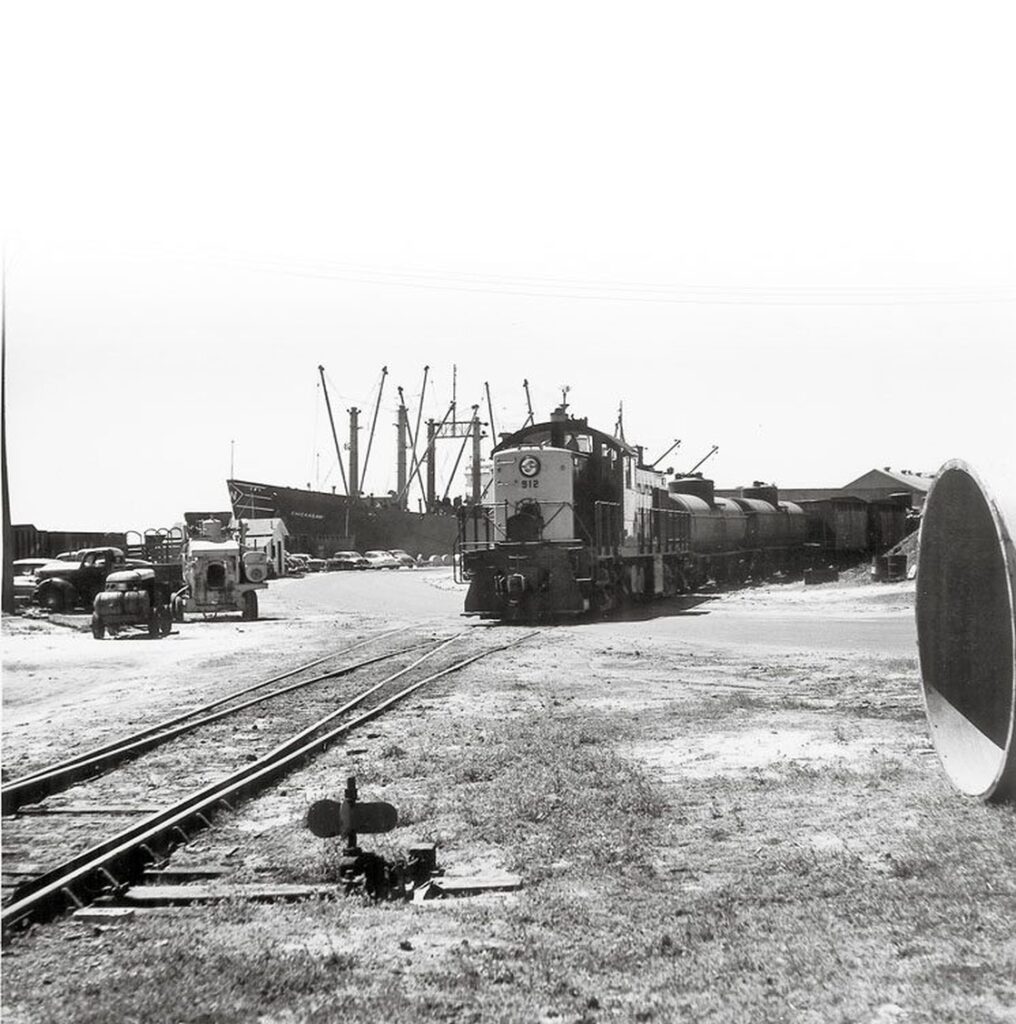
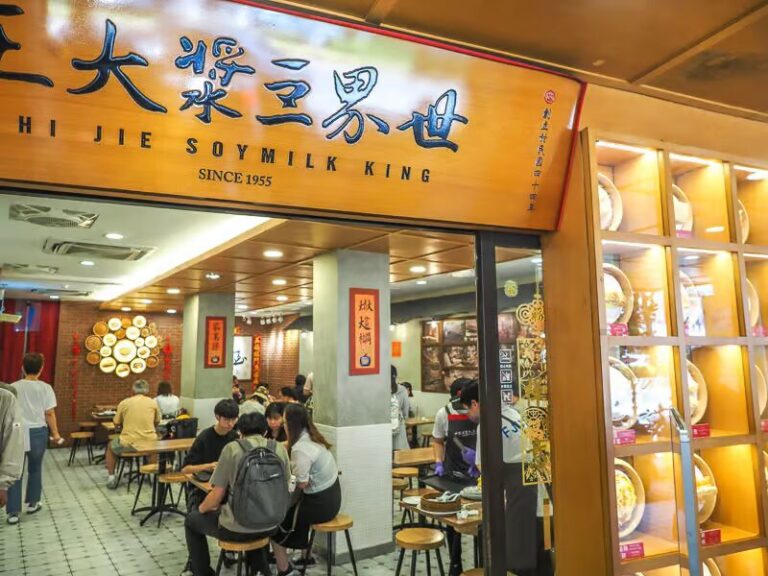
According to World Doujiang King (世界豆漿大王), in 1955 Li Yun-zeng (李雲増), a Shandong native, left the army and began selling shaobing and doujiang with army comrades at the foot of Zhongzheng Bridge (中正橋) in Yonghe. Many veterans from the mainland lived nearby, and the business is said to have started from a street cart. There were people who could make a Shandong breakfast, and people nearby who knew its taste.
Who came to the shop, and when, later widened. According to the company’s history, as Taipei’s nighttime population grew, more customers came for doujiang as a late-night snack, until they outnumbered the breakfast crowd. In 1975, the shop began opening 24 hours a day.
The shaobing and doujiang stayed the same, but when people ate them changed with city life in Taiwan.

Spreading Beyond the Places They Came From
US Aid
From the 1950s, another major change came to wheat foods in Taiwan.
US aid brought large amounts of wheat to Taiwan, and domestic mills turned it into flour. Taiwan grew rice but relied on imports for much of its wheat, and American wheat became a major source of supply for postwar wheat foods.
Even if people from the mainland knew how to make wheat foods, making them every day required raw materials. The large volume of wheat became that foundation.
Replacing Rice with Flour
The government also promoted “replacing rice with flour” (以麵代米) to expand wheat use further. The aim was to replace part of the rice eaten at home with wheat and export the rice saved to earn foreign currency. Flour was also used in rations for soldiers, civil servants, and others.
Flour, however, cannot simply be cooked like rice. Unless people knew how to knead, roll, wrap, steam, and boil it, it was hard to bring into the home kitchen.
In 1962, CUSA (美援會), the government body overseeing U.S. aid, and the flour industry, among others, launched a push to promote wheat foods and set up centers in Taipei, Taichung, and elsewhere. These taught how to make dishes such as xiaolongbao and cong you bing (蔥油餅, scallion pancakes). The farm magazine Harvest (豐年) also ran illustrated instructions for rural women on making mantou, cong you bing, and steamed rolls (蒸麵捲). The effort was not only to supply wheat but to spread the ways of eating it.
Noodles Take Root in Taiwan
Even so, Taiwan’s staple did not switch from rice to wheat. From 1963 to 1971, rice’s share of staple food consumption actually rose from 83.23% to 91.71%, while flour stayed between 1.46% and 2.23%. Rice remained at the center.
At the same time, households eating both rice and noodles increased, from 10.37% in 1968 to 23.44% in 1977. Rather than giving up rice, more households ate noodles, dumplings, mantou, baozi (包子, filled steamed buns), and cong you bing alongside it.
The wheat-eating habits of postwar migrants came together with American wheat and the campaign to replace rice with flour. Wheat foods settled into everyday life in Taiwan as one more option.
Fu Pei-mei and Television
The way cooking was passed on changed as well.
The cook Fu Pei-mei (傅培梅) was herself one of those who came from the mainland in 1949. To learn cooking in Taiwan, she reportedly paid restaurant chefs who made dishes from various regions to teach her. From 1962, she taught cooking on television.
Until then, learning the cooking of an unfamiliar region properly depended on connections with people from that region or with cooks. Television brought those dishes straight to the home screen. With cookbooks as well, people who were not from Sichuan could cook Sichuan food, and people not from Jiangsu or Zhejiang could cook Jiangsu-Zhejiang food.
The skills Fu had gathered by going from cook to cook now reached homes widely through television.
What Stayed in Everyday Taiwan
Dumplings Become Everyday Food
Dumplings show this change clearly.
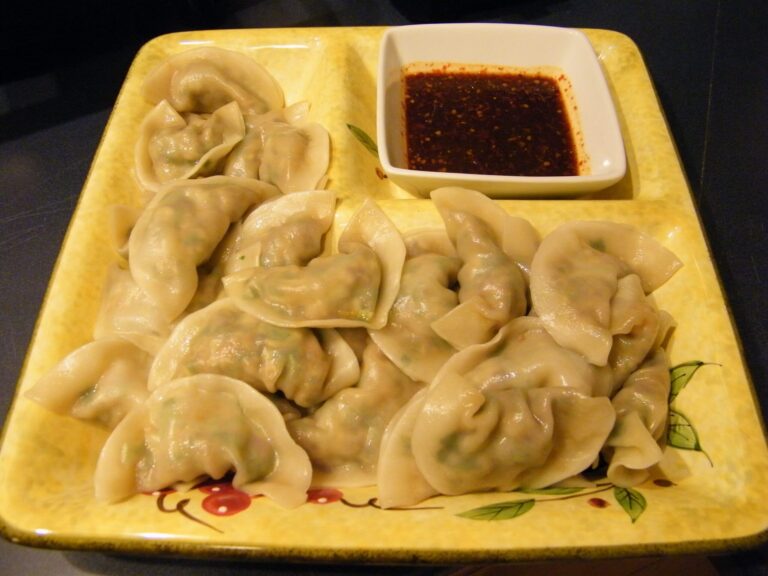
Some of those who came from the mainland made dumplings as everyday food. In juancun and areas with many waishengren, families wrapped them at home, and shops selling dumplings opened in town. Later, dumplings also became frozen foods and the products of dumpling shops. In Taiwan today, eating dumplings alongside rice needs no special explanation.
A wheat dish tied to particular regions of the mainland became one of Taiwan’s ordinary dinners.
Beef Noodles, Rebuilt in Taiwan
Beef noodles took a somewhat different path.
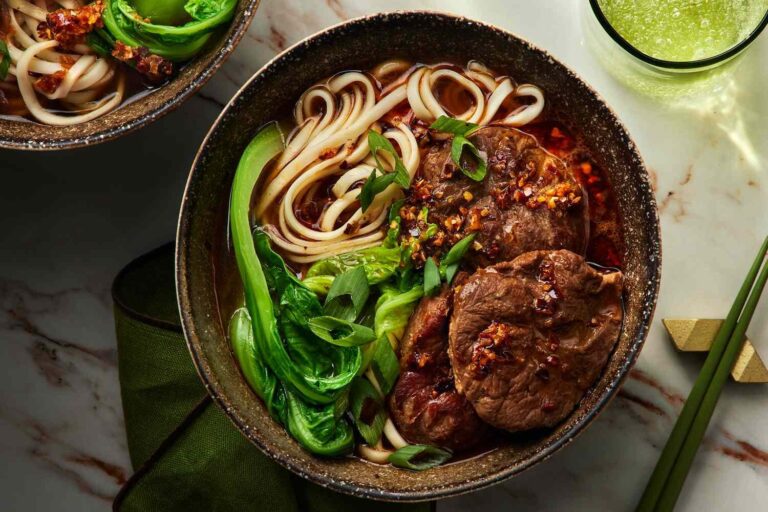
It is hard to see Taiwan’s beef noodles today as a dish brought over in finished form from one region of the mainland. There are qingdun (清燉, clear broth) and hongshao (紅燒, red-braised) versions, and the spices and noodles vary from shop to shop.
The historian Lu Yao-tung (逯耀東) said that in the 1950s the first beef noodle stalls in Taipei stood near the Paokung Cinema (寶宮戲院) and under the arcades of Nanyang Street (南陽街). He also said that people first ate the dish to remember home, but as it spread, in his words, the foreign land became home. He said, too, that the “Sichuan-style” hongshao beef noodles were not carried over from Sichuan but were born in Taiwan, and that Sichuan has no such dish.
A dish started by people looking for the taste of home spread while changing shape in Taiwan. That process itself made Taiwan’s beef noodles what they are today.
Chuan-Yang Cuisine Fades
Not every dish that came to Taiwan after the war lasted in the same way.
In the 1950s and 1960s, Chuan-Yang cuisine (川揚菜), which combined Sichuan and Huaiyang cooking, held an important place at high-end banquets. It was served at state venues for receiving guests, such as the Grand Hotel (圓山大飯店), and was widely known for a time. From the 1970s, its presence faded. Tastes in high-end dining changed, and Cantonese and other cuisines grew.
Dumplings, beef noodles, shaobing, and doujiang, meanwhile, were eaten again and again in town and at home. Dumplings can be wrapped at home, beef noodles can be sold from a small shop, and shaobing and doujiang can be started from a street stall. That closeness to daily life may have been one reason these dishes lasted.
Arriving in Taiwan and continuing to be eaten in Taiwan were not the same thing.
Dishes No Longer Tied to a Home Province
Around 1949, more than one million people moved from mainland China to Taiwan. Those from Shandong knew the food they had eaten in Shandong. People from Jiangsu, Zhejiang, Sichuan, Hunan, and Guangdong each had the tastes of their own home regions.
In Taiwan, these people lived close together and opened shops. People from other regions began to eat their food, and the ways of making it spread. Wheat arrived in large amounts, families began making wheat foods at home, and in time anyone with a television could learn dishes from across China.
Dumplings became an ordinary dinner, and shaobing and doujiang became part of Taiwan’s morning scene. Beef noodles took shape in Taiwan as a distinct dish. Today, no one needs to know the home province of the person who made them.
Some of the dishes that crossed to Taiwan from across China, after decades of being made and eaten, became food that needs no explanation of where it came from. That is probably what lines Taiwan’s streets today: dishes whose home province no one asks about anymore.
— Detour —
a little further to walk
- Notes on the Taste of Taiwan Before 1949
- Notes on the History of Taiwanese Beef Noodle Soup
- Notes on Taiwan’s Layered Breakfast Streets