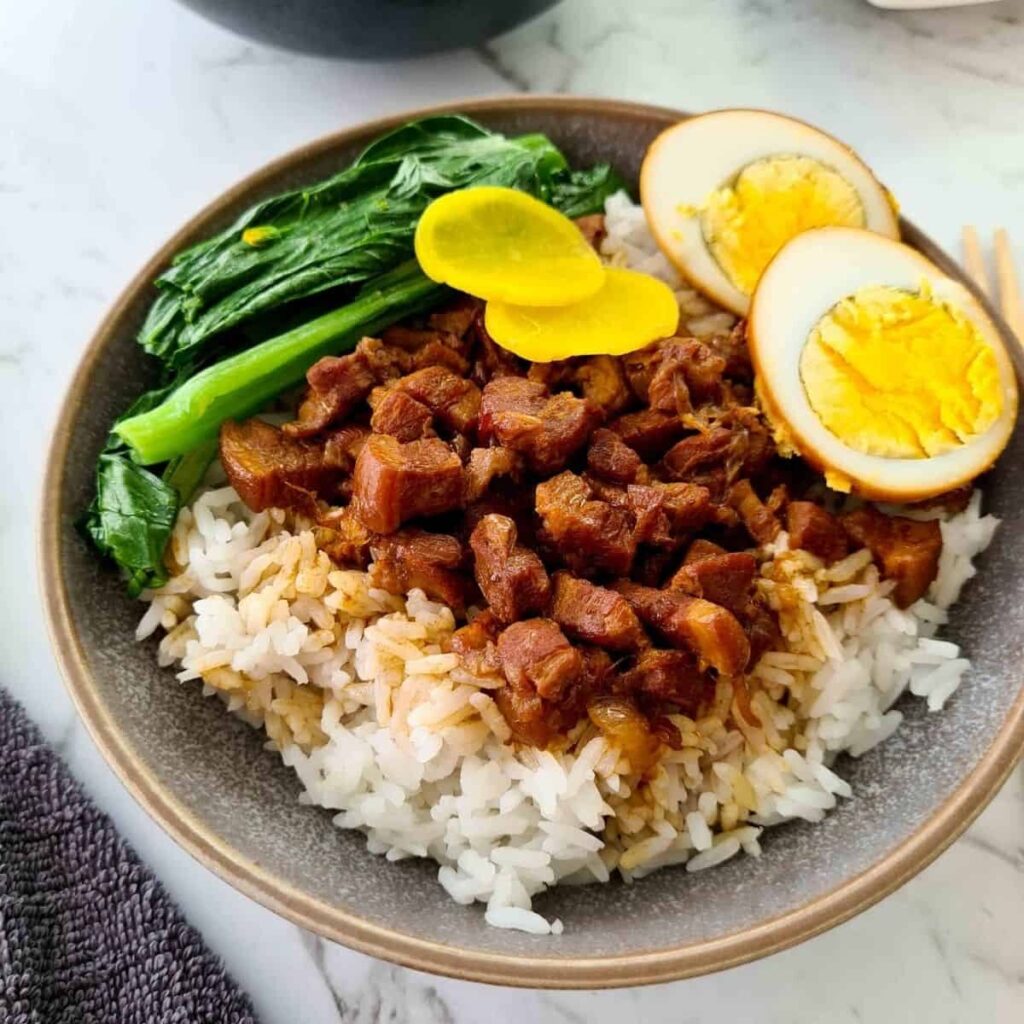
A bowl of lu rou fan that might cost around 30 NT dollars at a street stall sells for nearly twice that beneath Formosa Chang’s yellow sign. At lunchtime, office workers and older regulars still fill the seats, eating from bowls that arrive with strikingly little variation.
Walking through the streets of Taipei, a yellow sign with red lettering enters the field of vision.
Behind the glass at the storefront, pots line up in quiet order.
Under steady lighting, pork simmers without urgency.
The name reads Formosa Chang Lu Rou Fan.
It is a place that presents a dish seen in homes and street stalls — braised pork over rice (lu rou fan) — deliberately as a chain restaurant.
Stepping inside, the temperature is constant.
The floor is dry.
The flow of ordering is clear, leaving little room for hesitation.
Between Price and Perception
This bowl has long belonged to Taiwan’s everyday life.
At a stall, it is not unusual to find one for around 30 NT dollars.
Here, the price is closer to 60.
Measured plainly, the distance is double.
Perhaps because of this, it is sometimes described as a place for visitors.
Yet at noon the seats are nearly full.
Office workers in suits sit beside older customers returning from errands.
The density cannot be explained by tourism alone.
What, then, are people paying for?
It does not seem to be taste alone, yet taste cannot be irrelevant.
To follow the answer, it is necessary to return to the beginning.
The Memory of a Beard Born from Busyness
The history reaches back to 1960.
It began as a small stall set across from a police station in Taipei’s Shuanglian district.
Its founder, Chang Yen-chuan, was said to work continuously to keep the braising fire alive.
Sleep was short. There was little time even to shave.
People began referring to him simply as the bearded proprietor.
In time, the description became the shop’s name.
By the 1970s the stall moved indoors.
Here, a new idea appeared — QSC, meaning quality, service, and cleanliness.
For a private eatery, it was still an unfamiliar concept.
Not only flavor but environment would be managed.
The posture seems to have prepared the ground for what followed.
Giving Shape to Lu Rou Fan
Originally, this bowl differed from home to home and shop to shop.
The ratio of fat, the degree of sweetness, the presence of spice — none were fixed.
No single form could claim authority.
The restaurant approached this ambiguity by narrowing it.
Recipes were quantified.
Flavor was aligned.
Branches multiplied so that the same image could rise wherever one ate.
There is something faintly reminiscent of how Yoshinoya fixed the image of the beef bowl in Japan.
Lu rou fan is this kind of dish.
By presenting that shared understanding, the restaurant may have acquired a cultural role beyond simple commerce.

The Design of Thin Slices
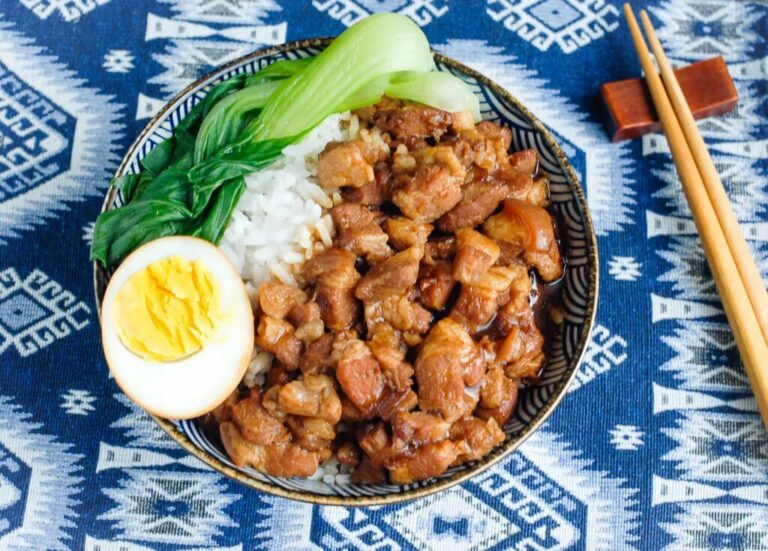
Looking into the bowl, strips of skin-on pork belly lie layered across the rice.
Cut into narrow rectangles.
Fat and lean loosen at their boundary and merge in the mouth.
A slight stickiness remains on the lips — a sensation known locally as nianzui.
It is not accidental.
The texture is intentional, guided through a central kitchen.
Reproducibility is high.
Whenever one visits, the impression returns nearly unchanged.
That stability may be what draws people quietly back to their seats.
Another Bowl Beside It
Many guidebooks recommend the pork.
Yet another option sits nearby.
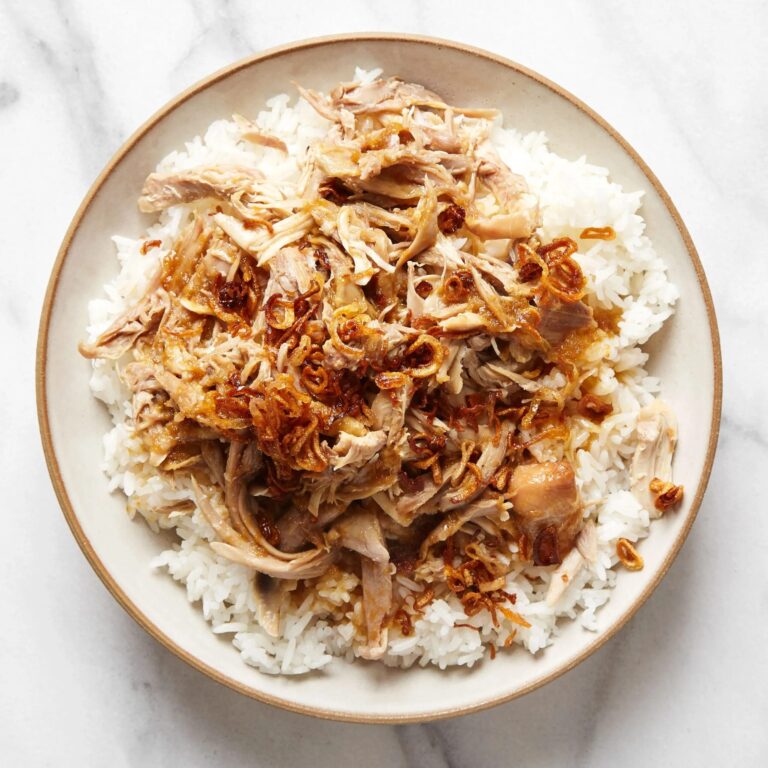
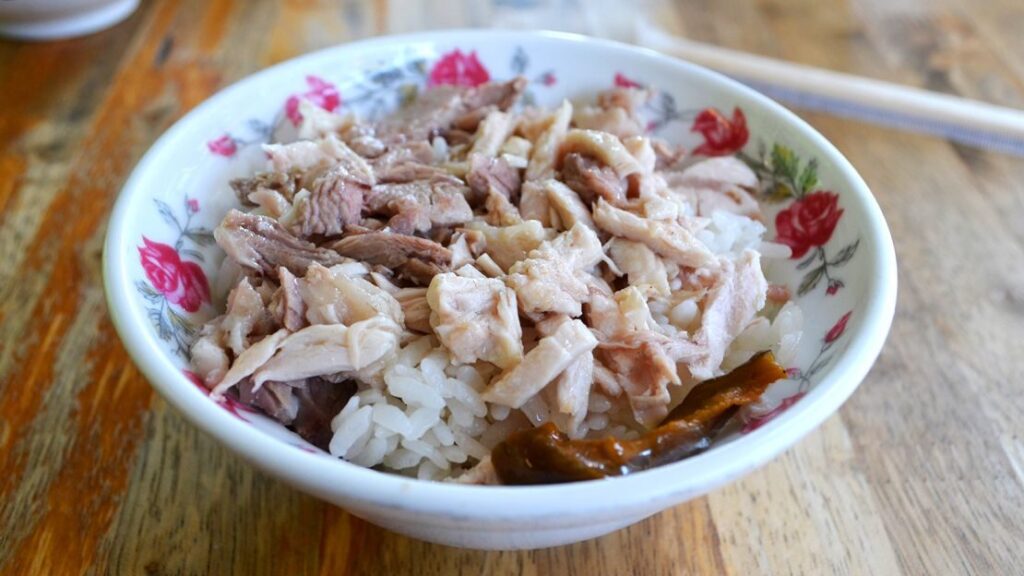
Chicken rice (ji rou fan).
Shredded meat spreads across the surface, the scent of chicken fat rising softly.
Where the pork carries density, this one feels lighter.
When the stomach is heavy, people seem to choose it almost without thought.
Looking across the room, different bowls often share the same table — one rich, one restrained.
A place that allows such exits tends to endure.
A Meal Without Noise
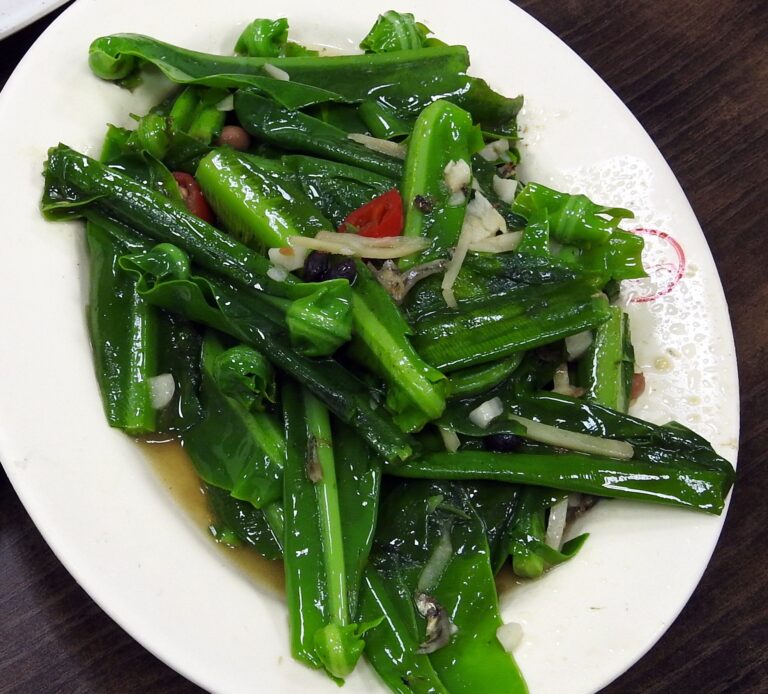
On the side, blanched greens appear.
Steam lifts from bitter melon pork rib soup.
The composition does not end with the bowl alone.
Air-conditioning remains steady.
No oil pools on the floor.
Payment is straightforward, leaving little confusion.
The heat and sanitary uncertainty that sometimes accompany street stalls feel distant here.
Perhaps this environment forms part of the added cost.
The condition of being able to focus on the meal is larger than it first appears.
The Act of Standardizing
Elsewhere in Taiwan, other restaurants have also given form to dishes once defined by variation.
Din Tai Fung is one example.
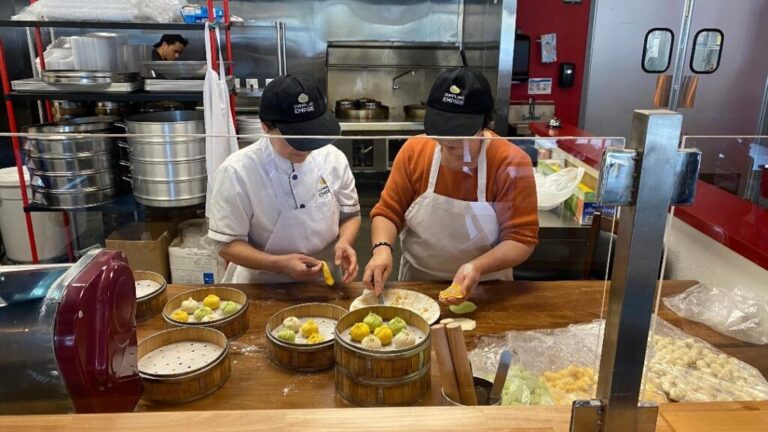
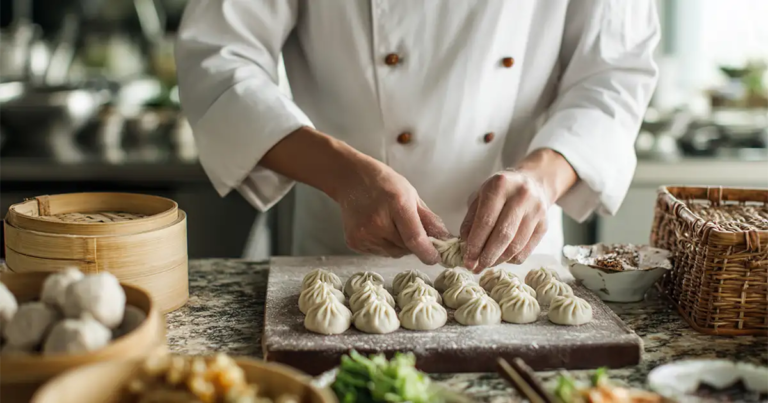
Xiaolongbao once differed widely in wrapper thickness, broth, and proportion.
The restaurant measured them: eighteen folds, consistent weight, unified steaming time.
Across locations, nearly identical forms arrive at the table.
In such moments, food begins to resemble craft.
A shared global image of the xiaolongbao emerged.
Part of what travelers imagine as Taiwanese flavor may have been quietly fixed there.
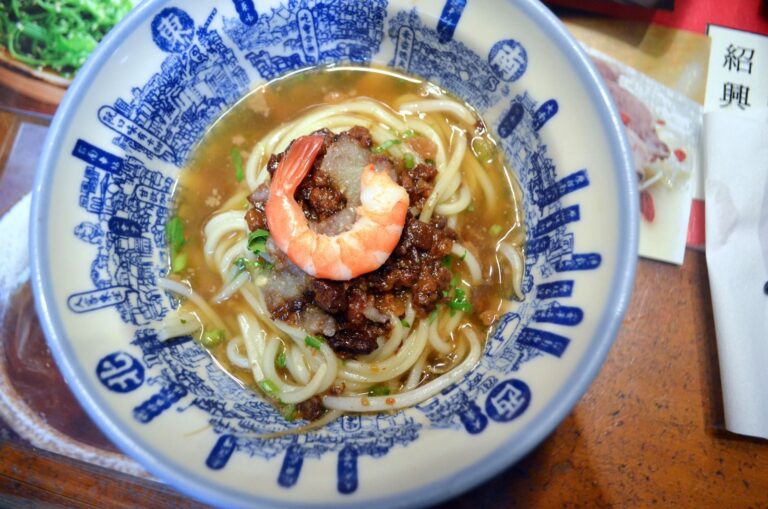
Another example is Du Xiao Yue, associated with Tainan-style danzai noodles (danzai mian).
Once a street preparation, quantity and taste were largely left to the cook.
The shop reduced that variability.
A small bowl.
Restrained minced pork.
The scent of shrimp.
Through repetition, it became something like a reference point.
Defining the Outline of Taiwanese Cuisine
What these places share is not simply the selling of food, but the arrangement of it into a form that can be easily understood.
When a contour stabilizes, comparison becomes possible.
Memory follows.
This is a value that runs parallel to the richness created by countless independent kitchens.
Formosa Chang can be placed within that lineage.
Taiwanese food culture has never been shaped by chance alone.
Alongside the improvisation of stalls runs a quieter accumulation of standardization.
Through it, the image of what is seen from outside as Taiwanese cuisine seems to have taken shape.
Everyday Life, Translated
Some travelers, after many meals elsewhere, return here at the end.
A confirmable answer is placed before them.
There is a baseline of flavor, little environmental fluctuation, something against which memory can be checked.
Perhaps this restaurant has translated a domestic meal into the system of modern commerce — giving it an outline that can be shared.
The work is not dramatic.
Yet when the same yellow sign appears somewhere in the city, one can already anticipate the bowl.
For many, that degree of certainty may be enough.
I empty the bowl and step back outside.
No particular aftertaste remains.
— Detour —
a little further to walk
- Notes on Formosa Chang as the Singular King of Lu Rou Fan
- Notes on Formosa Chang Beyond the Dining Room
- Notes on Formosa Chang’s Turning Point