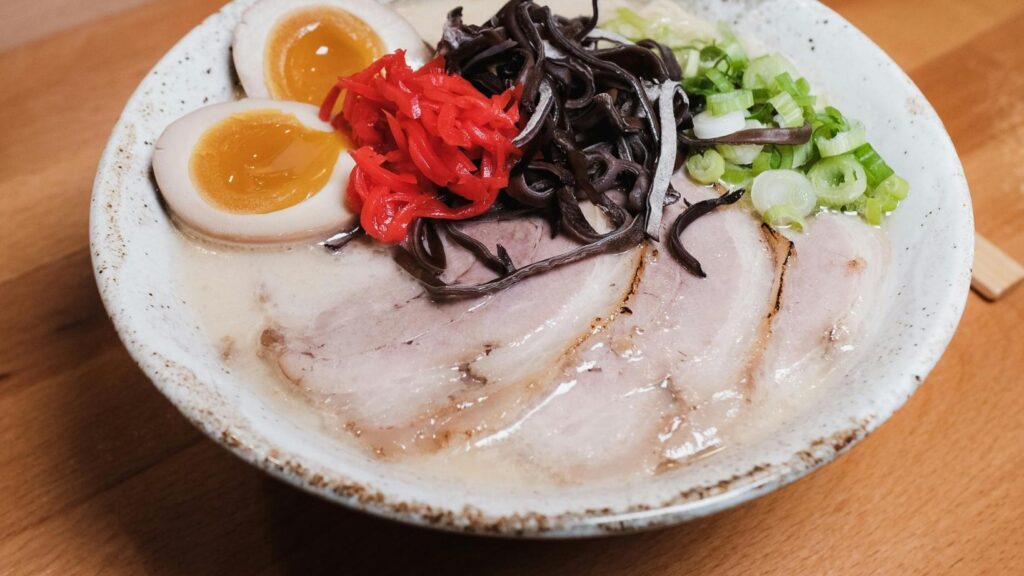
In Hakata, the smell of simmering pork bones can appear suddenly on the approach to a ramen shop, strong enough to make some people turn back. Inside, the bowl continues in the same direction: opaque white broth, pale noodles, and almost no color beyond the toppings.
Tonkotsu ramen is the lineage within Japanese ramen that moved in the most extreme direction. Within a dashi culture that valued clarity in broth, it deliberately chose opacity. It pursued density over delicacy, and weight over aroma. What resulted was the combination of a milky white liquid boiled down to the marrow of the bone, and an extremely thin noodle whose firmness can be specified in units of seconds.
The origin is placed in Kurume, Fukuoka, in the 1940s. But the path to its current form involved multiple transformations — the Nagahama market, the expansion into Tokyo, the redefinition carried out by Ichiran and Ippudo. A dish that divided preferences within Japan became so widespread abroad that pork bone ramen and ramen itself became effectively synonymous.
The Air That Changes Within Fifty Meters
Walking through Hakata, there are points where the air changes. A particular smell reaches the nose and signals that a tonkotsu ramen shop is nearby. The smell comes from the steam that rises when pork bones are simmered over continuous heat for many hours. Some describe it as an animal odor. A foreign visitor encountering it for the first time often recoils. The reactions — wondering whether something has gone bad, whether it is safe to eat — are not unusual. Some turn away from the shop on account of the smell alone.
For a regular, however, the smell carries a different meaning. It functions as a signal that activates appetite. As the smell intensifies on the approach to the shop, the pace quickens naturally. Among those with experienced noses, some use the strength of the smell to judge the quality of the soup before entering. Tonkotsu ramen occupies the opposite end of the spectrum from consommé, which is appreciated through clarity and aroma. It extracts the marrow from animal bone and dissolves fat and protein into the liquid. The direction it pursued was concentration and density rather than delicacy. The smell is one result of that pursuit.
Its Position Within Japanese Ramen
Tonkotsu ramen can appear to be a self-contained dish. Within the full landscape of Japanese ramen, however, it is one lineage among several. Japanese ramen carries a number of foundational flavor traditions — soy sauce, salt, miso, and pork bone — each of which has taken root over a long period while changing form by region. Soy sauce became the center in Tokyo. Miso spread through Hokkaido. Pork bone took deep root in Kyushu.
Each lineage is connected to the climate and working conditions of its territory. In the cold north, miso — high in calories and warming — was chosen. In coastal areas, salt ramen developed, where the purity of the stock is tested directly. Shelf stability, temperature, caloric density — the conditions that were required appear to have determined the direction of the flavor. Within this, tonkotsu chose the most extreme structure of all. It selected opacity over clarity and moved toward weight and density rather than lightness. Though it shares the framework of ramen, the direction it pursued differs substantially from what soy sauce or salt ramen aimed for. That difference has divided preferences and produced diversity within the culture as a whole. Tonkotsu remains the most physically oriented of the group — the lineage that pushed furthest in the direction of acting directly on the body.


A Bowl Designed Without Color
Looking down at the bowl when it arrives, one notices that color is sparse. White soup, white noodles, brown chashu pork, green onion, black wood ear mushroom. For a food, the palette is limited. The soup is white and opaque, like milk. No dairy is used, but the appearance is close to cream. The noodles are thin, close to somen in diameter, white, with a round cross-section. The cooking time is short and they finish firm. The chashu is thinly sliced, most often made from rolled pork belly that has been simmered.
The most distinctive element among the toppings is the black wood ear mushroom — a fungus common in Chinese cooking but less frequently found in other styles of Japanese ramen. Bamboo shoots could substitute, but wood ear is the more common choice in tonkotsu shops. The reason is texture. Its firm, resilient bite creates a rhythm within a creamy soup that tends toward monotony. Soft chashu, smooth soup, fine and supple noodles, and the hard chew of the mushroom. This bowl is organized through the contrast of textures rather than through color.
Producing White Without Dairy
The soup is white — a whiteness that resembles milk, but no dairy product is used. The color is the result of a chemical process called emulsification. When pork bones are simmered over high heat for a long time, the gelatin and fat inside the bones dissolve into the liquid. As these are agitated vigorously with the water, the fat particles disperse into extremely fine droplets and the liquid turns white and opaque. As collagen dissolves, viscosity increases, and the soup clings to the tongue when taken into the mouth.
This process is closer to an industrial operation than to conventional cooking. The bones are sometimes broken in advance to increase their surface area, and pressure may be applied during cooking. Heat is driven through to the interior of the bone, drawing out its components entirely into the liquid. The time required ranges from several hours to more than ten. What results is a soup of extremely high concentration and caloric density. Among liquids produced from animal bone, few reach this degree of density.
The Birth of the White Soup, and Its Spread from Kyushu to Tokyo
The birthplace most commonly cited for tonkotsu ramen is Kurume city in Fukuoka Prefecture. In the immediate postwar period, it is said to have begun as food for laborers, using cheaply available pork bones to fill the stomach. The soup of that time, however, bore little resemblance to what exists today. Simmered over low heat, it was only slightly clouded — not white.
The turning point came in 1947, at a shop in Kurume called Sanku. The owner left the kitchen and entrusted the heat management to his mother, who forgot to lower the flame. The pot continued to boil over high heat for an extended period. When the owner returned, the liquid had turned white and the fat and water had merged. Under ordinary circumstances this would have been discarded as a failure, but a taste revealed that the marrow’s richness had been drawn out with unusual force, producing a concentration unlike anything before. The accidental overheating had triggered emulsification, and the original form of what would become the defining tonkotsu soup appeared at that moment. From Kurume, this soup eventually made its way to Hakata, and then to Tokyo.
The Nagahama Market and the Extremely Thin Noodle
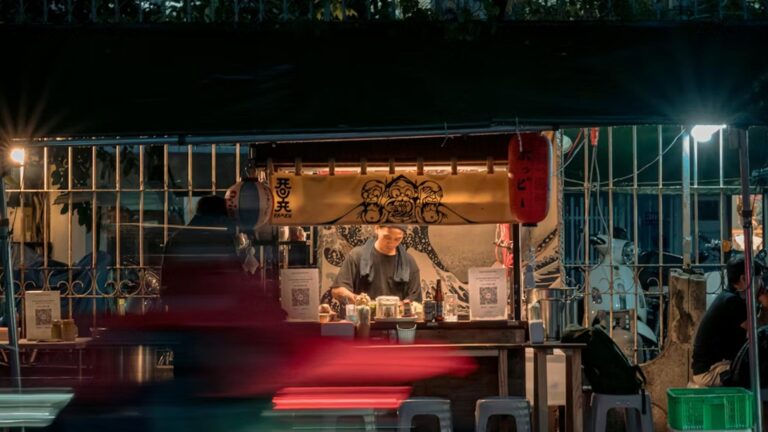
The noodle in tonkotsu ramen is thin — a straight noodle close to somen in diameter, with a round cross-section and a smooth surface. This stands in contrast to the thick, wavy noodles used in miso ramen or Iekei ramen. The origin of this extremely thin noodle is said to lie in the Nagahama fresh fish market in Fukuoka. Nagahama is a market where auctions begin in the early morning, and the workers there needed to eat within tightly limited windows of time. The thinner the noodle, the shorter the cooking time. To finish eating in the few minutes available between auction rounds, the noodles became progressively thinner.
From that culture, the kaedama practice also emerged — adding a portion of freshly boiled noodles to the remaining soup in the bowl. Because the additional noodles cook quickly, they arrive within seconds. The speed that market workers required in order to fill their stomachs in a short time determined the shape of this dish. The culture of specifying noodle firmness also traces back to Nagahama: barikkata, meaning very hard; harigane, meaning wire-hard; konaotoshi, meaning flour-drop, leaving the noodle nearly raw. Cooking time is adjusted in units of seconds, and the wheat core is left intact. It is a fixation on firmness that goes beyond al dente — and it also originated from the demands of market workers seeking speed and efficiency.
The Kaedama System
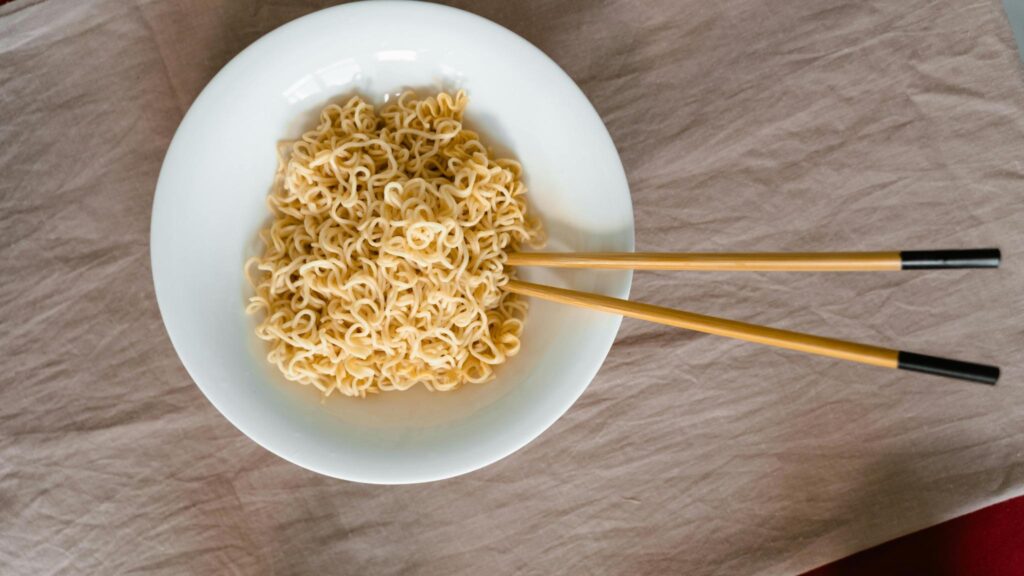
The extremely thin noodle carries a clear weakness. Because of its thinness, it absorbs moisture quickly in a hot soup and softens. If ordered in a large portion, the texture of the noodles at the end of the meal is already gone. The individual character that tonkotsu ramen pursued in the firmness of its noodle is lost over time. The answer to this problem is kaedama. Only a small initial portion of noodles is provided. When it has been eaten and soup remains in the bowl, freshly boiled noodles alone are added. The added noodles are mixed into the remaining soup and eaten. The noodles are always fresh from the pot and the texture is preserved. The soup is not wasted.
It is a simple system, but a rational invention created to solve the specific weakness of an extremely thin noodle. Most shops price the addition at around one hundred yen. Calling out kaedama just before finishing the bowl brings a small portion of boiled noodles in a strainer to the table within seconds. These are tipped into the bowl and mixed with what remains. This back-and-forth between customer and kitchen produces a distinctive rhythm within the shop. The exchange continues even while the meal is in progress.
A Bowl Completed at the Table
On the table of a tonkotsu ramen shop, several small containers are typically arranged — pickled red ginger, spicy mustard greens, grated garlic, white sesame. These are provided without charge, but they are not merely courtesy items. They are tools for the customer to alter the combination of soup and noodle by hand.
The red of the pickled ginger is unnaturally vivid — dyed to a color far beyond natural ginger. Its sharp acidity functions to reset the tongue after it has been coated by concentrated fat. After several bites, placing red ginger in the mouth makes the next sip taste like the first again. The acid cuts through the fat and refreshes the perception. Many customers add mustard greens and garlic at the moment they order kaedama. The heat of the greens and the aroma of the garlic dissolve into the soup, and what is in the bowl begins to resemble a different dish. The color deepens, the smell intensifies, the flavor changes shape. Within the same bowl, the meal reveals a different character midway through. The table condiments function as a means of countering the physiological tendency toward monotony.
Why the World Chose Tonkotsu
Many of the Japanese ramen chains operating internationally carry a pork bone-based soup as their primary offering. Ichiran is tonkotsu. Ippudo is tonkotsu. Cases of soy sauce or salt-based shops achieving comparable international reach are relatively rare. One reason lies in the context of flavor. The subtle umami of soy sauce or salt ramen is difficult to receive fully without an existing familiarity with Japanese dashi culture. The creamy, concentrated pork bone soup, however, can be understood within the Western food framework of potage or chowder. A smooth, heavy, emulsified white soup is not an unfamiliar sight to those audiences.
The animal smell that once caused many to turn away has been moderated through careful preparation and improvements in technique. The fact that Ichiran’s soup carries almost no smell is a clear example of this. When the roughness was washed away and the product was presented as a rich, creamy soup, tonkotsu crossed borders. The most local, most body-proximate lineage of ramen became the most internationally successful. This inversion is worth recording.
The Sensation That Remains in the Body
Leaving the shop after finishing the bowl, one sometimes notices a faint strangeness on the lips — a thin film, slightly adhesive. This is attributed to the collagen contained in the soup. Running a finger across the lips, there is a faint resistance, a slight weight. The same quality of presence remains in the stomach. This is nothing close to a light feeling after a meal. And yet it does not prevent movement. If anything, there is heat remaining in the interior of the body. That, perhaps, is the distinguishing property of this dish. It extends slightly beyond the frame of what eating usually does.
— Detour —
a little further to walk
- Notes on the History of Japanese Tonkotsu Ramen
- Notes on the Overseas Path of Japanese Tonkotsu Ramen
- Notes on Ippudo and the Reframing of Tonkotsu Ramen