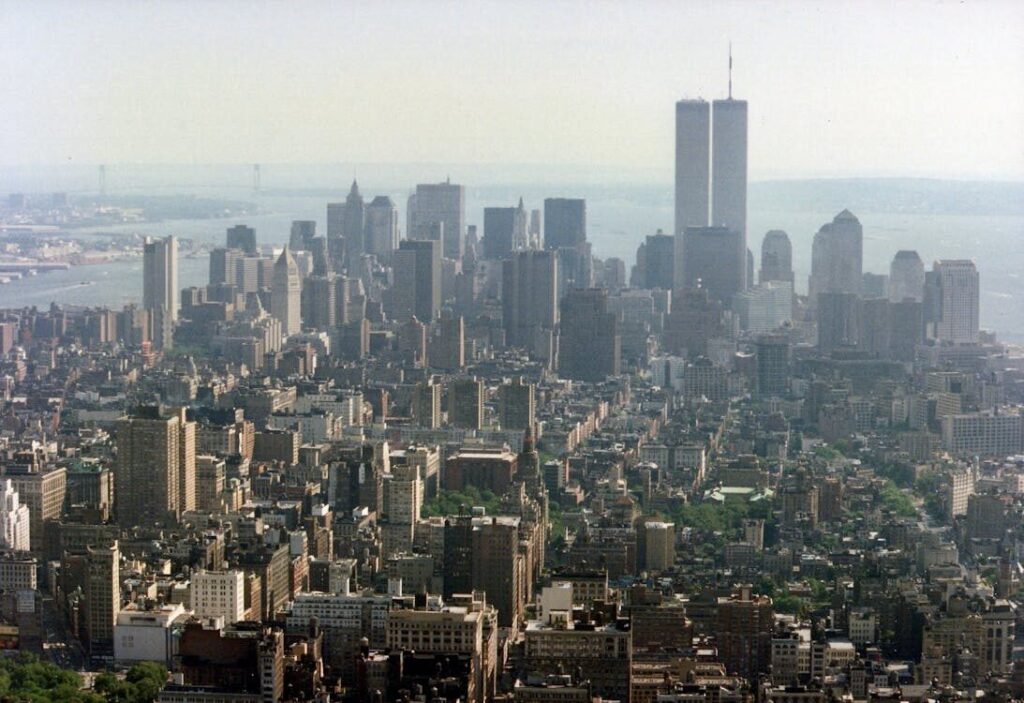
Outside an Ippudo, the first thing you notice is what is missing: the heavy pork-bone smell that usually announces tonkotsu ramen before the door comes into view. Inside, pale wood, soft light, and quiet jazz make the bowl feel out of place in a way that is difficult to ignore.
One stands in front of the shop. It could be Tokyo, New York, or Paris — it makes no difference. The first thing registered is not a smell but its absence. A tonkotsu pork bone ramen shop should, in principle, announce itself through the nose before it comes into view. The heavy animal odor that rises from bones simmered over high heat for long hours — that air should be present. Here, it is not. The door opens. The floor is not blackened with grease. A pale wooden counter runs in clean lines. The lighting is soft. Quiet jazz plays. This does not look like a place where laborers replenish calories in a hurry. It is not a space where shouts pass above bowls of soup. From what has long been called the most savage of ramen styles, only the blood-smell has been carefully extracted. What remains is a uniform, managed white liquid and a composed interior. That incongruity is where the account begins.
What Tonkotsu Ramen Originally Was
In its original form, tonkotsu ramen was born in Kyushu. Pork bones are simmered over high heat for extended periods, drawing out the marrow and fat. Sustained boiling causes the fat and water to intermingle and emulsify. The result is a soup that turns white and opaque as milk. The noodles are thin — extremely thin, fast-cooking noodles became the dominant form, and the kaedama system of adding a fresh portion midway through the meal was invented alongside them. The original shops were not quiet. The floor was slippery with grease and the smell was strong. These were not defects so much as structural consequences. The yobimoshi method — a giant cauldron kept going for days, with fresh stock continuously added — produced increasing depth of flavor and, simultaneously, increasing intensity of smell. The longer the accumulation, the stronger everything became. That was what tonkotsu was. It existed at some distance from cleanliness and refinement. Knowing that premise, the interior of Ippudo begins to carry a different meaning.

The Shift of 1985
The clock moves back to Fukuoka in the 1980s. At that time, tonkotsu ramen shops were described by three words that rhyme in Japanese: dirty, smelly, frightening. The floor was greasy. The manner of service was rough. The space functioned as explicitly male territory. For a woman to enter alone was psychologically difficult. In 1985, Ippudo opened in the Daimyo district of Fukuoka. Its founder, Kawahara Shigemi, was not a typical ramen craftsperson. He had previously run a bar. He looked at tonkotsu from outside the industry rather than from within it. He observed ramen not as a dish but as a space. What bar management had taught him was not flavor but the design of a stay — how to make customers feel comfortable spending time in a place. That perspective was brought into the most rough-edged category of food in the country. This was not simply the opening of another new shop. It was a quiet reversal directed at the existing culture of ramen.
Abandoning the Continuous Cauldron
At the time, the dominant method in Hakata ramen was the yobimoshi — the continuous, multi-day, top-up cauldron. Flavor deepened with time. Smell deepened equally. Grease accumulated in the interior and the floor became slippery. And yet, this was believed to be the authentic form. Ippudo did not adopt this structure. Instead, the soup was made fresh each day and used in full before the day was out — the torikirri method. In exchange for the complexity produced by historical accumulation, cleanliness and reproducibility were chosen. The smell was reduced. The flavor became stable. Rather than the accidental variations of density that continuous simmering produces, the concentration became something managed and consistent. This was not the continuation of a tradition. It was closer to a redesign. The roughness of the bone was not preserved — it was trimmed away. The animal was groomed and made fit for urban life. Without that operation, the pale wooden counter and the quiet jazz would not have been possible. Ippudo did not merely refine the taste of the pork bone. It selectively removed the noise that surrounded the existence of pork bone. That removal may be what produces the absence of smell one notices standing outside the door.
Designing a Wider Market
One looks at the table. Pickled red ginger and spicy mustard greens are arranged there. Beside them sits a cold pitcher — not water. Rooibos tea, or barley tea. A liquid for washing away the film of fat that a pork bone soup tends to leave behind. It does not read as a simple drink. It functions as a device for cutting through the grease and preparing the mouth for the next sip. Also visible is a hair tie. This was never a necessity in ramen shops. But for customers with long hair, it addressed a real concern — the discomfort of eating surrounded by steam and grease. These items are not incidentally present. They are positioned as components of the spatial design. The old ramen shop was a male space. Voices were loud, eating was fast, departure was immediate. Ippudo removed the smell, composed the space, and quietly lowered the psychological threshold. As a result, a new category of customer appeared — women dining alone. Their presence at the lunchtime counter increased. The market surrounding a single bowl expanded naturally. As the customer base changed, not only turnover but time spent in the shop extended. Ramen shifted from a meal defined by speed to a meal defined by having somewhere to be.
Controlled Stimulation Inside the White Broth
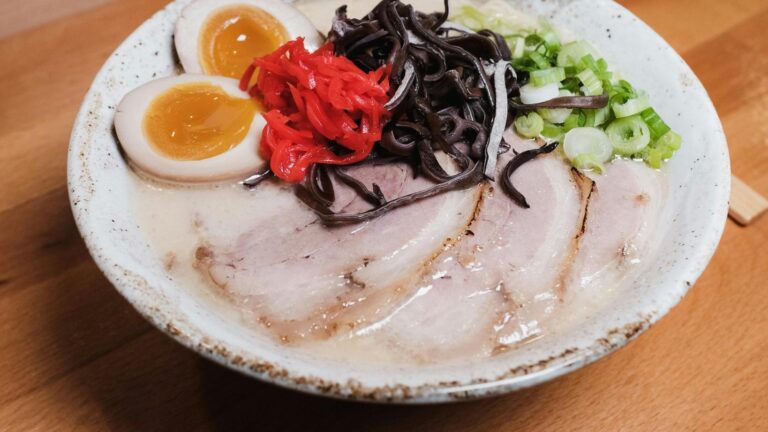
The menu presents two names: Shiromaru Motoaji and Akamaru Shinaji. Shiromaru is described as the origin. The pork bone soup stripped of smell and refined to the maximum degree of smoothness. The color is uniform and there is little foaming at the surface. The visual presentation is also composed. That degree of completion carries its own vulnerability. Stripped of its roughness, some customers found themselves with a faint sense of something missing. Akamaru was placed there to address that absence. At the center of the white soup, a red spiced miso sits. Around it, black aromatic oil forms a border. The customer breaks it apart with chopsticks and dissolves it slowly. Stimulation spreads through what had been a quiet liquid. The first sip and the sip taken several minutes later are different flavors. Change across time has been designed in. This is not incidental seasoning. It is a structure in which a controlled stimulation is added retroactively after the wildness has been removed. A white canvas is prepared, and flavor is introduced into it like pigment being dropped. Rather than restoring roughness, a managed sense of intensity is injected. The soup at Ippudo is not delivered in a finished state. It is designed to be completed by the customer’s hand. That process itself becomes the experience.
Translating Tonkotsu for the City
The package refined in Fukuoka did not remain a regional success. In 1994, Ippudo opened at the Shin-Yokohama Ramen Museum. The following year, it moved into Ebisu in Tokyo. At that time in Tokyo, tonkotsu ramen was still a minority presence — smelly, rough, the food of enthusiasts rather than ordinary diners. Ippudo recontextualized that image for the urban setting. Bringing a clean, quiet tonkotsu ramen shop into the refined neighborhood of Ebisu was not the act of transporting a regional dish unchanged. It was a translation for the city. The smell was cut. The space was ordered. The flavor was stabilized. As a result, pork bone soup was integrated into the ordinary landscape of eating out. In the latter half of the 1990s, the ramen boom accelerated. Television programs elevated craftspeople into figures of cultural attention. Kawahara Shigemi stood on that stage and came to be described as the charismatic figure of the ramen world. Ippudo ceased to be a single success story and expanded into a large chain. The regional stall culture became a nationwide industry. At its center was the redesign that Ippudo had carried out. At this point, tonkotsu ramen left behind its identity as a regional dish. It completed its transformation into an urban product.
Redefinition Across the Ocean
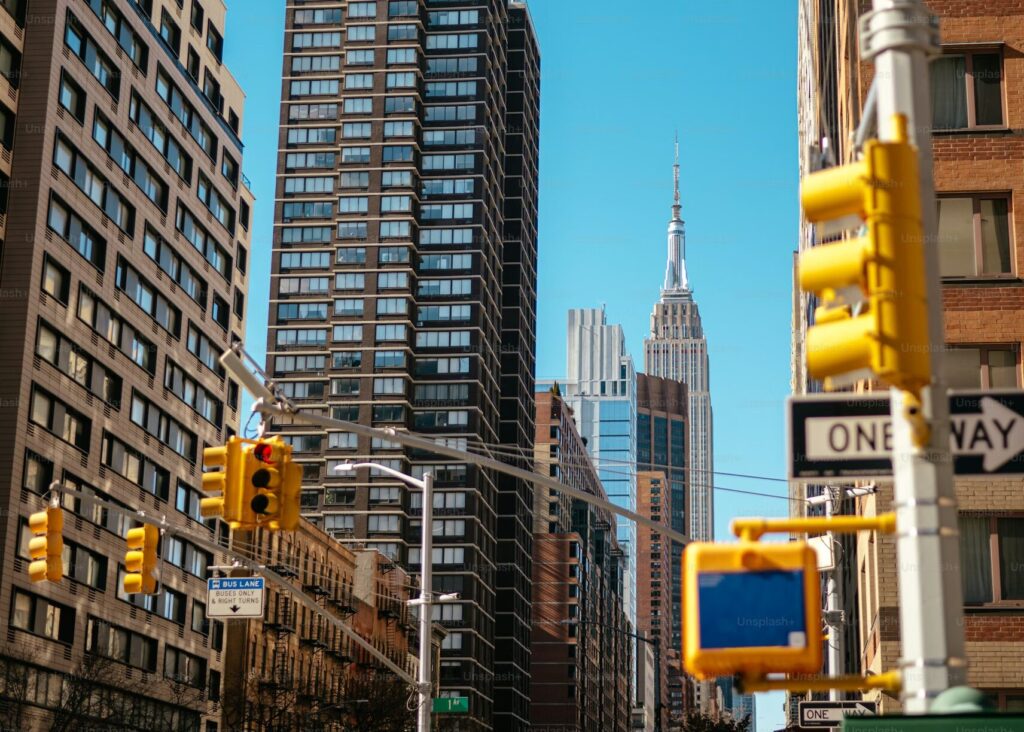
Once domestic expansion had run its course, the room for growth gradually narrowed. Locations were established across the major cities and the supermarket shelves held cup noodle versions. In the latter half of the 2000s, the domestic market showed signs of saturation. For capital that required continued expansion, the next stage turned naturally toward the outside. In 2008, Ippudo opened in the East Village in New York. The location was not chosen at random — a district where youth and culture accumulate, a city center where eating out is consumed as entertainment. There, the positioning of ramen was rebuilt again. From a fast Japanese meal into a dining experience through which one spends an evening. A waiting bar was installed inside the shop. Customers drink cocktails while waiting for their seats. Ramen was converted into a dish worth waiting for — not something to hurry through, but an experience that takes time. The spatial design refined in Fukuoka and Ebisu, combined with the founder’s sensibility from years of running a bar, converged here. The silkily smoothed pork bone soup was received by local customers as something resembling a potage. The animal smell had been removed and the fat had been converted into smoothness. A price point of roughly twenty dollars per bowl was established. What was being sold was not the noodle itself. It was time spent in the city at night.
Blending Into Everyday Infrastructure
More than a decade has passed since the success in New York. By the time the 2020s arrived, Ippudo was no longer a new or emerging presence. The parent company is listed on the stock market. The enterprise continues to expand as global capital. Looking at the domestic situation, the locations have also changed. From street-facing shops to food courts inside large commercial complexes. A simplified format called Ramen Express has multiplied. On weekends, families line up. The customer base, once predominantly male, has been completely replaced. Parents with children, shoppers on their way home — these are the ordinary users now. Ippudo is no longer a specific destination. It has become something embedded in the flow of daily movement. Its sharper cultural edges have softened and it has merged into the backdrop. It functions as part of the infrastructure of the street. It is sometimes compared to Starbucks. The same experience is reproduced in any city. The shift has been made to a stage where stability is prioritized over individuality.
Halal as the New Boundary
In the process of spreading locations across the world, a new set of constraints appeared: religious dietary codes. The most significant of these was the question of halal. In Islamic regions, pork itself is prohibited. For Ippudo, whose foundation is pork bone broth, this was a constraint that touched the core of what the product was. At the same time, the value system of veganism has also expanded. The number of people who avoid animal-sourced ingredients entirely has grown. These were not temporary trends. They were structural realities that any company entering the global market would necessarily encounter. The response Ippudo chose was substitution. A plant-based Akamaru was developed. No pork bone is used. A white opaque soup is reproduced using only plant-based ingredients — soy milk, kombu, and others. The richness of the fat is also constructed from plant rather than animal sources. The visual appearance and the viscosity are brought as close as possible to the original pork bone version. What is being reproduced is not the flavor but the structure. It is a design for maintaining the experience while circumventing the religious restriction. In 1985, the smell was removed. Now, to cross the wall of halal, the pig itself has been removed. The process of sanitization reaches its furthest point here. The animal’s presence is completely abstracted.

The Broth Without Bones
At a table in a shopping mall. In a refined shop overseas. People are finishing the white soup. The smell of bone that once filled the kitchen in Kurume is absent. The memory of the grease that made the floor slippery is gone. Everything is managed and made uniform. The flavor has been adjusted to be safe for anyone. What remains is a white, smooth liquid. The roughness that once characterized the culture has been removed. Ippudo resembles a vast filtration device — the wildness is passed through it and only the refinement emerges. What is eaten now is a tonkotsu without its bone. It is not a reproduction of a reality. It is closer to a perfectly designed fiction. And yet the bowl is emptied. Only the white film remains at the bottom.
— Detour —
a little further to walk
- Notes on the History of Japanese Tonkotsu Ramen
- Notes on the Overseas Path of Japanese Tonkotsu Ramen
- Notes on Japanese Tonkotsu Ramen