A bowl encountered in New York
Open a ramen menu in New York, London, or Paris, and the photographs are likely to show an opaque white soup. Not the translucent amber of soy sauce, not the pale clarity of salt. White, from the beginning. For someone who grew up in Japan, there is something slightly strange about this. Japanese ramen carries multiple traditions — soy sauce, salt, miso — and the sense that any single one represents the whole is not strong within the country. And yet abroad, the white opaque tonkotsu pork bone ramen (ton kotsu ra-men) became the face of the category. What had been a regional dish from one part of Kyushu settled into place as the global standard. This does not appear to be an accident. The white broth held certain qualities that the other styles did not, and there were people who understood those qualities and carried them outward.
The tonkotsu lineage within Japanese ramen
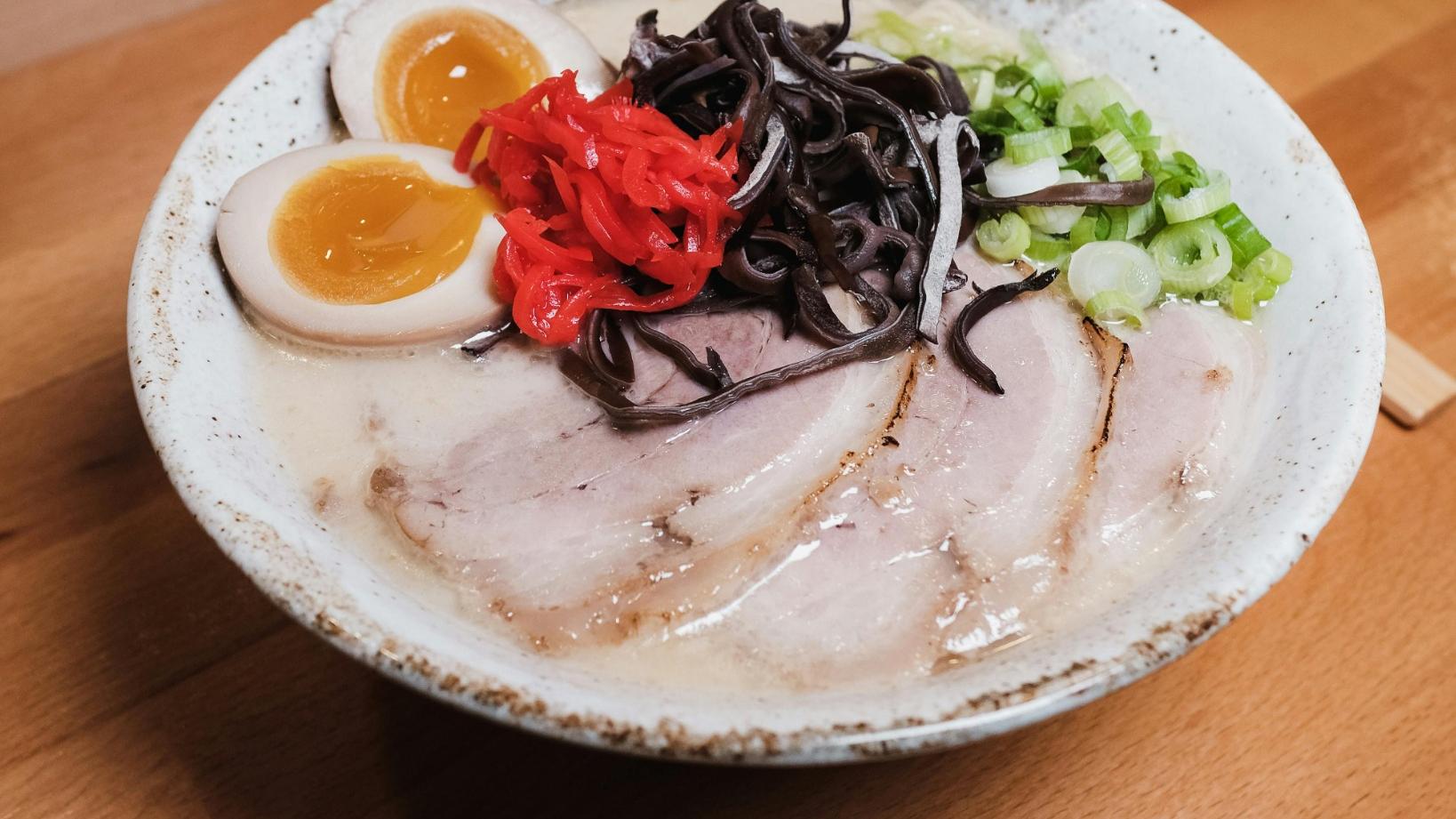
Tonkotsu ramen belongs to one current within the broader flow of Japanese ramen — the lineage that pushes animal-based broth to an extreme, alongside soy sauce, salt, and miso. Where most ramen has been built on a foundation of transparent stock, this style carries turbidity from the outset. The material is pork bone — not the meat, but the bone itself, simmered at length to draw out fat and dissolved matter. What results is a white, opaque liquid, the direct opposite in appearance of a clear broth. The direction of flavor also differs: weight over delicacy, density over aroma. Within Japanese ramen culture, this lineage has consistently occupied the position closest to the body, developing as the current that prioritized nourishment and fullness above all else.
Ajisen Ramen, the often forgotten pioneer
When the international expansion of ramen is discussed, the names Ippudo and Ichiran tend to come up. But there is a presence that was competing abroad much earlier. Ajisen Ramen, founded in Kumamoto, carries modest name recognition within Japan but built a network of overseas locations early. In the 1990s, Ajisen entered mainland China and Hong Kong, and the soup it brought with it was the white opaque pork bone broth. In Chinese food culture, a white cloudy soup is understood as a symbol of nourishment — a long-simmered baitang has been received as something beneficial to the body. Ajisen did not position the bowl as a greasy Japanese snack. It was presented as a nutritionally dense soup. That framing fit naturally into local sensibilities, connecting to existing understanding rather than importing an unfamiliar context. The ma yu — the charred garlic oil that is a characteristic of Kumamoto ramen — also played a role. The strong, immediately legible smell of burnt garlic crosses into regions where knowledge of refined dashi is not assumed. The impression lands before the structure of the flavor needs to be explained. Speed of reception was chosen over depth of understanding. As a result, Ajisen penetrated broadly into Asian markets.
Santouka and the memory of malls
When considering the expansion in North America, another name appears. Santoka, founded in Asahikawa, Hokkaido, serves a white, pork-bone-based salt ramen with a red pickled plum placed at the center of the bowl. In the early 2000s, Santoka opened in Japanese supermarkets and food courts across various parts of the United States. The locations were not in city centers but often in suburban areas. At that time, ramen was not yet a trend. For Japanese expatriates and Asian American residents, the options were limited. In that context, Santoka offered something reliable. It did not generate much public attention, but it was a place where a dependable bowl could be found. For people living in the suburbs, it functioned as an anchor — less an occasion for dining out than an extension of ordinary life. As a result, ramen settled into place not as a special dish but as part of the daily routine. Santoka was not at the front line. It supported the ground behind it.
Ippudo and the shift in Manhattan
The moment the trajectory changed significantly was 2008. Ippudo of Hakata opened in the East Village in New York. At that moment, the positioning of ramen shifted. It was no longer a cheap and fast meal. It became something one takes time to experience. A bar was set up inside the shop where customers could drink while waiting for their turn. The wait itself was incorporated into the experience. A different rhythm was introduced into a city accustomed to impatience. The soup was also adjusted. The unwanted smell was reduced and the texture in the mouth became smoother. Local critics described the bowl as a potage rather than a soup. The pork bone broth began to be discussed in a different language. At this point, the white soup was fully translated. What had been a regional dish from Japan took on the form of urban dining.
Why tonkotsu was accepted
Japanese dashi did not fit easily into Western food culture. The smell of bonito and kombu registers as strong to a nose without prior exposure. The smell of fish can evoke raw seawater. Caution often arrived before appreciation. The clear soy sauce broth, pale in color, was also difficult to evaluate. Examples exist of it being described as looking like dishwater. It was rejected visually and by smell before the depth of its flavor could be understood. Dashi was an element that resisted translation. Tonkotsu, in contrast, produced a different response. The white, opaque liquid was already a familiar sight. The viscosity produced by animal fat and dissolved gelatin recalled bisque or chowder. The concept of a rich, dense soup applied directly. It was understood by feel rather than requiring explanation. That common ground was what pushed the pork bone broth forward. It appears to have been less a matter of the taste itself and more a matter of how it was received. The reason it spread across the world was not only that it was good. It was that it was easy to translate.
Ichiran and the movement into high price
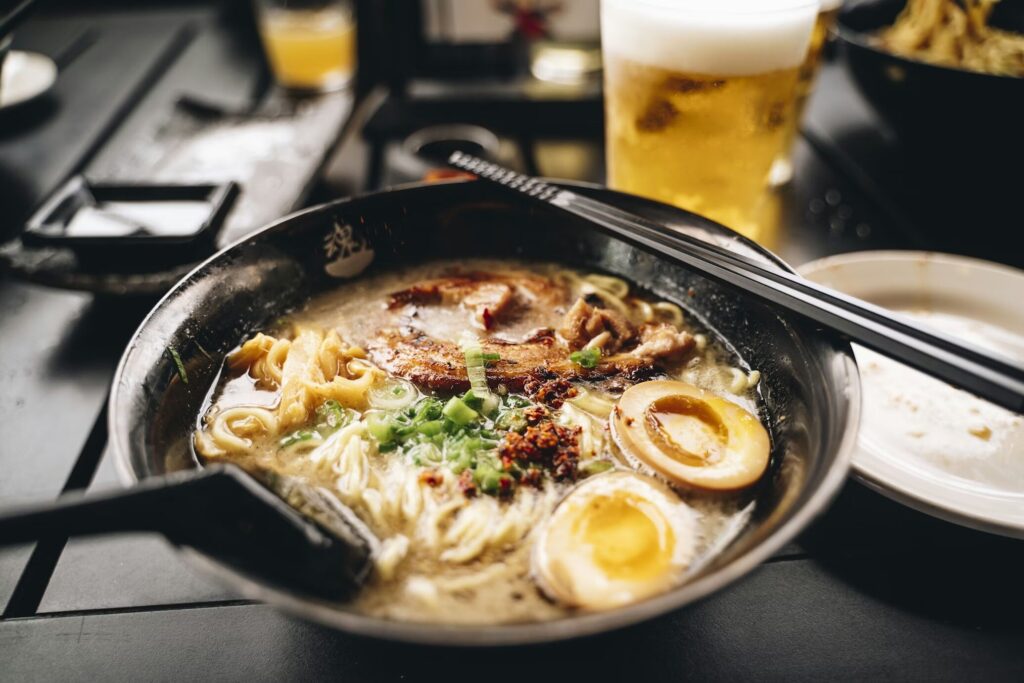
At the current end of this trajectory stands Ichiran. The white pork bone broth has moved into its next stage. In New York, a bowl including tip amounts to roughly three to four thousand yen in value. It occupies a different position from the laborer’s meal it once was. It is offered less as food than as an experience. Customers sit in partitioned seats, separated from the gaze of others, and face the bowl in a space where external information has been removed. The structure, called the flavor concentration counter, eliminates the surroundings and directs attention entirely toward the act of eating. This format is sometimes described as Zen-like. Stillness and immersion become the value. The pork bone ramen that was born in Japan has been converted abroad into high-priced leisure. What was once a cheap source of energy has become a premium experience product for affluent consumers. This inversion does not appear to be accidental. It is the visible outcome of translation and repositioning carried through to their conclusion.
Viscosity as a carrier of culture
The white soup that emerged from a kitchen in Kurume was not aimed at the world from the start. It was the product of a failure and an overheated pot. It was accepted locally, changed shape, and spread. In Asia it was understood as nourishment. In America it was reinterpreted as potage. What was common across every place it reached was its weight. The high viscosity functioned as a form of satisfaction. Looking at the white fat remaining at the bottom of the bowl, one can observe that this dish has already crossed borders. It has left the frame of regional food and acquired a role within a global market.