A Street with Red Lanterns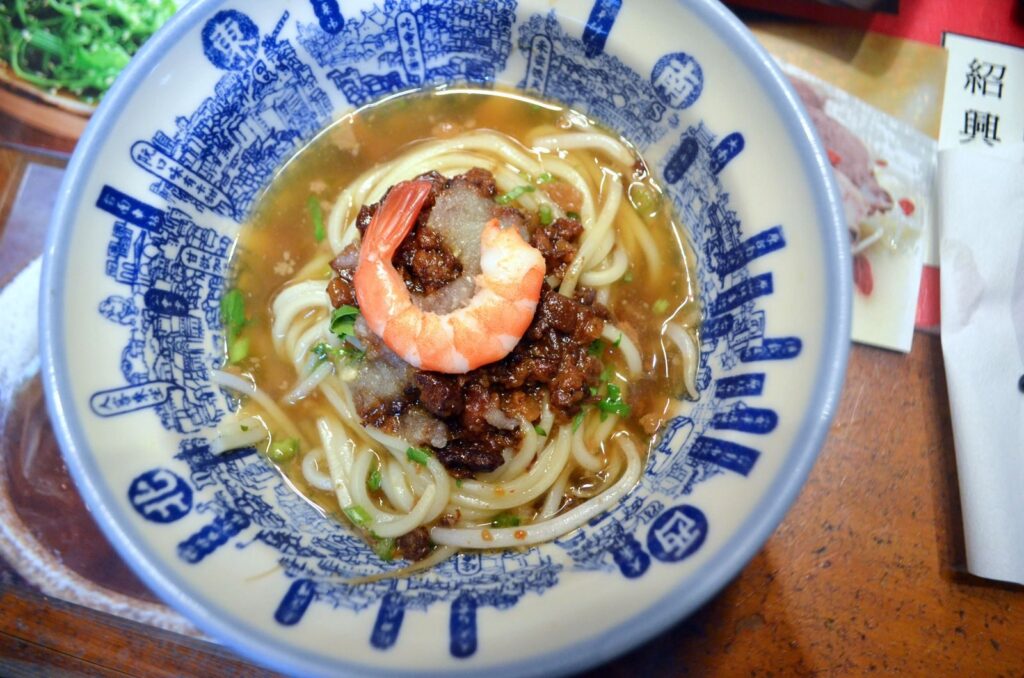
Walking through the center of Tainan, I notice red lanterns hanging along a street lined with old buildings.
They do not insist on attention.
They stand slightly straighter than the others.
White walls. Wooden doors.
A wide entrance, open enough to show the inside from the street.
The sign reads Du Xiao Yue.
It is a familiar name in tourist areas, yet the exterior avoids excess decoration.
People keep arriving.
There is no one calling out.
The shop simply continues to exist there.
The Stove as a Stage
Inside, the first thing I see is not a register.
A low, old-style stove sits close to the floor.
In front of it, a cook sits on a short stool,
boiling noodles without speaking.
Steam rises steadily.
The dining room is clean and evenly lit.
Only this corner seems to follow a different clock.
It feels less like a kitchen and more like an exhibit.
Here, the method is shown before the food.
1895 and a Practical Beginning
The year was 1895, just before Japanese rule began.
The founder, Hong Yuetou, was a fisherman in Tainan.
During typhoon season, there were months when he could not go out to sea.
These were the quiet months.
The problem was how to get through them.
He carried a shoulder pole and sold noodles while walking through town.
The phrase Du Xiao Yue was not a brand name at first.
It described an action.
To get through the slow season.
To turn idle time into income.
From Street to Shop
Many noodle sellers disappeared with their carts.
Others stayed on the street.
This shop chose to become a fixed place.
Shelter from weather.
A seat to sit on.
That decision created stability unrelated to taste.
The same characters were written again and again on red lanterns.
Over time, the shop shifted from one among many
to a place people came looking for by name.
A Sealed Pot of Continuity
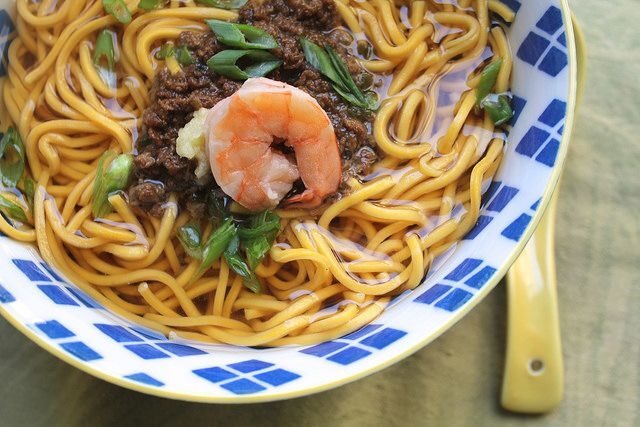
What defines this bowl is not the broth
but the minced pork placed on top.
Here, it is made from a recipe kept since the beginning.
Taiwanese shallots.
Pork from the hind leg.
The sauce has been replenished over time,
carrying years within it.
This topping is sold in cans.
Its flavor is treated as intellectual property.
It can be copied.
Its history cannot.
Refinement Through Tourism
Some say it is expensive.
Some call it made for visitors.
It is true that this is not a roadside bowl.
Clean tableware.
Consistent service.
Signs in several languages.
These are preparations for crossing borders.
Local food is translated into a form for guests.
This shop has taken on that work.
A Flame That Does Not Move
The cook still sits on a low stool by the stove.
That posture has not fully separated
from the time of carrying a shoulder pole.
What began as a way to survive the quiet months
continues in another form.
The noodles still rise in steam
from the same position.