From orange to white, a quiet shift
Walking through Taipei, I keep seeing two kinds of bicycles.
Older ones in orange.
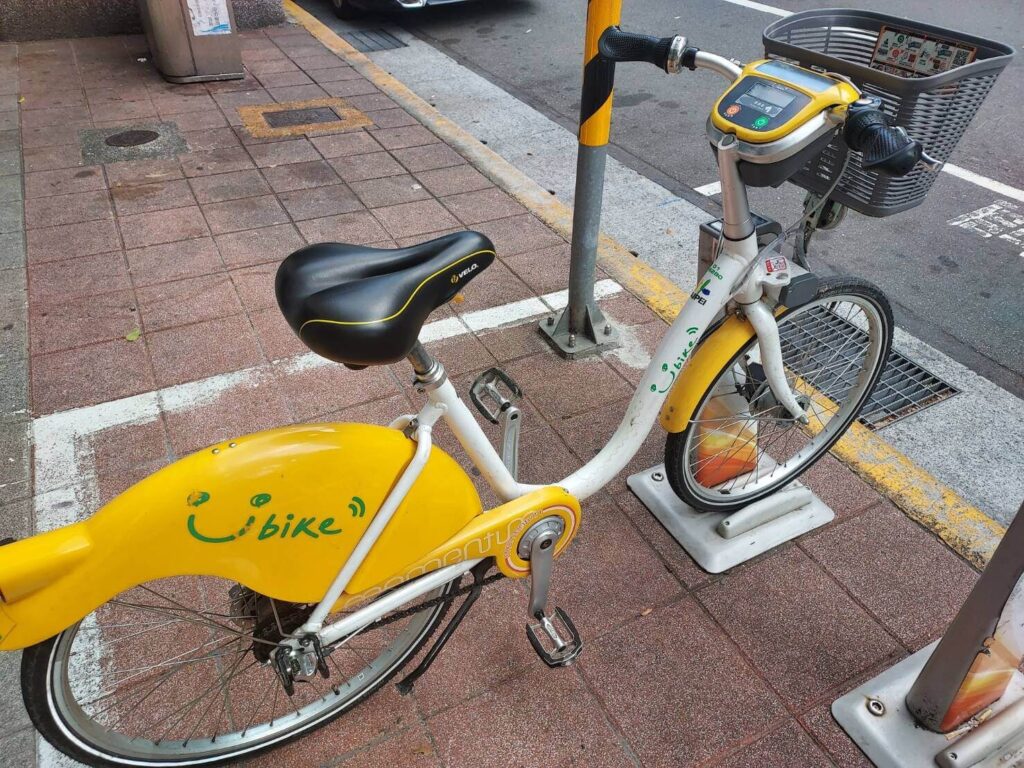
Newer ones in white and yellow.
For most people, it looks like a simple design update.
Old units remain. New ones replace them. Nothing more.
But with closer attention, these two are not variations of the same line.
They differ at a structural level.
The color did not change.
The role did.
Not a difference in color, but in kind
YouBike 1.0 was an installation in the city.
YouBike 2.0 is a collection of individual units spread across it.
The difference is not visual.
It lies in how each relates to the city.
When 1.0 was dominant, YouBike existed only where it could be installed.
With 2.0, it began to appear where it would actually be used.
This was less an upgrade of user experience than a redesign for survival as urban infrastructure.
Released from construction
A YouBike 1.0 station was clearly a piece of infrastructure.
The ground had to be opened.
Power lines had to be drawn.
Control columns had to be fixed in place.
Permits were required.
Construction took time.
Budgets and political coordination were unavoidable.
The logic became simple.
Not where we want to place it,
but where we are allowed to place it.
As a result, coverage was coarse.
Gaps remained.
The system was too heavy to fill a five-minute walking radius.
With 2.0, this changed.
The bicycle itself generates power and communicates.
The station becomes a simple metal stand fixed to the ground.
No digging.
No wiring.
Short installation time.
This is not convenience.
It is the removal of constraints.

The brain moved
In the 1.0 era, intelligence sat with the station.
The bicycle was only an object to be identified.
With 2.0, this reverses.
A small terminal attached to the handlebar
holds communication, authentication, and records.
Each bicycle becomes an independent unit.
The station no longer manages.
It merely receives.
This matters.
Coverage no longer depends on fixed nodes.
The city is filled by distributed units instead.
Changes felt by touch
The difference appears as soon as you ride.
The saddle adjusts with one hand.
Locks are controlled digitally, not mechanically.
The stand is stable. The center of gravity is low.
Nothing is dramatic.
But these changes accumulate under the assumption of daily use.
This is not a tourist bicycle.
It is built for commuting, school runs, and ordinary movement.
Here, the conditions for something to remain in a city become visible.
Why local systems disappeared
Kaohsiung once had C-bike.
Tainan had T-bike.
They were local systems, rooted in place.
As 2.0 spread, they faded.
The reasons are straightforward.
No power construction.
Lower installation costs.
Standardized operation.
From an administrative view, there was little reason to maintain separate systems.
Ownership stopped making sense.
The island turned yellow.
One card works everywhere.
This is not a cultural victory.
It is an operational one.

A bicycle as a moving device
YouBike 1.0 was bicycle rental.
YouBike 2.0 is a mobility device placed across the city.
It is always there.
It is easy to take.
That feeling is not accidental.
On the handle of the white bicycle,
inside that small screen,
is the answer Taiwan’s cities chose for their transport.