The Decision to Use Docks
Shared bicycles are, globally, a system that often fails.
In China and in parts of Europe,
a brief boom was followed by abandonment.
Bicycles piled up on sidewalks.
They fell over.
They broke.
Uncollected, they became part of the scenery.
In many cities, these bicycle graveyards became real.
Seen from that background,
Taiwan looks slightly different.
YouBike did not achieve a spectacular success.
It is simply still being used.
Among many failures,
why did Taiwan remain?
Why Shared Bicycles Tend to Fail
Looking at failed cases,
the reasons are not complex.
Many systems were too free.
You could rent anywhere.
You could return anywhere.
In prioritizing user convenience,
management was handed over to the city.
When bicycles were left behind, responsibility was unclear.
When they blocked the way, no one knew who should move them.
Convenience turned directly into burden.
Freedom was not always good for the city.

Taiwan Chose Constraint
YouBike did not follow that path.
It did not allow returns anywhere.
Bicycles must be returned to a station.
Use does not end until they are.
At first glance,
this looks unfriendly to users.
But this constraint is what allowed YouBike
to function as a public object.
Destinations are fixed.
Bicycles do not accumulate on their own.
Responsibility does not disappear.
YouBike chose order over freedom.
The Dock as a Deliberate Choice
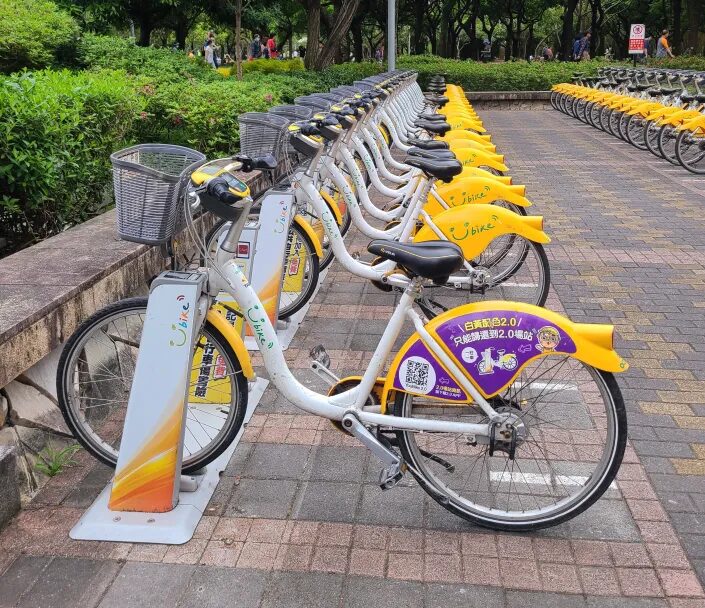
The dock system keeps bicycles
inside the city, not outside it.
It is designed with return in mind,
not abandonment.
As a result, bicycles are less likely
to become nuisances.
YouBike chose not to be merely convenient,
but to avoid being disliked.
For public infrastructure,
this was a critical decision.
How Version 2.0 Changed the Dock
Docks once had a weakness.
They were difficult to install.
They did not scale easily.
In the era of YouBike 1.0,
expanding stations required major construction.
With 2.0, this changed.
By placing communication functions on the bicycle itself,
stations became simpler.
Power and basic fixtures were enough.
The barrier to installation dropped,
and numbers could increase.
The idea stayed the same.
Only flexibility was added.
Density Made Constraint Unnoticeable
For docks to work,
one more condition is needed.
Density.
If return is required,
return points must be close.
YouBike stations are placed with the assumption
that another one is only a few minutes away on foot.
Because of this,
returning rarely feels troublesome.
Constraint is offset by placement.
User experience is not embedded in the app,
but in the city map itself.
What Taiwan Did Was Not Flashy Innovation
YouBike survived
not because of a bold invention.
Convenience was slightly reduced.
Durability was prioritized.
Freedom was limited.
Order was maintained.
What Taiwan did was move against the trend.
As a result,
YouBike remained
while many others did not.