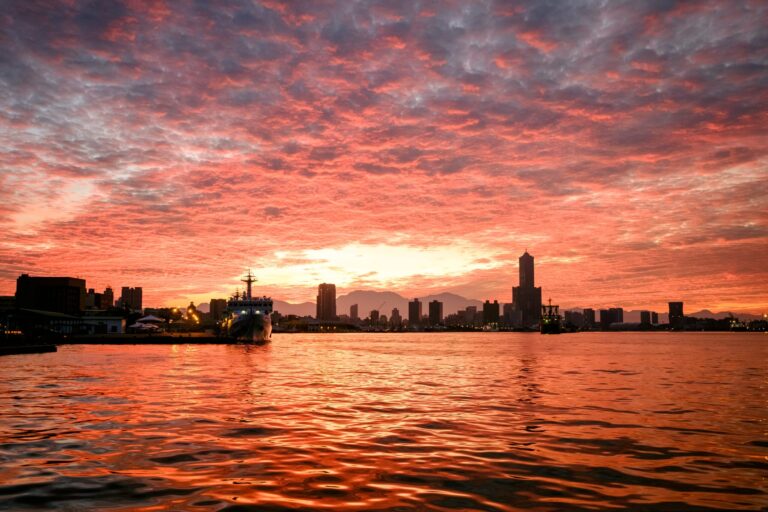
Around Kaohsiung’s 85 Sky Tower, a library, concert hall, exhibition center, cruise terminal, and light rail now form a busy waterfront district. The tower still rises above them, while many of the functions once meant to fill it sit in separate buildings outside.
Walk around Kaohsiung’s 85 Sky Tower (高雄85大樓) today, and the scene is different from 2019, when the building’s upper floors shut down.
People gather in front of the Kaohsiung Main Public Library (高雄市立圖書館總館). A little toward the harbor are the Kaohsiung Exhibition Center (高雄展覽館) and the Kaohsiung Music Center (高雄流行音樂中心). The light rail runs between them, and the Kaohsiung Port Cruise Terminal (高雄港旅運中心) now stands on the harbor. At what used to be the edge of the port and the industrial zone, people now have separate reasons to come: to read, to hear music, to go to a trade show, to walk by the water.
From among them, you look up at 85 Sky Tower. About 30 years ago, this building set out to stack shops, offices, a hotel, and entertainment into one tower and create a “vertical city” (垂直立體城市). Today, similar urban functions stand one by one outside 85 Sky Tower rather than inside it. It looks as if the city once planned inside one building has slowly moved outside.
Still, it would be wrong to say the city has finally caught up with the tower. This redevelopment did not begin as a way to save 85 Sky Tower.

As the tower began to weaken, another plan began around it
In December 1999, the year 85 Sky Tower fully opened, a special district plan for the Kaohsiung Multi-Functional Commerce and Trade Park (高雄多功能經貿園區) was announced for the area around it. The plan was to convert waterfront land used by the port and industry to other uses, such as logistics, business and trade, and leisure. It was designed to fit the national Asia-Pacific Regional Operations Center (亞太營運中心) policy. The city did not start redeveloping the area after the tower failed.
Around the same time, two futures had started to run side by side. One was the future of stacking a hotel, offices, shops, and entertainment inside a giant private building, 85 Sky Tower. The other was the future of turning the wide stretch of land around it into a business district.
Neither went as planned. In 85 Sky Tower, the shops on the lower floors weakened early, and the hotel kept operating as owners changed. The district plan around it was not completed quickly either. A 2013 review of the plan named the slow pace of development as a problem.
Even so, the district itself did not disappear. In 2011, the area was relaunched as the Asia New Bay Area (亞洲新灣區), and development continued as the content of the plan changed.
The same ground, a different future
The 1999 trade park and today’s Asia New Bay Area use roughly the same land, but what they try to put there has changed.
The first idea was to turn the waterfront into a hub for logistics and trade. Later, public facilities such as the library, the exhibition center, the music center, and the cruise terminal were built, and the light rail linked them. In 2021, a national-level plan to gather 5G and AIoT industries began, and in 2023 an expanded version, “Asia New Bay Area 2.0,” was approved. The focus moved to bringing in corporate headquarters, research and development, IC design, and finance. In the same year, Mayor Chen Chi-mai (陳其邁) called the thinking behind the old trade park an outdated idea. The same planning framework stayed in place, while the functions envisioned for it were repeatedly revised to fit what each era thought it needed.
85 Sky Tower fixed the city imagined in the late 1980s and the 1990s, almost as it was, inside one building. The area around it took longer to finish, and in exchange it could change its goals along the way. That is the difference in time between a single building and a city plan.
This time, not everything goes into one building
Walk through today’s Asia New Bay Area, and the difference from 85 Sky Tower is clear. The library has its own building. The music center has its own building. The exhibition center and the cruise terminal are separate too, and the light rail connects them. Company offices, research centers, housing, and hotels are being built on separate plots by separate developers.
85 Sky Tower stacked functions close to these into one building. Today’s Asia New Bay Area spreads them across a whole district.
On its own, this might look like nothing more than a bigger development. The pattern of investment is different as well. 85 Sky Tower gathered many urban functions inside one giant private project. In today’s Asia New Bay Area, public investment such as the library and the light rail laid the base first, and several private companies and developers are coming in on top of it. It is neither a district built only by the public sector nor a project that one company carries on its own. The aim of building the future ahead of time may be similar, but who builds it, and how investment is organized, has changed.
This time, the grounds for the future are also a little different
Even so, it is too early to call the Asia New Bay Area a finished district. It is not at the stage of adding buildings to meet demand from companies and people already there. The idea is to attract companies, prepare offices and research sites, create jobs there, and as a result bring in more residents and spending. In that order of events, this plan also builds the future a little ahead of time.
There are differences from the 1990s. According to Kaohsiung City, by the end of 2025, 340 companies had established a presence in the Asia New Bay Area, with cumulative investment reaching NT$36.6 billion. This is a count of companies with a presence in the district, not of major corporate headquarters alone. Still, this is no longer a district that exists only on paper.
Elsewhere in Kaohsiung, investment in semiconductors and advanced manufacturing is also moving ahead. The Asia New Bay Area itself will not become a factory zone. Still, the rise of new kinds of industrial demand across Kaohsiung is a major difference from the 1990s.
On the other hand, a large amount of floor space is still to come. Large developments that include corporate headquarters, research, retail, and housing continue. Some, such as Foxconn’s planned flagship headquarters there, are expected to be completed in the 2030s.
The grounds for this bet are firmer than they were 30 years ago. Even so, Kaohsiung is once again preparing space in advance, on the expectation that future demand will come here.
85 Sky Tower is not trying to return to what it was
In the middle of that district, 85 Sky Tower itself is still in use. The building is not a ruin. Some parts are used as small units called taofang (套房) and as offices, and the NSYSU College of International Finance (國立中山大學國際金融研究學院) and a city-run startup hub have moved in. On the former hotel floors, which went to auction in 2019, a large-scale renovation is under way.
No one has bought back the whole building to bring shops, a theme park, a hotel, and offices back under one operation. The university comes in as a university, the offices are used as offices, and the taofang stay with their separate owners. The former hotel floors are being renovated to reopen as a hotel.
Efforts to put the building to new uses did not start recently. About five years after completion, there were already reports of talks to rent empty floors to National Sun Yat-sen University as housing. Rather than restoring the whole building, new uses go into the parts that can be used. That adjustment has gone on for a long time.
Inside, 85 Sky Tower changed from a single vertical city into a building with many owners and many uses. Today’s revival does not run that breakup in reverse. The pieces remain separate; what changes is how they are used.
Being occupied is not the same as being a destination
Even with universities and offices moving in and a hotel coming back, the old landmark does not automatically return. There are two different kinds of “revival” here.
One is being used as real estate. If new users fill the empty floors and more people work, study, live, and stay there, the economic reason to keep up a giant building comes back.
The other is becoming a destination again for the general public. The old 85 Sky Tower had a department store, a theme park, a hotel, banquet halls, restaurants, and an observation deck. Even people with no errand had several reasons to go.
Today’s university and offices are different. The people who go there have clear business, but they give Kaohsiung residents little reason to wander over to 85 Sky Tower on a day off.
Around the tower, those reasons are actually growing. People already come right up to the tower for the library, concerts, trade shows, and walks by the harbor. What remains is whether, in that district, 85 Sky Tower can once again become a place that draws people inside.
From a future in one building to a future in a district
About 30 years ago, 85 Sky Tower stacked Kaohsiung’s future inside one building. That future was not pure fantasy. The Sanduo shopping district really did grow, and Kaohsiung kept developing.
But the city’s changes did not fit the shape that one building had imagined. Other centers of transport and commerce emerged, and the 103-story tower planned next door has still not been built. Inside the tower, the shops, the hotel, the taofang, and the offices each moved on their own timelines.
Through all of this, the city plan at the tower’s feet did not disappear. As the choice of what to place in the area changed, the library went up, then the music center and the exhibition center, the light rail began running, and companies and research centers moved in. The urban functions once meant to be gathered in one building are now split among many buildings and many players, spreading out around 85 Sky Tower.
It is still too early to say the city has caught up with the tower after 30 years. Will companies and people really gather, with workers and residents crossing paths on weekdays and the district running even on days without events? That is still in progress. What role 85 Sky Tower will play in that district has not been decided either.
Kaohsiung is once again building the future ahead of time in the same place—this time, in the shape of a district rather than a single building.

— Detour —
a little further to walk
- Notes on the Decline of Kaohsiung’s 85 Sky Tower
- Notes on the Birth of Kaohsiung’s 85 Sky Tower
- Notes on Why Kaohsiung Did Not Extend South