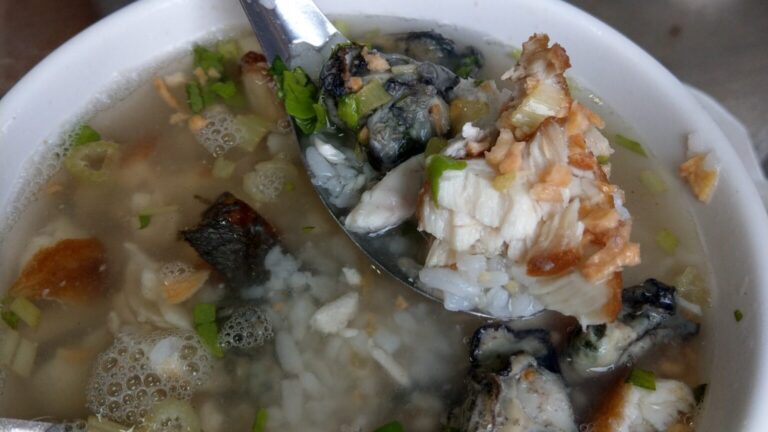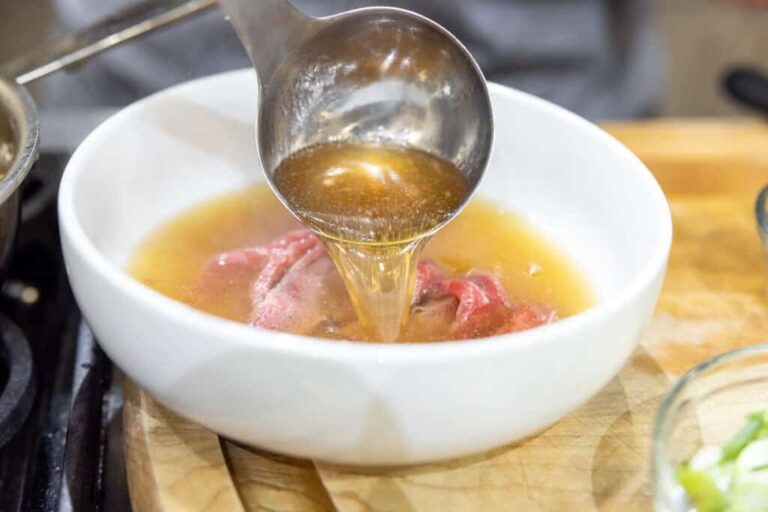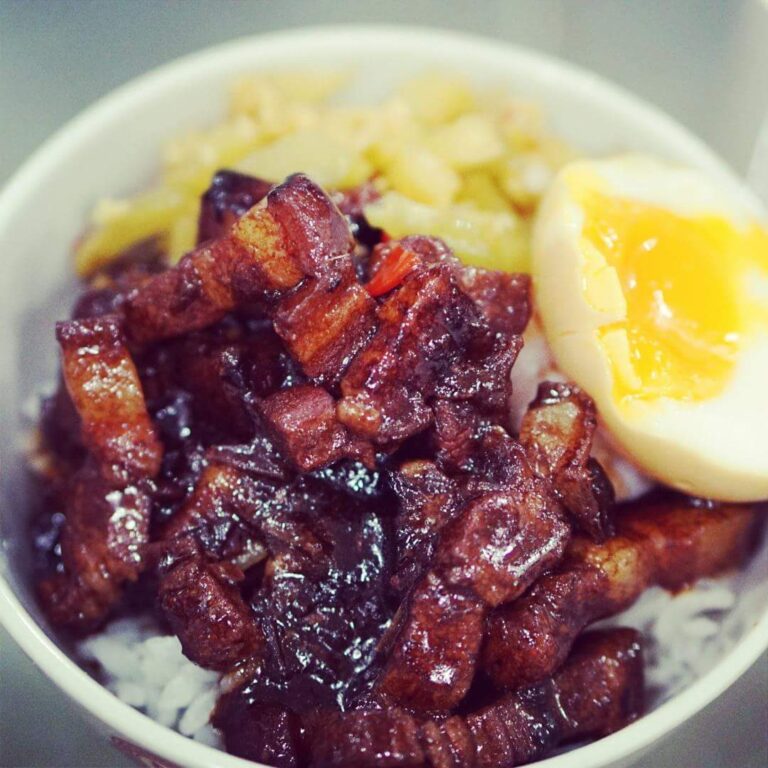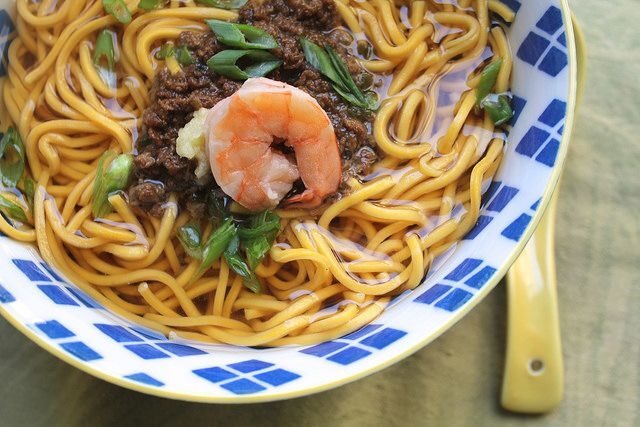
In Tainan, danzi noodles arrive in a bowl scarcely larger than a teacup: thin noodles, minced pork, one shrimp, and clear broth made from shrimp heads. Diners sit low beside the stove, eating a portion designed to leave room for another.
Danzi noodles known locally as danzai mian, are served in a small bowl.
Thin noodles.
A modest spoonful of minced pork.
A single shrimp.
The clear broth is not made from pork bones, but from shrimp heads.
The portion is small.
This is not a dish meant to fill the stomach.
It ends in one bite, takes shape in the second,
and after the bowl is emptied, leaves the sense that another would still be welcome.
In Tainan, this small bowl has been passed down over a long stretch of time.
A small bowl and a lowered gaze
When eating this dish, one’s gaze naturally drops.
In traditional shops, customers sit on low bamboo stools,
almost like bath chairs, facing small tables.
Dim light. Rising steam.
The cook does not stand, but works seated by the stove.
This feels closer to a snack than a full meal.
It exists not for satiety, but for the tongue.
A stripped-down microcosm, reduced to essentials.
Typhoons and the meaning of “slow months”
The origin of danzi noodles is said to lie in late nineteenth-century Tainan.
The founder, Hong Yutou, was originally a fisherman.
From summer into autumn, typhoons often strike the Tainan coast.
During these months, boats cannot go out to sea.
For fishermen, this meant periods without income, known as slow months.
To endure this gap, Hong took up a shoulder pole and sold noodles on the street.
The word danzi refers to that carrying pole.
And du xiao yue, “getting through the slow months,” was not a slogan but a necessity.
This dish was born as a form of risk management
within an unstable livelihood tied to the sea.
Design as subtraction
The bowl is strikingly small.
Unlike Japanese ramen, it is not meant to stand alone as a complete meal.
It was designed not as a staple,
but as something to appreciate for its precision of flavor.
Not to feed, but to let one taste.
By reducing quantity, each element becomes clearer.
Plain, yet deliberate.
A dish that exists through subtraction.
Flesh for topping, heads for broth
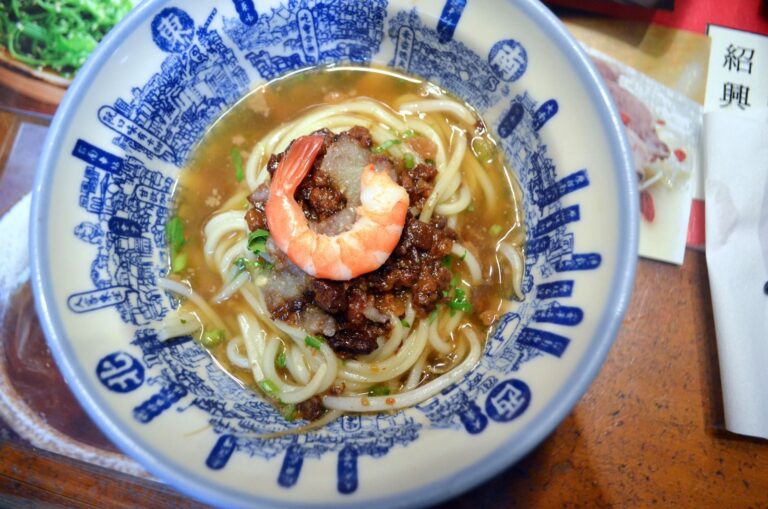
The components are few.
The minced pork, simmered for a long time, forms the core.
A single shrimp sits at the top of the bowl.
The broth comes from shrimp heads, not bones.
The flesh becomes the topping, the heads become the stock.
This is not accidental.
It reflects a fisherman’s logic of using everything available,
maximizing yield while drawing out aroma.
Inside the small bowl,
practical knowledge is neatly folded.
The memory of the shoulder pole in gesture
Those who prepare this dish do not stand.
They sit at the same eye level as the customer,
boiling the noodles and seasoning them in front of the table.
This posture is said to be a remnant of the era
when the dish was sold from a shoulder pole.
The memory of mobile street vending
remains embedded in the act of cooking itself.
At the end, minced garlic and black vinegar are added.
The richness of pork and shrimp broth, left alone, can blur.
Garlic sharpens. Vinegar tightens.
Here again, seasoning works not as addition,
but as control.
Eating the time of Tainan
Danzi noodles exist in Taipei as well.
But to people in Tainan, they appear as a different dish.
In Tainan’s version,
local history and pride are soaked into the bowl.
The gentle sweetness is not unrelated
to a time when sugar was a luxury
and Tainan prospered as a center of the sugar industry.
Sweetness, here, is also a memory of abundance.
Today, we eat this dish in air-conditioned rooms.
Still, when sitting low and inhaling the scent of shrimp,
one may faintly trace the choice of a fisherman
who walked the city with a shoulder pole during typhoon season,
selling noodles to survive.
The bowl is small.
What lingers after it is emptied
feels like the accumulated time of Tainan itself.


— Detour —
a little further to walk
- Notes on Du Xiao Yue and Danzi Noodles in Taiwan
- Notes on Du Xiao Yue in Taiwan’s Night Markets
- Notes on the Origins of Taiwanese Oyster Omelet