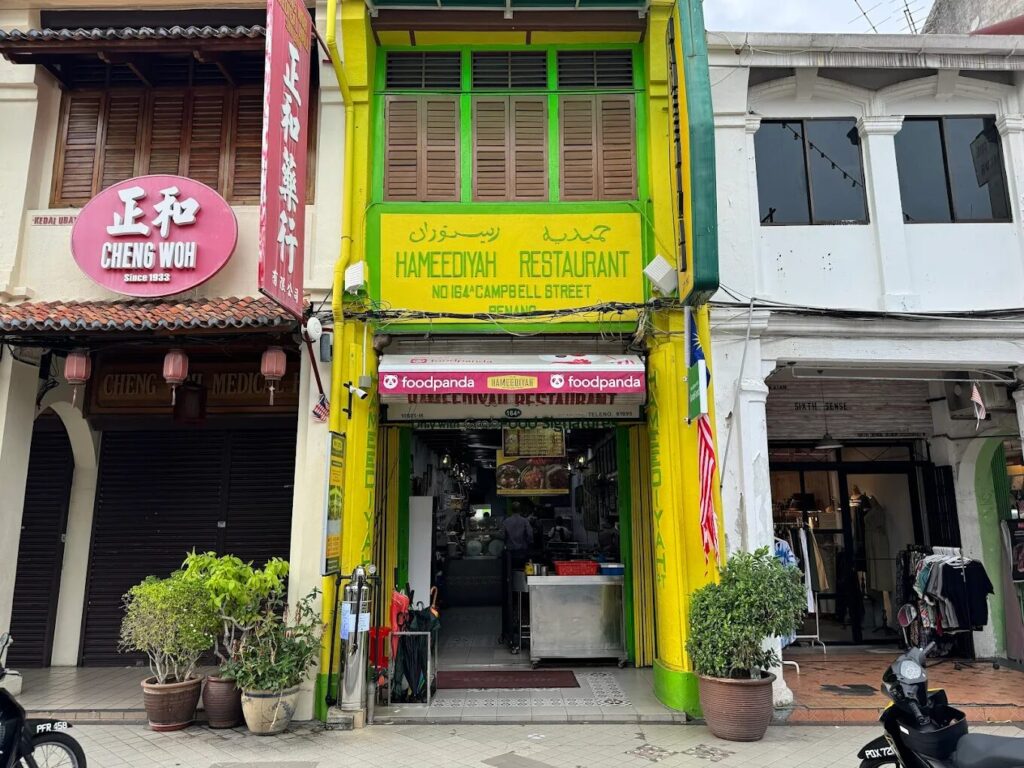
On Campbell Street, a bright yellow-and-green shophouse draws tourists to its doorway while regulars move through it without stopping. Inside, the curry arrives with the dense, freshly ground scent of a spice stall rather than a display preserved for visitors.
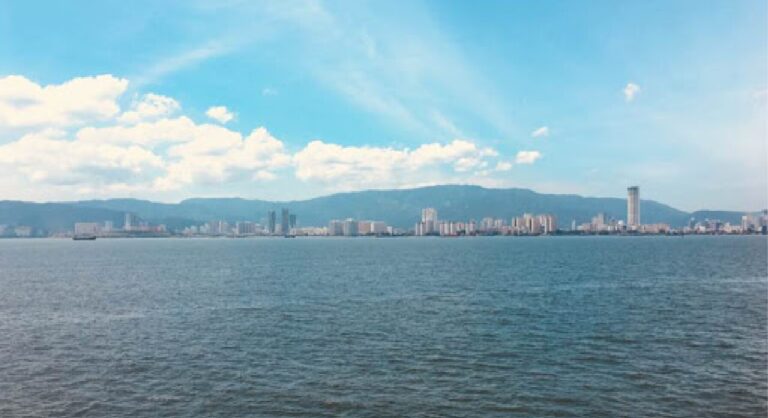
I walk along Campbell Street in George Town, Penang.
The daylight is hard. The air is thick.
Cars and motorbikes pass without pause, and the shade on the sidewalk stays narrow.
Then a yellow wall appears.
A colonial shophouse painted in bright yellow and green.
Near the entrance, the air seems slightly denser.
Hameediyah.
The sign carries the words Est. 1907.
It looks proud, but also administrative.
A place that feeds hunger, and at the same time operates like an institution.
It is often described as the oldest nasi kandar restaurant still operating in Malaysia,
and it has been recognized by the Malaysia Book of Records.

A Different Kind of Presence
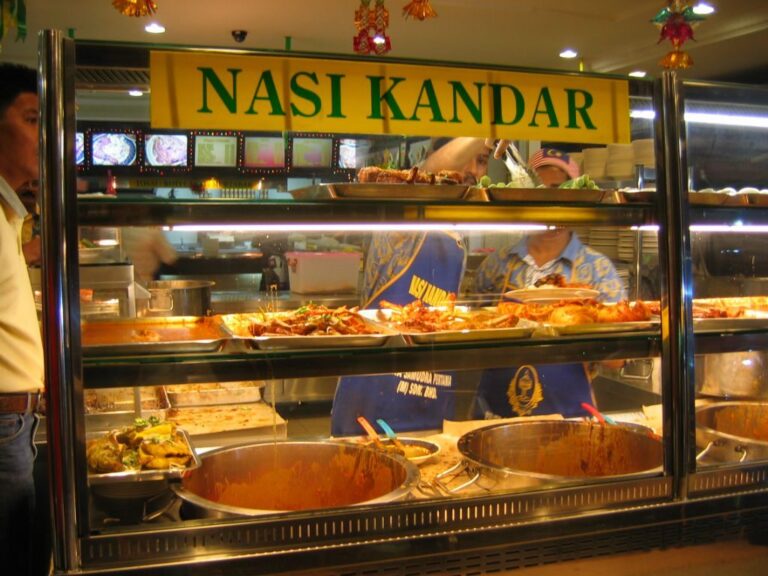
Many nasi kandar shops share the same face.
Stainless counters. Steam. The smell of curry.
Fast hands. Fast turnover.
Hameediyah sits in the same heat, but its outline feels sharper.
The yellow wall should be dirty, but it still works as a sign.
Not just paint, but a marker.
Tourists pause in front of it.
Locals pass through as if it is part of the street’s furniture.
The same place becomes both a destination and a shortcut.
A Legend That Begins Under a Tree
Inside, the first thing that arrives is the smell of curry.
Behind it is something sharper.
A scent like crushed spice seeds.
The restaurant’s origin is often linked to South Indian spice traders.
The founders, said to include Ahamed Seeni (or M. Rajakkani), were not cooks at first.
They were merchants of spice.
The story goes that they once sold food across the street,
under a large rain tree, carrying pots on a shoulder pole.
Nasi kandar under a tree.
The phrase still survives as a local legend.
They used high-grade spices from their own trade,
not sparingly, but as the base of the curry.
That reputation spread.
A roadside operation became a fixed address, and a century began.
When a stall becomes a shop, something is usually lost.
Here, it feels as if the form was fixed before it could fade.
Fresh Masala as the Core
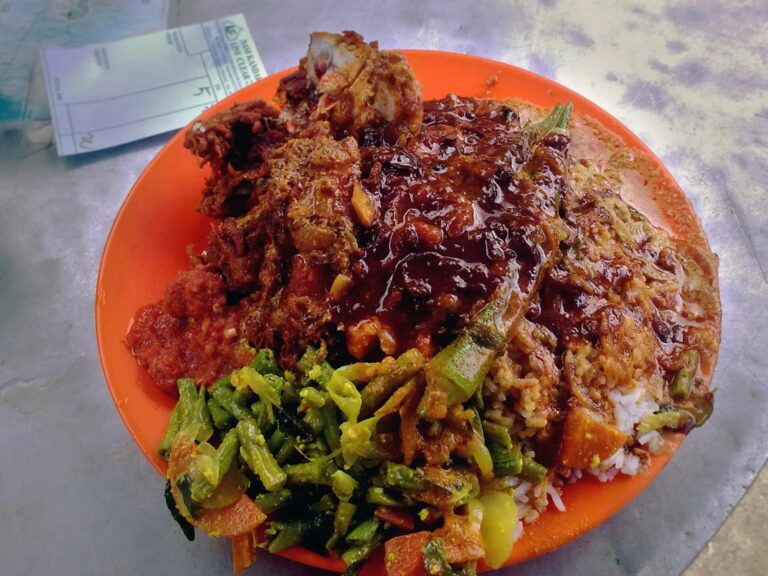
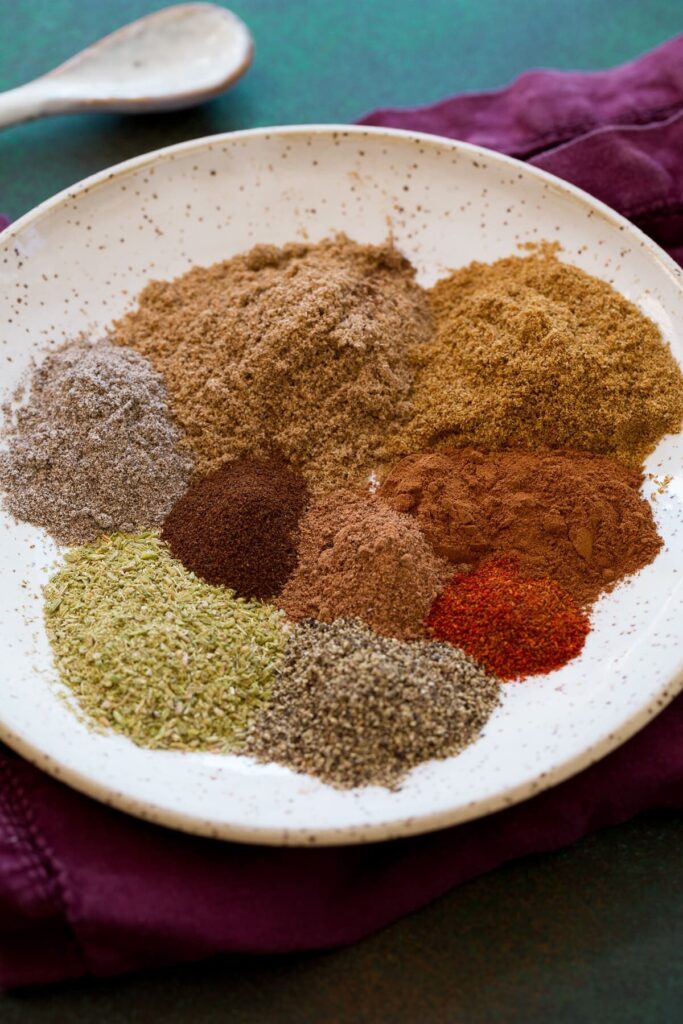
Many shops rely on commercial curry powders and pre-mixed blends.
Hameediyah is often described as an exception,
still committed to freshly ground rempah.
The difference appears less as taste than as density.
The scent arrives before the plate does.
It enters the mouth before heat does.
Two dishes are frequently mentioned as signatures:
beef rendang and ayam kapitan.
The rendang is a deep brown mass.
The meat is cooked until the fibers loosen.
Sweetness and heat sit together, and the weight of oil remains.
Ayam kapitan has a different face.
The aroma is brighter, and the finish is lighter.
There are many layers of spice, yet the structure feels controlled.
The flavor reaches into the meat, thread by thread.
But it is not only heavy.
It is complex, with depth, and slightly refined.
A century of survival leaves its trace in this kind of balance.
Yellow and Green as Memory
Hameediyah’s colors are yellow and green.
At first glance, they look loud.
On this street, they settle in.
George Town’s shophouses carry strong colors.
Blue, red, white.
Yellow holds a different temperature, like an old advertisement.
The color is not only meant to stand out.
It has become a stable identity.
Even while eating inside, the yellow wall stays in the mind.
The taste is remembered together with a surface.
The Other Main Character: Murtabak
Some people say it is incomplete to leave with only a plate of rice and curry.
Hameediyah has another centerpiece.
Murtabak.
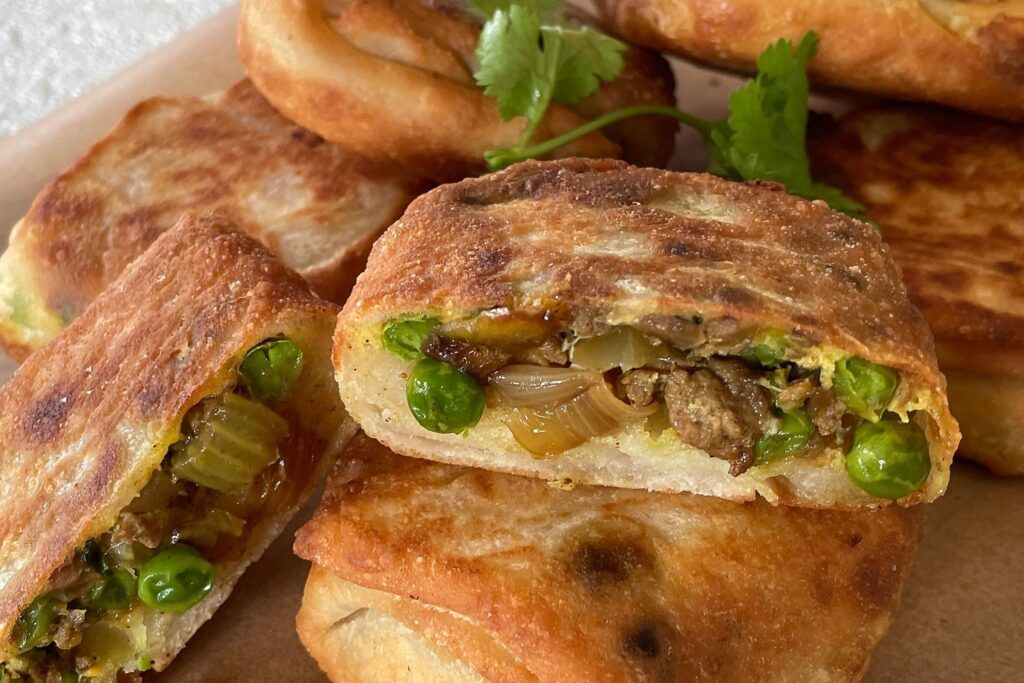
Minced meat and onion, seasoned with spice,
wrapped in dough and pan-fried until the surface hardens.
In many places it is treated as a side item.
Here it behaves like a main course.
It is unexpectedly thick.
The filling is dense.
When it is cut, steam escapes.
The crust is fragrant, and the smell of oil is direct.
A small pile of pink onion pickle comes with it.
Eaten together, the acidity interrupts the fat.
The mouth resets.
Then the next bite becomes possible.
This is a different kind of fullness from the brown mountain of curry.
Flour, oil, meat.
At Hameediyah, it is not treated lightly.
Choosing Biryani as a Method
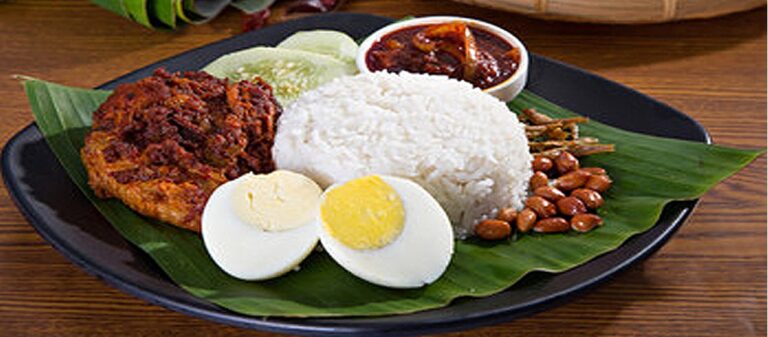
In most nasi kandar shops, plain white rice is the default.
At Hameediyah, some people choose biryani instead.
In a restaurant born from spice trade,
choosing fragrant rice feels consistent.
Plain rice works as a container.
Biryani arrives already carrying its own structure.
Before any curry is poured, there is already a layer of aroma on the plate.
There is no correct choice.
But here, the design seems to begin at the level of rice.
Upstairs, Past and Present Share a Table
Upstairs, there is air-conditioning.
The heat thins as soon as the stairs end.
Old tiles.
High ceilings.
Black-and-white photographs of earlier years.
Yet the food brought to the table should not be far
from what port workers once ate under a tree.
Tourists and regulars sit in the same room,
breaking down the same brown mass.
The building has been cleaned.
The scent and the weight of the dish remain sharp,
as if stored without dilution.
Even when the street noise becomes distant,
the smell on the plate does not disappear.
Keepers of Spice
Outside again, the tropical air returns.
Humidity wraps the skin, and sweat comes back quickly.
But the body keeps traces of cardamom and clove.
Water does not erase it at once.
Being the oldest does not only mean being old.
It can also mean holding the local standard for a long time.
The yellow wall on Campbell Street remains in place,
and the scent that began under a tree stays fixed inside the building.
Hameediyah Restaurant (Main Branch)
— 164 A, Lebuh Campbell, George Town, 10100 George Town, Pulau Pinang, Malaysia
— Daily 9:00–23:00 (check holidays)
— Founded by spice traders; recognized by the Malaysia Book of Records
— Detour —
a little further to walk
- Notes on Nasi Kandar and the Weight of a Shoulder Pole in Penang
- Notes on Mamak Culture Born in Penang
- Notes on Nasi Kandar Kudu on Jalan TAR in Kuala Lumpur