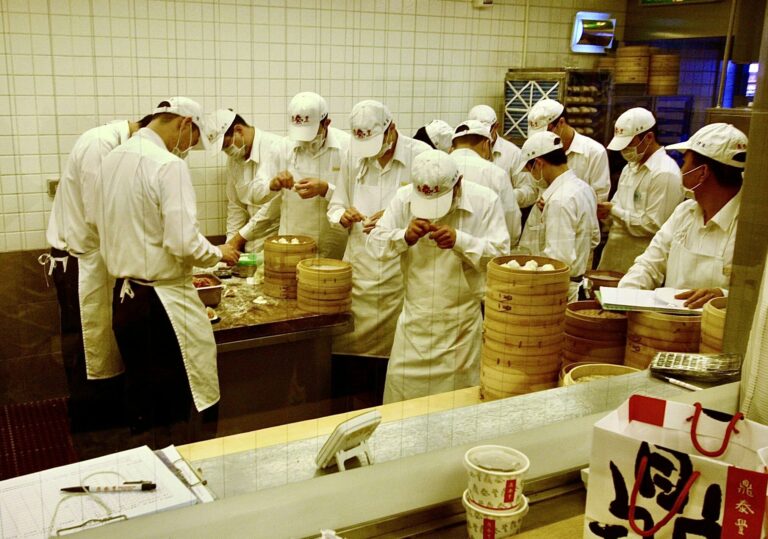
For a time, Din Tai Fung’s storefront held two businesses at once: peanut oil measured by weight and bamboo steamers sending xiaolongbao into the street. The first baskets came from a man living and working inside the oil shop, not from its owner.
The story of Din Tai Fung is often told in a clean line.
An oil shop failed.
The founder invented xiaolongbao as a last move.
The city responded.
The world followed.
That line is half true, and half false.
The first basket was not steamed by the founder.
It was steamed by a man living inside his shop.
This is not a history of invention.
It is a history of accepting someone else’s skill.
That acceptance seems to have shaped the place more than any recipe.
1972: the pressure of canned cooking oil
At the time, Din Tai Fung was only an oil wholesaler.
The name on the storefront was “Din Tai Fung Oil Shop.”
Peanut oil was measured and sold by weight.
It was a small trade that filled gaps in Taipei’s daily life.
In the 1970s, the market shifted.
Supermarkets began to stock cooking oil in cans.
Oil stopped being something measured at a counter.
It became something sealed at a factory.
Standardized.
Branded.
Placed on shelves.
The old oil shop began to lose its role.
Yang Bing-yi and his wife, Lai Pen-mei, needed another path.
Half the shop was empty.
The tanks remained in the back, but the space in front was unused.
They needed something that could stand in that space.
The man who borrowed the storefront
Yang’s proposal was simple.
Use the front of the shop.
Sell xiaolongbao there.
In the back: oil tanks.
In the front: bamboo steamers.
A strange double business began.
Taipei already had this food.
It had arrived with migrants and regional cuisines from across the strait.
Din Tai Fung did not create it from nothing.
But the steam from Lu Ji’s baskets changed the air of the street.
Heat and scent slowed people down.
Those who would have passed by stopped in front of the door.
The oil business received no attention.
The side project gathered a crowd.
A line formed.
A space that had been rented out began to take over the shop itself.
The center of gravity moved forward.
The day the owner became the student
A smaller owner might have reacted differently.
He might have raised the rent.
He might have copied the method and taken it back.
Yang did not.
He bowed to Lu Ji.
He said he would quit the oil trade.
He asked to be taught.
That moment remains symbolic.
The man who owned the shop entered apprenticeship under the man who lived in it.
He must have felt fear.
Oil was declining, but it was still a trade he knew.
It had weight and routine.
Leaving it was not easy.
Still, he moved toward the winning side.
He placed himself under the side with skill.
He swapped roles without hesitation.
Lu Ji’s technique passed to Yang, and later to Yang’s son, Yang Ji-hua.
The inheritance was not a family recipe.
It was a borrowed craft.
Why Din Tai Fung became a team
Din Tai Fung does not foreground individual artisans.
Whoever wraps, the shape remains the same.
Wherever you eat, the temperature lands in the same place.
That may come from the founder’s starting point.
If Yang had been a natural genius with a single personal style,
the shop might have ended as a stubborn one-man kingdom.
Instead, he began as a beginner.
He was not the one who could make it first.
He was the one who was rescued.
When a business depends on borrowed skill, accuracy becomes a virtue.
Not instinct.
Not mood.
Repetition.
Later standardization, the respect for craft, the quiet discipline of the kitchen—
they look like a continuation of that first experience.
The shop became less like a chef’s dictatorship,
and more like a collection of techniques that could be reproduced.
That structure lasts longer.
And it travels farther.
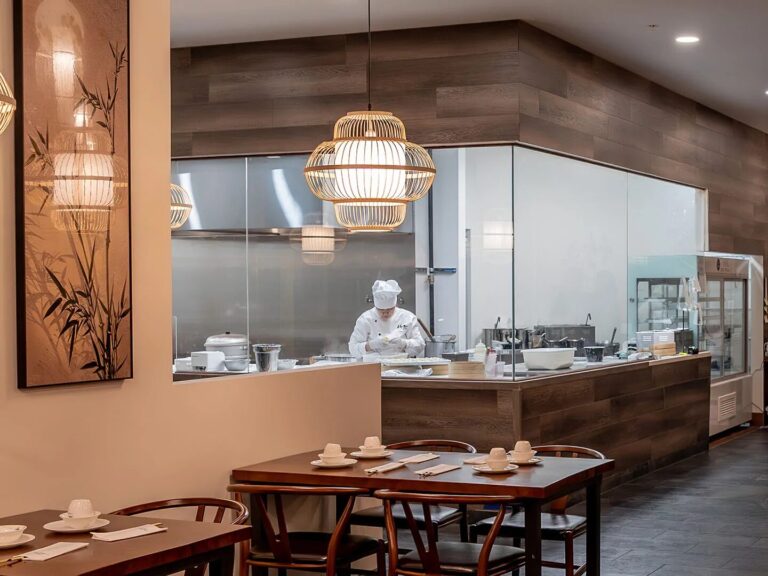

The long interval before the world noticed
Receiving the technique did not complete the shop.
It was still a small dim sum place in one corner of Taipei.
The time that followed was long.
More steamers.
More hands.
More lines to manage.
Xiaolongbao becomes harder as the number increases.
As customers grow, variation becomes visible.
Differences in skin thickness.
Differences in heat.
Differences in timing.
The shop needed to reduce that movement.
So it aligned motions.
It tightened technique.
It adjusted the air of the room.
Not as decoration, but as prevention.
So accidents would not happen.
So visitors from outside would not get lost.
This accumulation became preparation, even if no one called it that.
In January 1993, the New York Times introduced Din Tai Fung
as one of the world’s top restaurants.
The shop did not step onto the stage.
It was picked up by someone else’s eyes.
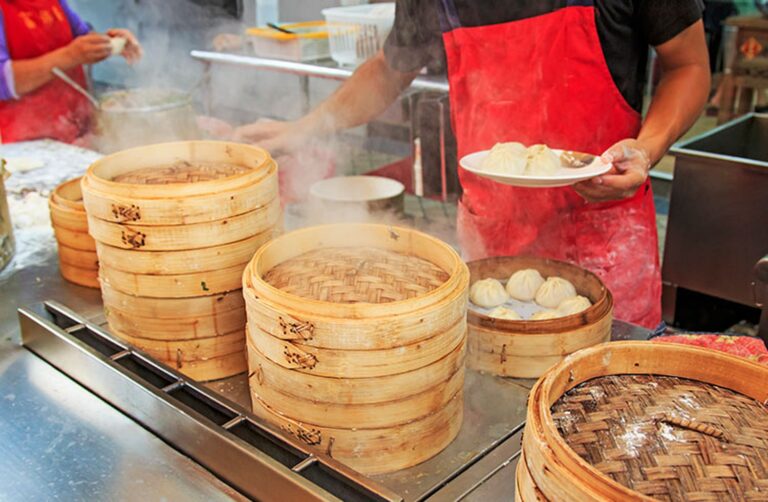
A name that does not remain on the sign
Lu Ji’s name is not on the current logo.
It does not appear in the storefront design.
Even in official stories, he stays in the background.
Still, his trace remains.
Inside the steam rising from baskets across the world,
the first steam belongs to him.
Another trace remains as well.
Yang’s decision.
To admit what is good.
To change without pride.
To let another person’s skill become the foundation.
The base of a global brand was not a brilliant invention.
It was one quiet sentence.
Use this space, if you want.
That sentence changed the front of an oil shop.
Then it changed a family business.
Then it opened a path from a Taipei street corner to the world.

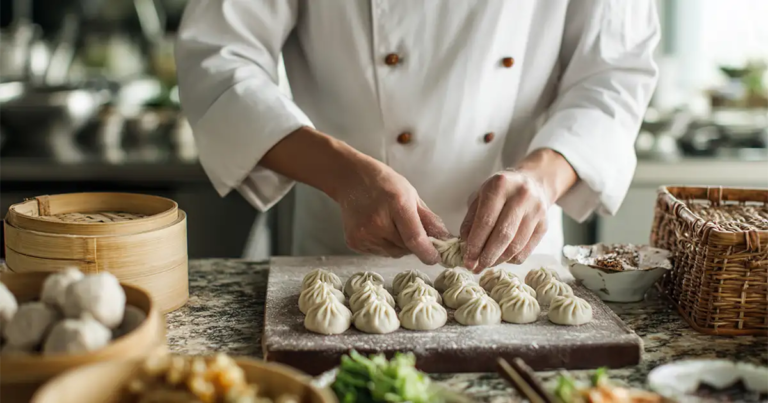
— Detour —
a little further to walk
- Notes on Din Tai Fung
- Notes on Xiaolongbao and the History Taiwan Inherited
- Notes on the Globalization of Taiwan’s Xiaolongbao