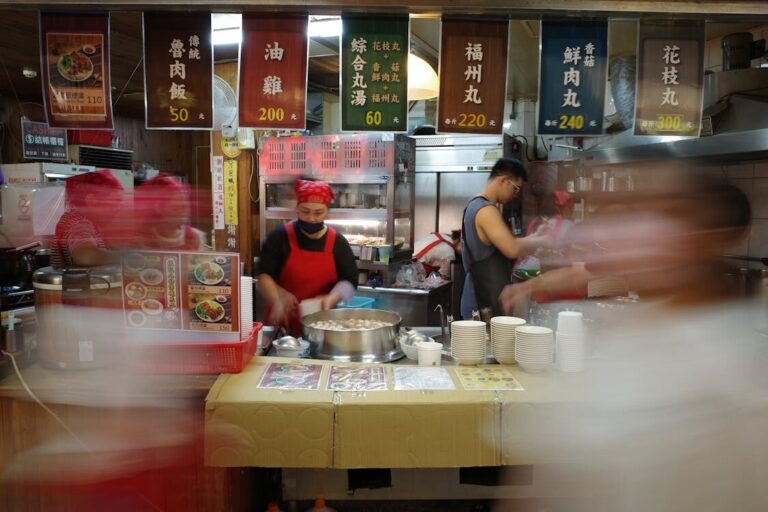
The yellow sign promises braised pork rice for 39 NT dollars. At the register, trays of soup, greens, eggs, and fried pork quietly turn that small bowl into something most diners treat as a full meal.
On a Taipei street corner, a yellow sign stands out.
Behind the glass, metal pots. Even lighting.
The storefront of Formosa Chang sits on the extension of street stalls, yet feels orderly.
The most visible number on the sign is the price of braised pork rice (lu rou fan).
A small bowl, 39 NT dollars.
Almost the same as a stall.
It is a strong number.
People slow down.
They step inside.
But if one pauses near the register and looks at the trays, another picture appears.
Almost no one leaves having spent only 39.
Most pay somewhere between 150 and 200.
No one seems forced.
People choose, add, and look satisfied.
It appears voluntary.
What the Mustached Logo Signals
There is a restaurant known as Formosa Chang, a nationwide chain built around lu rou fan.
It began in 1960 as a small street stall in Taipei.
Today, it is often treated as a reference point within Taiwanese food culture.
Inside, the lighting is bright.
The floors are dry.
Air-conditioning runs steadily.
Staff move in uniform.
The flow from ordering to serving is clear.
The dish comes from the world of street cooking.
The environment, however, feels corporate.
For many people, the name signals a meal unlikely to deviate far from expectation.
It may be one of the places that gave a stable outline to a dish once defined by variation.
Yet what is notable is this:
The presence of Formosa Chang does not end at the restaurant door.

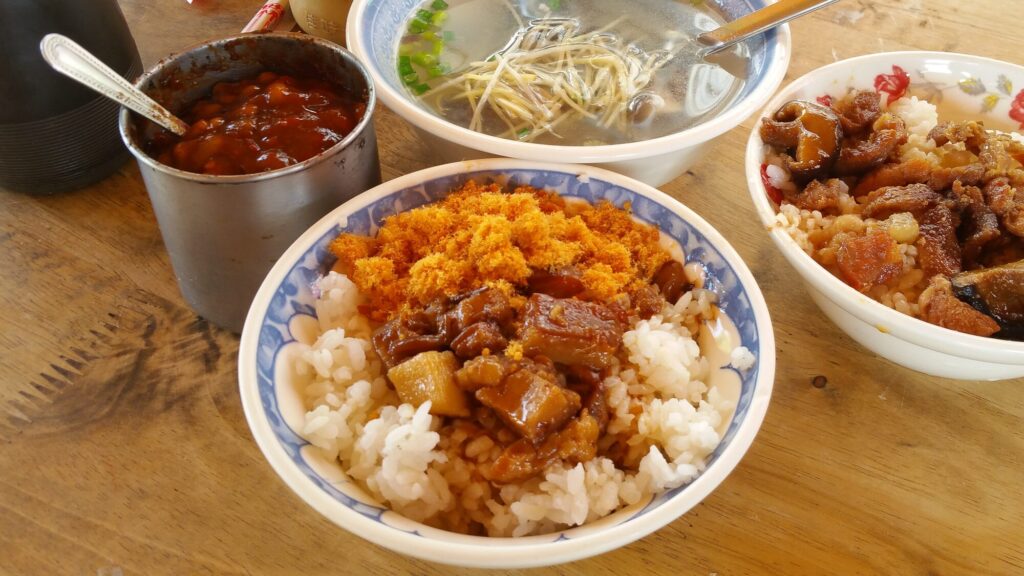
Lu Rou Fan as Taiwanese Everyday Life
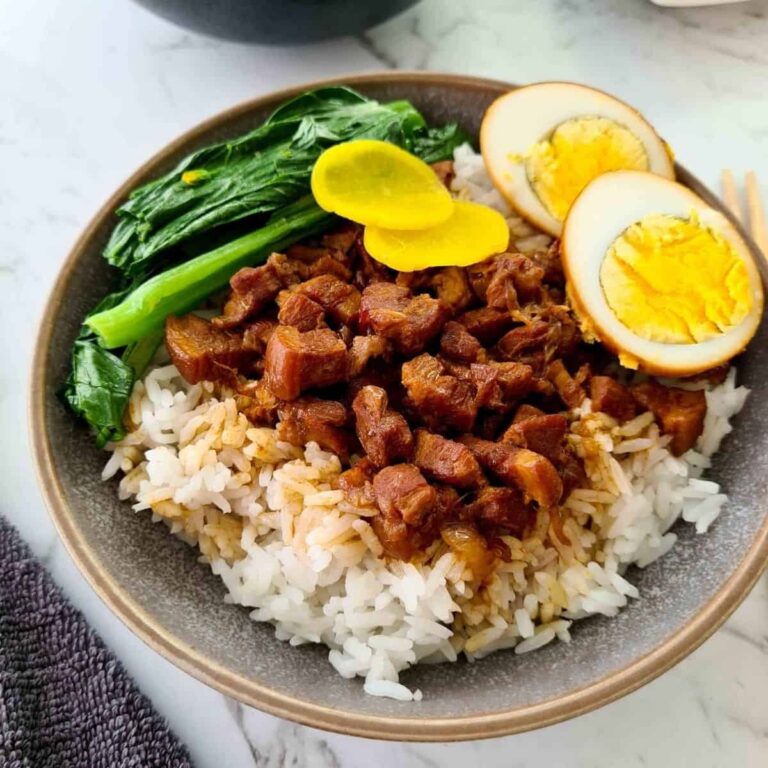
Lu rou fan is often described as a national dish of Taiwan.
Finely chopped pork is simmered in a soy-based sauce with a restrained sweetness.
It is then poured over white rice.
The structure is simple.
Differences between shops remain visible.
The ratio of fat to lean meat shifts.
Sweetness rises or recedes.
Sometimes star anise lingers at the edge.
Even so, most people picture roughly the same bowl.
The portion is modest.
The price is usually restrained.
Some finish it alone.
Others add greens or soup and let it become a full meal.
In Taiwan, this bowl rarely marks an occasion.
It sits closer to a baseline —
something that quietly supports the rhythm of ordinary days.
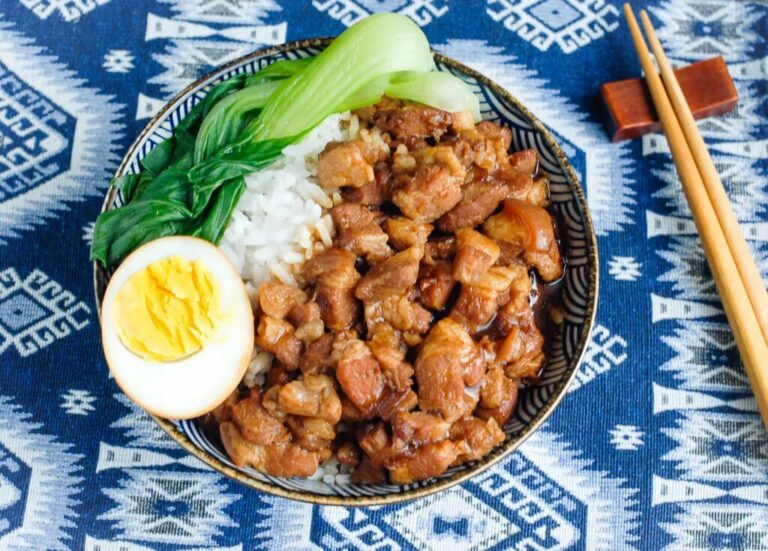
A Staple, Not a Complete Meal
In Taiwan’s food grammar, this bowl is not a finished unit.
It is central, but rarely sufficient on its own.
Rice with sauce and meat.
Closer, perhaps, to seasoned rice than to a full set meal.
In everyday practice, soup and vegetables are expected.
Without them, something feels incomplete.
Eating only the bowl is what one does when rushing, or settling for the minimum.
That sense of lack invites addition.
The feeling that something should be added is not learned here.
It is remembered.
Inside Formosa Chang, customers follow this grammar quietly.
No prompts.
No persuasion.
Just habit.
Four Sides, Four Functions
The side dishes are not simply listed.
Each occupies a position that compensates for the bowl’s limits.
Too much fat.
Not enough vegetables.
A narrow range of texture.
Each side counters one of these.
Bitter Melon and Pork Rib Soup (ku gua pai gu tang)
This receives the fat.
Bitterness and a clear broth reset the mouth.
The soup is not ladled from a large pot.
Each portion is sealed in a small ceramic jar and steamed individually.
The liquid stays clean.
Its role is precise.
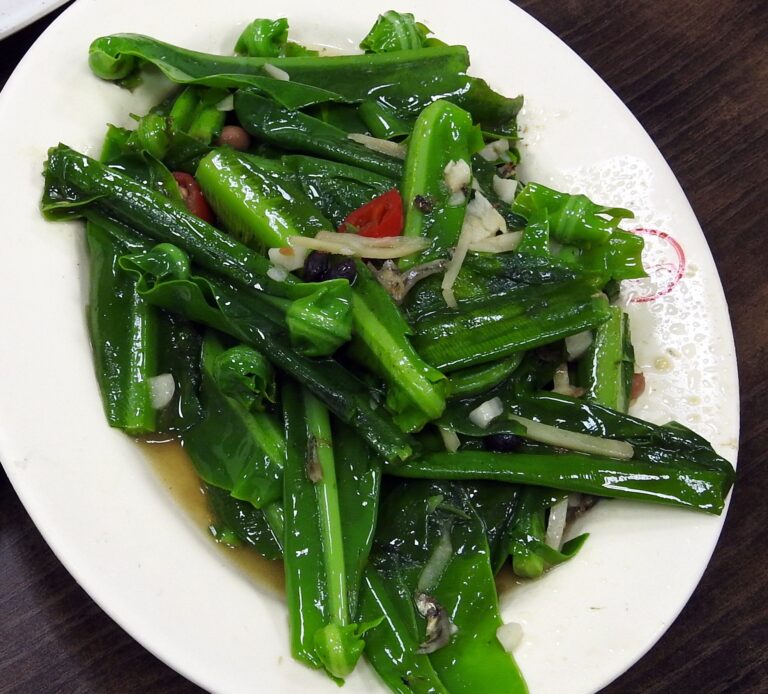
Blanched Greens (ang qing cai)
This plate works psychologically.
It offsets the guilt of lard and rice.
Seasonal vegetables, sauce, grated garlic.
Enough to justify themselves.
Chosen for health, but satisfying.
They enter the tray almost automatically.
Braised Egg (lu dan)
Duck eggs, not chicken.
Dense yolks.
Resistant to breaking.
They carry weight even beside the bowl.
A small indulgence, not an afterthought.
Fried Pork Cutlet (pai gu)
The meat in the bowl is sauce more than substance.
The desire to chew needs another answer.
The cutlet provides it.
Biting into fried meat completes the meal.
These items are not accidental.
They circle the bowl, filling what is missing.
One enters for 39.
One leaves having spent 200.
Quietly.
Willingly.
Upselling Built on Agreement
Seen from a distance, these sides do not provoke desire.
They do not shout.
Compare this with a Japanese curry chain like Coco Ichibanya.
Cutlets. Cheese.
Pleasure is the engine.
Formosa Chang works differently.
The motive is coherence.
The bowl looks cheap.
Enough, at first glance.
Then greens appear.
Meat and fat alone feel unbalanced.
Vegetables seem necessary.
Then soup.
A meal without liquid feels unfinished.
So the tray becomes:
The bowl.
Greens.
Soup.
Around 150 in total.
At no point does it feel expensive.
No one suggested anything.
The diner assembled the meal.
What remains is not the price, but the sense of having chosen correctly.
From Snack to Meal
At a stall, the bowl is light.
It can be eaten quickly.
Standing, even.
Here, placed among sides, it shifts position.
It becomes a staple.
With vegetables, soup, sometimes meat, the outline sharpens.
The feeling left behind is not surprise.
It is completion.
This is why families enter easily.
Concerns about balance are resolved before they arise.
The bowl does not stand alone.
It settles only when surrounded.
Formosa Chang does not offer novelty.
It offers the reassurance that the same assembly will work next time.
That, too, is part of the design.
— Detour —
a little further to walk
- Notes on Formosa Chang Lu Rou Fan in Taiwan
- Notes on Braised Pork Rice as the Base of a Taiwanese Meal
- Notes on Formosa Chang Beyond the Dining Room