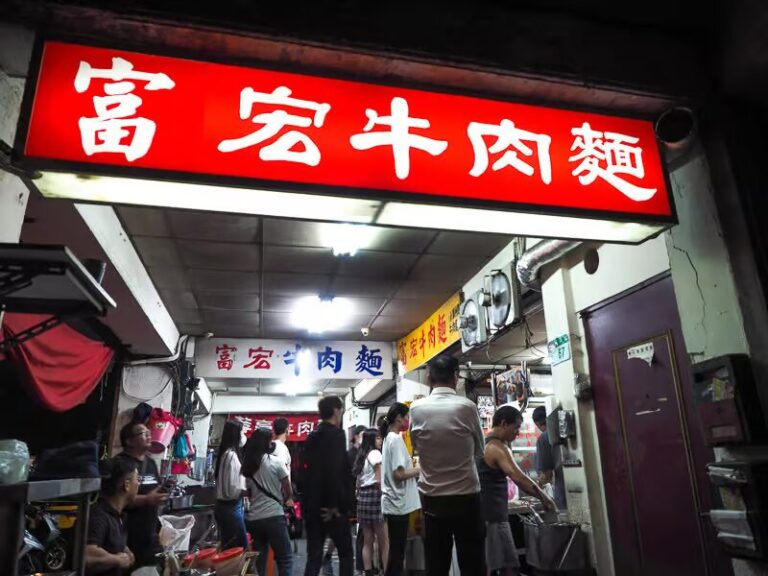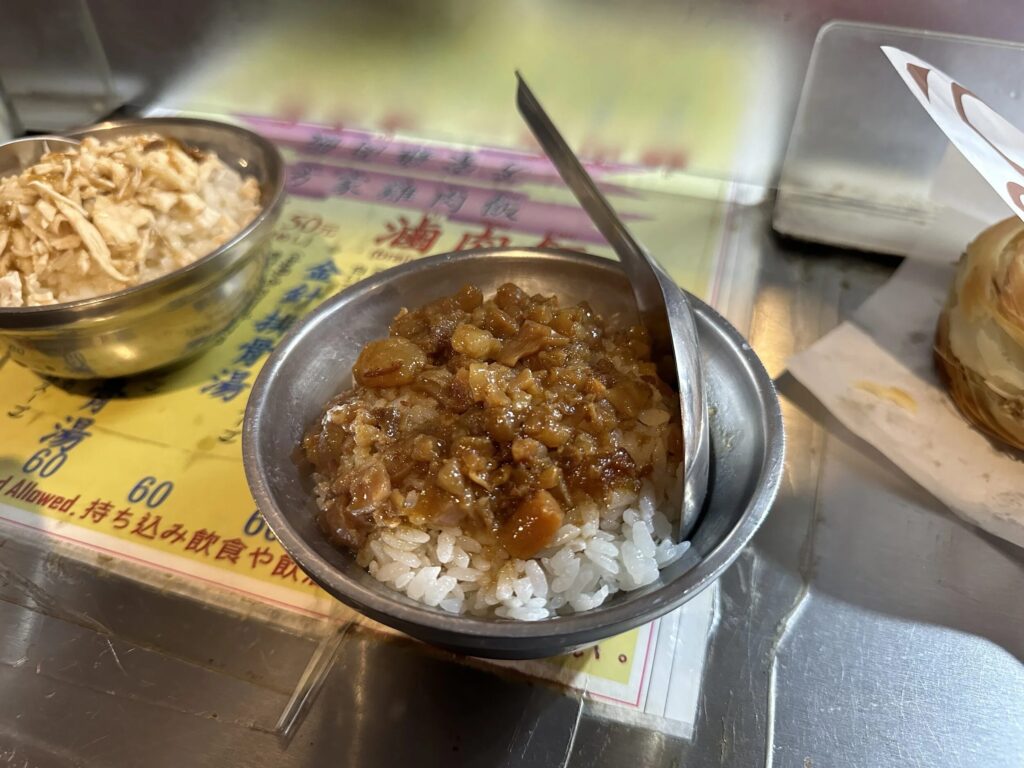
At some Taiwanese rice shops, lu rou fan and ji rou fan occupy neighboring lines on the menu, while ji lu fan puts both toppings in the same bowl. Outside the shop, however, the two dishes do not carry the same weight.
In Taiwan, lu rou fan (魯肉飯) and chicken rice, ji rou fan (雞肉飯), look like dishes of the same kind. Both are small bowls of white rice topped with a little meat, with fat and sauce soaking into the rice. They cost about the same. It is common to find both at one eatery, and there is even ji lu fan (雞魯飯), which puts chicken and braised pork in a single bowl.
Look at Taiwanese food as a whole, though, and chicken rice somehow seems a little low-key. In Chiayi there are chicken rice shops everywhere, and the dish represents the city. But when a dish is presented as representing Taiwan itself, lu rou fan is usually the one out in front.
How did two rice dishes that can be sold in the same shop, and can even share a bowl, end up in different places?
Three Rice Dishes on One Menu
A shop built around chicken rice may also sell lu rou fan. At Qiang Ji (強記雞肉飯), a chicken rice shop in Taipei, chicken rice and lu rou fan sit in the same rice section of the menu, along with ji lu fan, which combines the two. The same set turns up at other shops, including Liang Ji Chiayi Chicken Rice (梁記嘉義雞肉飯) in Taipei. There is nothing unusual about serving both from the same kitchen.
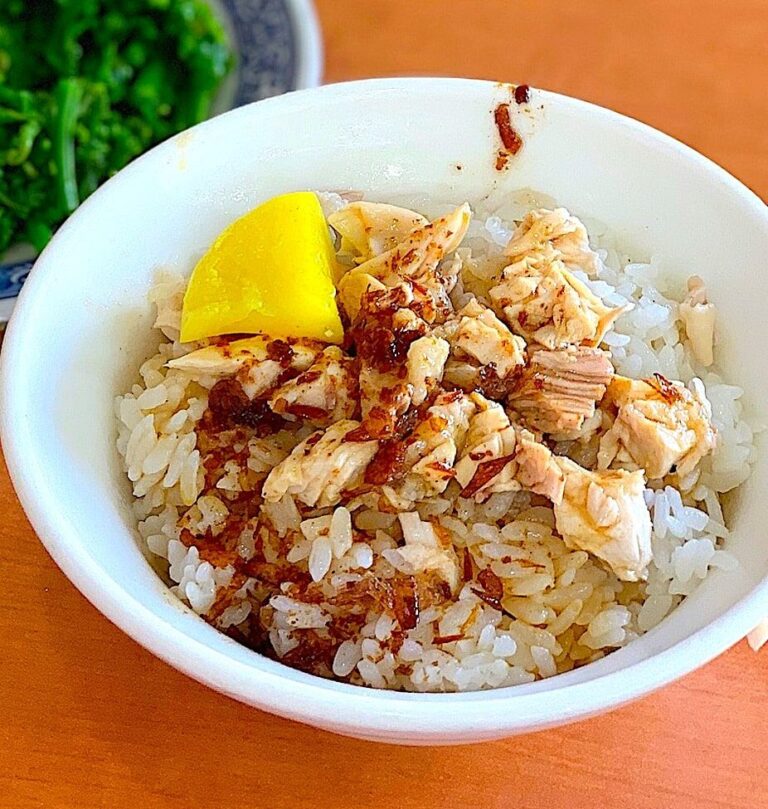
The story of how chicken rice began in Chiayi shows something similar. According to Lin Chao-cheng (林昭正), the second-generation owner of Penshui Ji Rou Fan (噴水雞肉飯, literally “fountain chicken rice”), the early version dates from a time when chicken was still eaten only on holidays. Chicken bought for religious offerings was torn into strips, laid on white rice, and topped with a braising liquid. His account does not say which braising liquid it was. It does show that the bowl was more than torn chicken and rice. A braising liquid went into it too.
Whether you look at today’s menus or at the old method, chicken rice and lu rou fan are not far apart. The difference seems to lie less in the bowl than in what goes on top of it.
Digging Into Lu Rou Fan
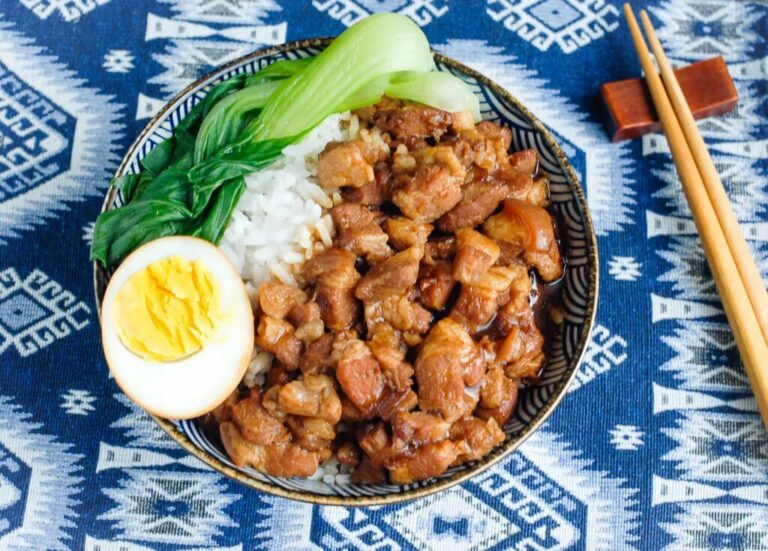
The name lu rou fan does not point to one dish across Taiwan. In the central and northern parts of the island, it usually means finely cut pork cooked in soy sauce and poured over rice. In the south, the same dish is called rou zao fan (肉燥飯), and the name lu rou fan can go to rice topped with a large piece of pork belly. Treat lu rou fan and rou zao fan as the same thing, and the southern lu rou fan drops out of the picture.
Looked at more broadly, the dish leads back to lu (滷), a braising method that cooks food in soy sauce and spices. Eating pork braised this way goes well beyond a single bowl of lu rou fan. Rou zao (肉燥, Hokkien bah-sò), finely cut pork cooked down, ties into this way of eating pork too.
Rou zao is not only for rice. The Ministry of Education’s Taiwanese Hokkien dictionary describes it as something mainly mixed into noodles or rice. In Tainan, rou zao shows up in rou zao fan and in many xiaochi (小吃, small eats), such as danzai noodles (擔仔麵), mi gao (米糕) and wan guo (碗粿). Take the rice away from the finely cut kind of lu rou fan, and its meat and flavor carry on in other dishes.
Chicken is eaten in plenty of other ways. But there is little sign that torn chicken like the kind in chicken rice works as a shared component across rice, noodles and xiaochi, the way rou zao does.

When Meat Was Expensive
Pork was not simply cut up while chicken was eaten whole. Chicken rice itself shows otherwise.
A chef whose huo ji rou fan (火雞肉飯, turkey rice) was entered as Chiayi City’s representative dish in 2013 described chicken rice as a frugal way ordinary people ate chicken, from a time when they wanted it but had to make it last. Accounts gathered in Chiayi also describe tearing a small amount of chicken onto rice when chicken was food for special occasions. Torn into strips and paired with rice, a little chicken could feed several people.
Pork could be stretched in much the same way. A well-known explanation of rou zao’s origin says that in poorer times people cooked cheap scraps such as trimmings, fat and pork skin. But Tsao Ming-tsung (曹銘宗), a writer on Taiwan’s food history, presents this as a guess. Another line of explanation says the method came from Fujian. It cannot be settled that rou zao was born in Taiwan from scraps.
Whatever its origin, finely cut pork cooked down with its fat and juices can carry flavor into rice or noodles even in small amounts. With pork as with chicken, cutting it small made a little meat go further.
The difference came after that. Torn chicken found its form in chicken rice, while rou zao also made its way beyond rice.
After Chicken Became Everyday Meat
It is hard to explain the difference by saying lu rou fan is older. In a co-authored history of Taiwanese food, Tsao notes that Hokkien dictionaries from the Qing era and the Japanese colonial period include lu rou (鹵肉), a word for pork braised in soy sauce, but not lu rou fan (鹵肉飯). Lu rou fan as a rice dish may have emerged after the war. Penshui in Chiayi is also said to have opened in 1949. The two bowls may not differ much in age.
If something came first, it was the component, not the bowl. At Du Hsiao Yueh (度小月) in Tainan, the founder, who came from Zhangzhou, is said to have used rou zao made the way he learned in his hometown in his danzai noodles from the shop’s founding in 1895. If that tradition holds, finely cooked pork was already being used in something other than rice before chicken rice appeared.
Chicken farming became an industry from the 1960s on, and chicken turned into a cheap everyday meat from then. In 2024, Taiwan’s annual per-person supply was 43.13 kilograms of poultry and 34.96 kilograms of pork. These are supply figures, not actual intake. Even so, they rule out explaining lu rou fan’s prominence by saying there is more pork than chicken to go around in Taiwan.
As chicken became cheaper, there was no obvious reason for rou zao, already used in rice, noodles and xiaochi, to disappear. Perhaps there was also no need to put chicken into uses that pork already covered. Chicken rice existed as a bowl of its own before chicken became cheap. In Chiayi, it became tied to turkey and turned into the city’s signature dish.
Chiayi’s Turkey Rice Took First Place in 2013
In 2013, the Agriculture and Food Agency (農糧署) gathered 56 rice dishes put forward by 21 cities and counties across Taiwan and held an online vote. Each local government entered a dish to represent its area. First place went to Chiayi City’s turkey rice.
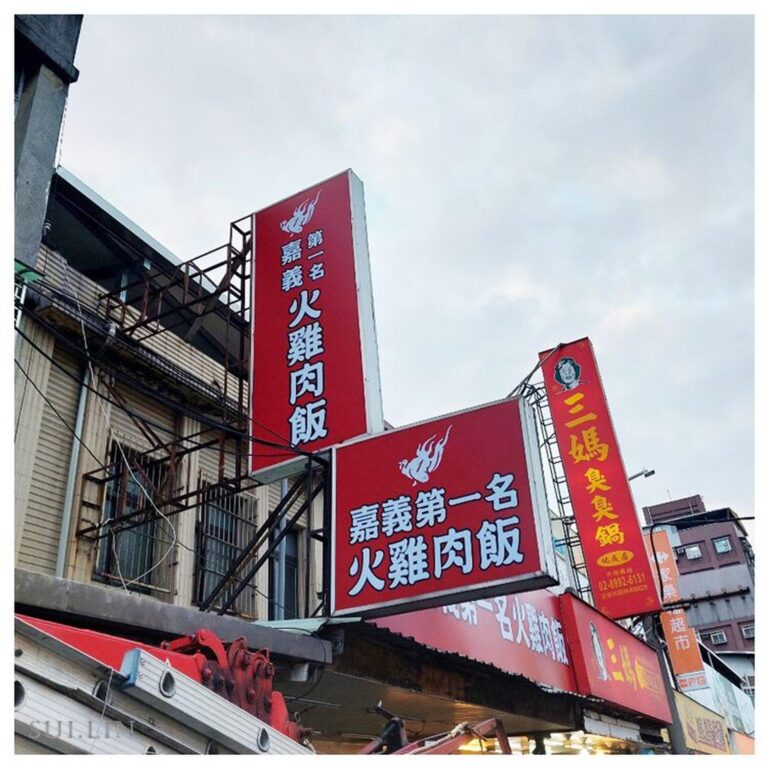
It was not a popularity contest against lu rou fan. The result says nothing about which of the two is better. What it does show is that turkey rice, entered as Chiayi City’s dish, went all the way to the top of a national vote. Outside Chiayi, shops with “Chiayi chicken rice” (嘉義雞肉飯) in their names can be found in Taipei and Taoyuan.
Lu Rou Fan on a Plane
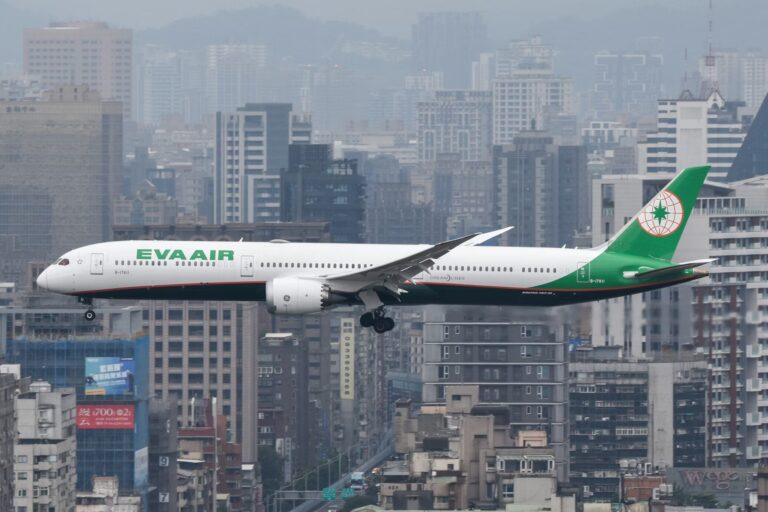
Three years earlier, in 2010, Formosa Chang’s (鬍鬚張) lu rou fan was taken up as an in-flight meal on China Airlines routes to the US West Coast. Being served on a plane does not by itself make a dish stand for Taiwan. What it shows is that lu rou fan was chosen as one of the dishes served on flights leaving Taiwan.
From 2017, the Department of Commerce under the Ministry of Economic Affairs ran a lu rou fan festival (臺灣滷肉飯節) and promoted the dish as “Taiwan’s national rice dish” (臺灣國飯). Reaching overseas visitors was part of the aim, and the event was held again in 2019 and 2021.
In 2013, Chiayi City put forward turkey rice as its own dish. When the Ministry of Economic Affairs promoted a dish in Taiwan’s name, it was lu rou fan. The 2013 vote and the festival had different organizers and different aims.
Two Objections Inside Formosa Chang
The same split shows up inside one company. In the 1990s, Formosa Chang, known for its lu rou fan, developed chicken rice as one of several new dishes without pork. When it was tasted in-house, people in the company objected.
One objection was that it could not compare with Chiayi chicken rice. The other asked why a shop that sold lu rou fan would sell chicken rice at all.
The two objections point in different directions. When chicken rice was judged, the point of comparison was Chiayi. Lu rou fan, before any comparison with a place came up, was the dish that defined Formosa Chang itself.
The 1997 outbreak of foot-and-mouth disease later led Formosa Chang to put chicken rice on sale at every branch, and today both can be ordered at the same counter. The two dishes could share a kitchen. Still, when people thought about them, a separate place seems to have been ready for each in their minds.
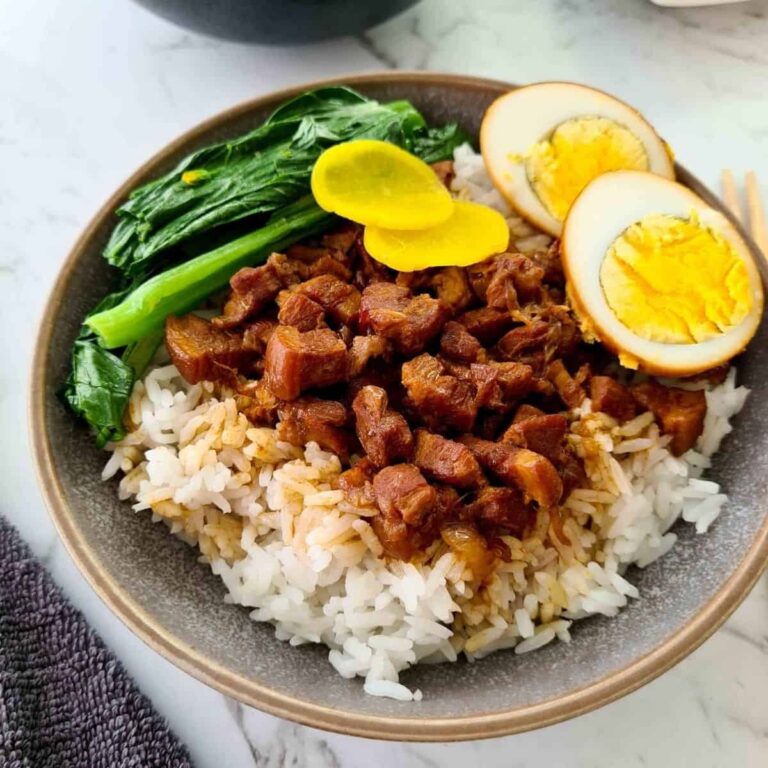
Beside the Same Bowl
Back at the first menu, chicken rice and lu rou fan still look alike. They can be sold in the same shop, and as ji lu fan they fit in one bowl. They may not be far apart in age. Both can be described as everyday food that stretches a little meat with white rice.
One layer down, the picture changes. On the lu rou fan side, a line of eating braised pork and using finely cut rou zao on noodles shows up before the name lu rou fan spread. That flavor was not confined to one bowl, and among Tainan’s xiaochi it still turns up in many places. In chicken rice, torn chicken did the same job of stretching a little meat over rice. But instead of becoming a shared component across rice, noodles and xiaochi like rou zao, it stayed strong as a single bowl, chicken rice, and over time became tied to the city of Chiayi.
Chicken rice is not the weak one, and lu rou fan is not the strong one. One took first place nationally as the dish that represents Chiayi. The other went on a plane and was called Taiwan’s national rice dish.
On the menu they sit side by side. Somewhere along the way, though, one seems to have come to carry the name of Chiayi, and the other the name of Taiwan.
— Detour —
a little further to walk
- Notes on Lu Rou Fan in Taiwan
- Notes on the Difference Between Lu Rou Fan and Rou Zao Fan in Taiwan
- Notes on Chicken Rice in Taiwan