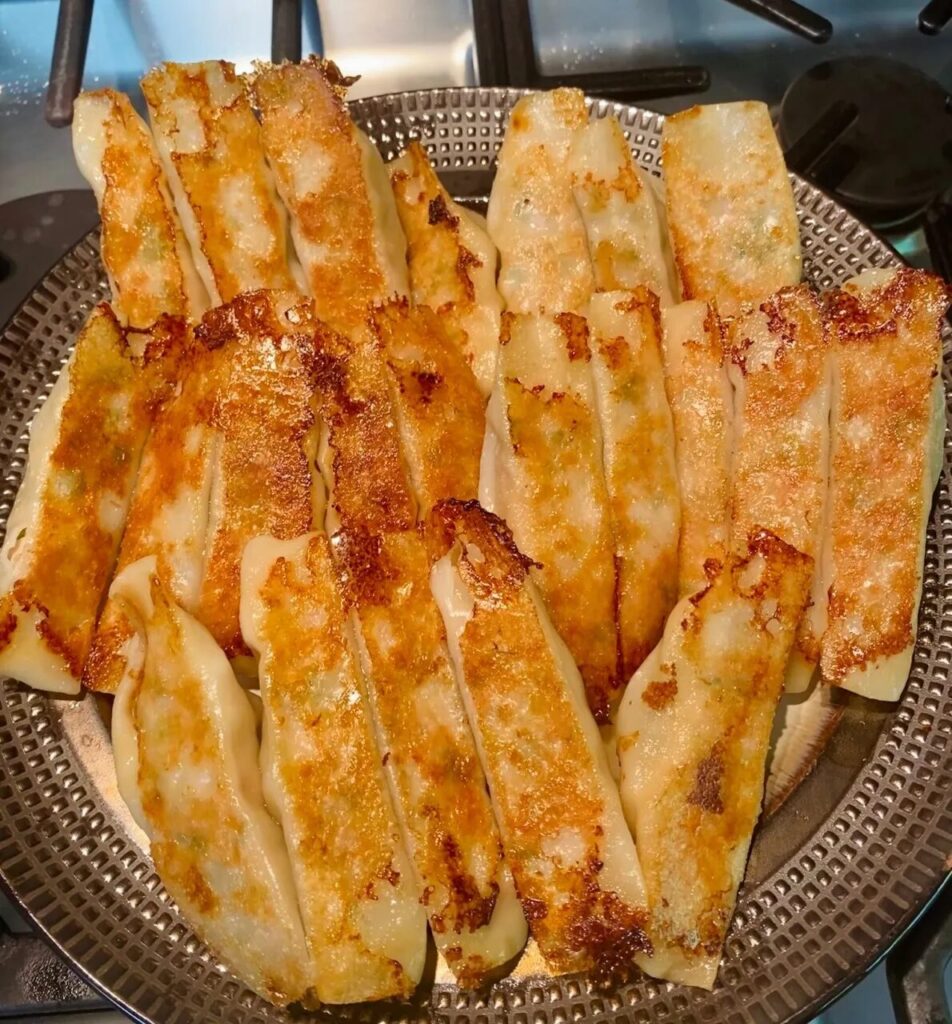
In Taiwan, asking for dumplings brings a pale, steamed plate; the browned pieces set against iron belong under another name. Guotie usually arrives in tight, slender rows, with each piece nearly indistinguishable from the next.
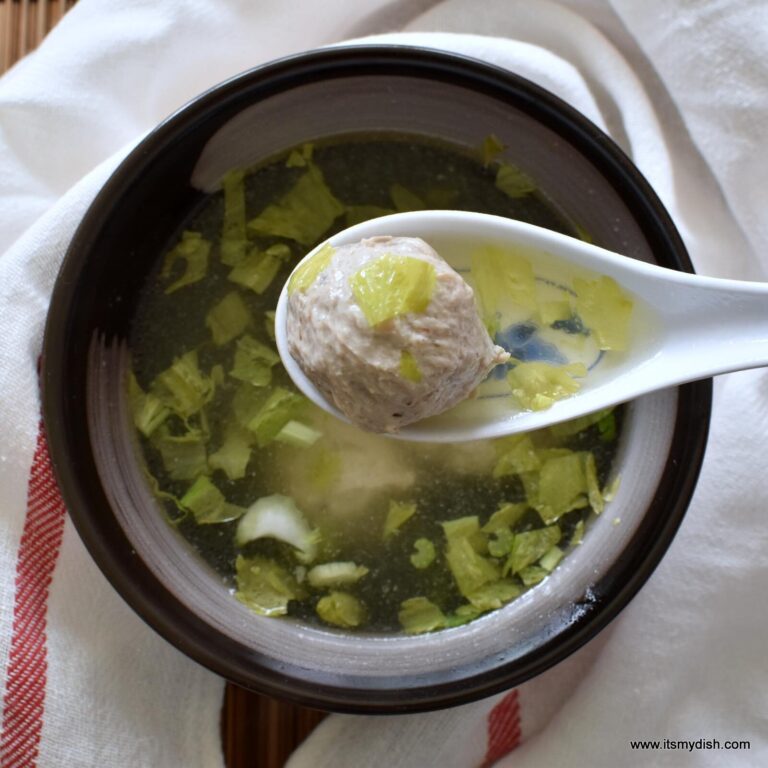
Boiled dumplings (shui jiao) appear first in this account only to clarify what guotie is not. In a Taiwanese eatery, if one orders under the single word dumplings, no sound of iron plates is heard. What arrives are pale forms wrapped in steam. If one desires the browned surface of something fried, one must look for different characters. Those characters read guotie.
The two characters describe the act itself. They record the moment of cooking. To stick to the pan. The skin presses against iron, moisture escapes, and a crust forms. The movement becomes the name. In Taiwan, this is not treated as a mere fried version of boiled dumplings. It is handled as a separate dish. On menus it is often placed in its own column rather than listed beneath dumplings. In language and in awareness, the two are divided from the beginning.
A Golden Band in a Sea of Water
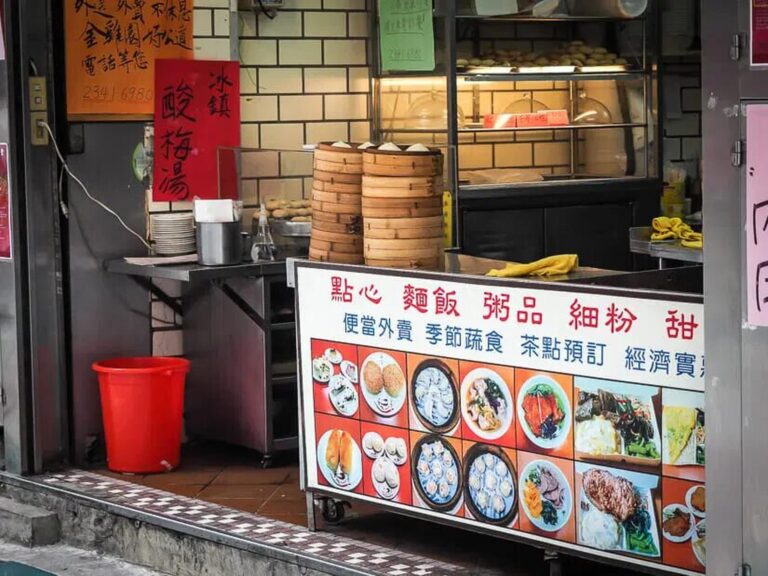
Walking through the city, one finds the words for boiled dumplings everywhere. Noodle shops, set-meal restaurants, narrow alley diners all display them. At noon steam rises. At night the pot remains on the flame. The boiled form has merged with urban life as completely as rice.
In contrast, places that sell guotie are fewer. One must seek out a specialist or a particular stall. In family-style eateries it is common to find boiled dumplings but no fried ones. This imbalance does not seem accidental. For many Taiwanese, guotie is not something eaten incidentally. It is chosen deliberately. On some days one wants the crisp surface. On some days one requires the sound of biting into a browned edge. It exists as a dish selected with intention. Within the watery world of boiled dumplings, golden bands appear only at certain points.

From a Scorched Pot
The origin of guotie is often traced to a northern anecdote. During the Northern Song dynasty, a cook is said to have run out of water while boiling dumplings. The bottom of the pot burned. The skins stuck. Steam remained trapped inside. When tasted rather than discarded, the exterior proved fragrant while the interior still held liquid.
An accident was preserved as method. At that stage there was no fixed form. Some were crescent-shaped. Others were closer to cylinders. The addition of frying did not dictate how they were wrapped. Each household retained its own style. On the mainland today, dumplings equivalent to guotie still vary in shape. No unified form dominates. Originally, guotie was one option among many.
The Misunderstanding of Leftovers
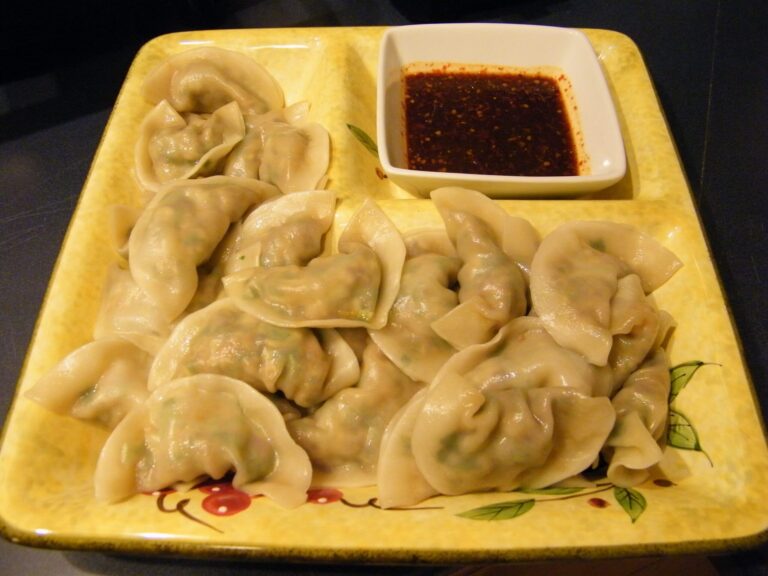
In Taiwan a common explanation circulates. Fried dumplings are said to be boiled dumplings reheated the next day. Yet locally the two are clearly distinguished. Dumplings that are boiled and then fried are called jian jiao. These remain round and thick, placed whole onto an iron plate.
Guotie, by contrast, is wrapped from the start with frying in mind. The thickness of the skin differs. The shape differs. The moisture content differs. Its structure anticipates browning and steaming in one continuous process. It is not a reuse of leftovers. It is a design conceived as complete from the beginning. Within Taiwanese food culture, this distinction is carefully maintained. The white forms submerged in water and the golden rows adhering to iron belong to separate genealogies.
1949 and the Flour Carried in Memory
In 1949 many mainlanders crossed to Taiwan alongside the Nationalist forces. They did not carry sacks of flour in their luggage. What they carried was the memory of flour. In the north, dumplings, buns, and noodles had been staples. Rice in some regions had held only a secondary role.
For these migrants, fried dumplings were not a festive specialty. They were one expression of daily wheat. At first they were sold in small shops run by retired soldiers. The flavors prepared in juancun military dependents’ villages were carried directly into the streets. Shapes and sizes were unlikely to have been uniform. Crescents and near-cylinders may have coexisted. Wrapping styles varied by household. Browning depended on the instinct of the cook. At that time guotie likely bore more individuality than consistency.
The Yellow Signboards of the 1990s
The landscape changed in the 1990s. Identical signboards began appearing on street corners. Bafang Yunji and Sihai Youlong. These names moved guotie into a new phase.
What had depended on the feel of individual hands became standardized. To expand across Taiwan, taste and form had to align. Whoever wrapped them, whoever cooked them, the result needed to match. Variations typical of street stalls gradually diminished. Guotie shifted from household memory to urban specification.
Why the Shape Became a Rod
Ordering today in Taiwan yields a row of slender sticks. Each resembles the next. The reason lies less in aesthetics than in process.
Round or crescent forms leave gaps when arranged on a flat iron surface. Empty spaces reduce the area that browns. A rectangular profile allows tight alignment. More units can be cooked in one batch. A flat base ensures even heat. The chance of burning some while undercooking others decreases. In takeaway boxes, the pieces fit without wasted space and resist collapse.
The shape appears chosen to answer efficiency rather than flavor. Alongside the crisped surface, guotie acquired an orderliness of alignment.
The Filling Adjusted to Taiwan
Once the form stabilized, the contents began to shift. Chain stores did not remain within northern traditions. Variants labeled Korean-style spicy, curry, or corn entered the menu. Combinations uncommon on the mainland stand naturally side by side in Taiwan.
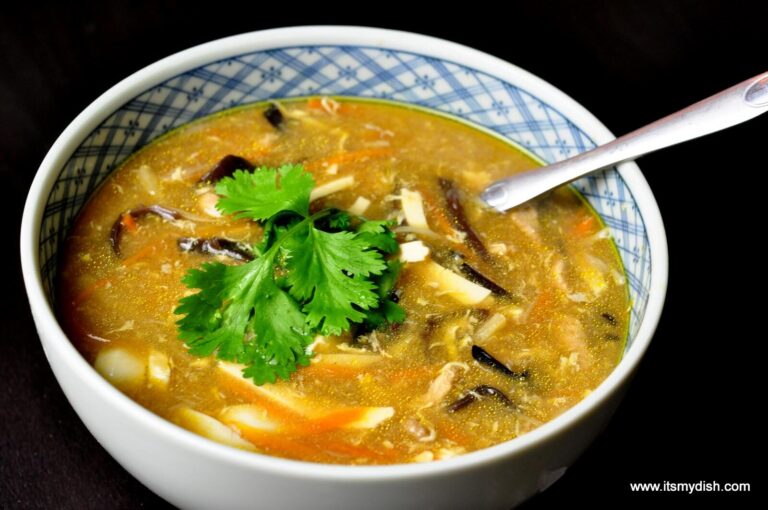
Levels of heat and sweetness adjust to local preference. The yellow signboards now blend into the city’s background. For students, guotie becomes an after-school snack bought with coins and eaten while walking. For office workers, it is fuel swallowed quickly beside a bowl of hot and sour soup. It is not a ceremonial dish. Yet it is firmly embedded in urban rhythm.
A Row of Gold
What began in a northern anecdote acquired a different posture in Taiwan. Today’s guotie is not the accidental product of a scorched pot. It stands as the outcome of urban selection.
The rods are even. The browning is consistent. The dimensions fit the paper box. This is less a recreation of legend than a form shaped by the needs of Taiwanese society. What we eat is not the original failure of the Northern Song kitchen. It is a golden row repeatedly reheated, reshaped, and aligned on this island.
At the intersection of tradition and efficiency, guotie rests without proclamation.
— Detour —
a little further to walk
- Notes on Boiled Dumplings in Taiwan
- Notes on Bafang Yunji and the Yellow Sign in Taiwan
- Notes on the Steamed Dumpling That Lost Its Shop