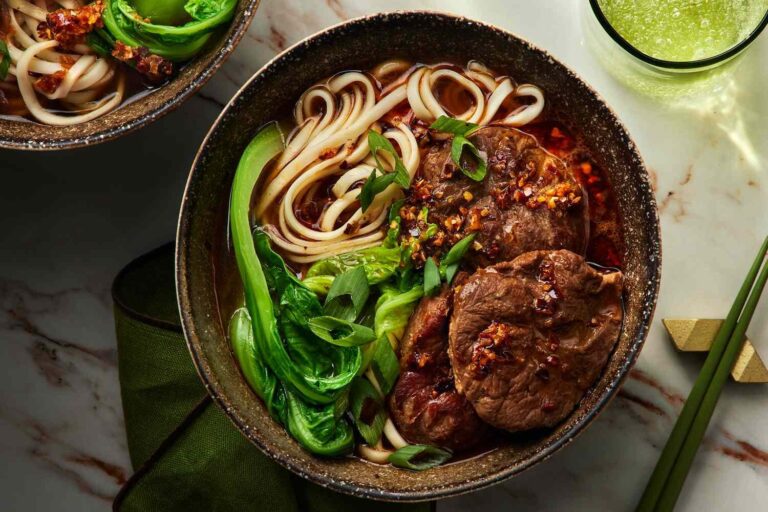
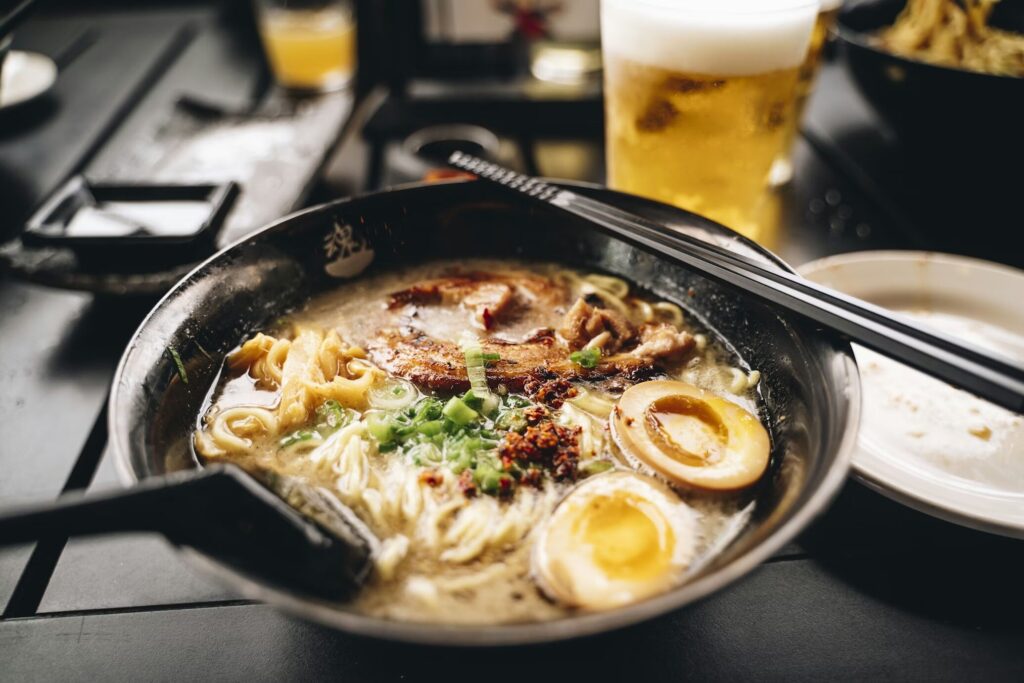
A bowl of ramen can look almost bare: noodles under a clear amber soup, a few slices of pork, an egg, and green onion. Yet beneath that surface are layered stocks, seasoning sauce, floating oil, and a preparation time measured in hours rather than minutes.
A bowl arrives at the table. A film of fat covers the surface and steam rises from it. The color of the soup differs by shop — sometimes a clear amber, sometimes a milky white opacity. The noodles lie submerged, and on top of them rest chashu pork, a soy-marinated soft-boiled egg, and sliced green onion.
It looks simple. It is not simple. Before this bowl reached the table, multiple stocks were layered, a seasoning sauce was incorporated, oil was floated on the surface, and toppings were chosen. The soup alone may have taken anywhere from several hours to more than a full day to prepare.
What ramen is — attempting to answer that question, one finds that the dish can be entered from any direction.
An Unfamiliar Experience That Begins with Sound
The first shock a foreign visitor receives inside a Japanese ramen shop is often not the flavor. It is the sound. The continuous noise of customers drawing noodles through their lips fills the interior without pause. The more a person comes from a culture where eating quietly is understood as courtesy, the more disorienting this is. The person at the next seat is making a large, unhesitating noise. No one around them appears to notice.
This is not a breakdown of manners. Drawing hot noodles forcefully into the mouth together with air causes the aroma to pass through the nasal cavity. The act of slurping has settled into place as the correct technique for eating this dish. The sound is a byproduct of full immersion.
Ramen is not Chinese noodle cuisine, and it does not belong to the lineage of pasta. A noodle culture that arrived from the continent during the Meiji period underwent a series of mutations within the Japanese landscape and became something else entirely. It has roots in China, but it evolved along a separate path from Chinese cuisine. Where sushi moved in the direction of stripping away ingredients to the extreme, ramen went in the opposite direction — accumulating umami, layering it, concentrating it. Stock is drawn, seasoning sauce is added, oil is introduced, toppings are placed. Multiple processes and multiple ingredients coexist within a single bowl. That directional difference is close to the essence of what ramen is.
A Bowl Rising from the Black Market
When the history of ramen is recounted, the Raiiraiken in Asakusa, established in 1910, is often cited as the starting point — a shop where a Chinese cook served Chinese-style noodles, regarded as one of the early forms of ramen in Japan. But the view that the form closest to what exists today was born in the chaos of the postwar period is deeply held.
Black markets appeared on the burned-out street corners of a defeated Japan. In a time of scarce goods and inadequate food supply, what the stalls offered were noodles made from cheap wheat flour, and soup produced by simmering the bones of pigs and chickens — the carcasses that would ordinarily have been thrown away — for long hours. This was not fine food. It was what laborers working in the rubble needed: cheap, hot, and filling. Calories and temperature were everything that ramen was asked to provide at that time.
The turning point came in 1958. That was the year Nissin Foods’ Ando Momofuku invented the product he named Chikin Ramen — the first instant ramen. Noodles were fried in oil, dried, and sealed in a bag with powdered soup. Pour in boiling water and eat in three minutes. Through this invention, ramen was separated from the craftsperson’s hands. It could be stored and transported anywhere. It could be mass-produced in a factory. The dish that had lived in the steam of stalls was transformed in that moment into an industrial product that could sit on a shelf. It would later become space food, and would be exported to every part of the world.
The Structure of Accumulated Umami
Looking across the noodle dishes of the world, most construct their flavor through salt, spices, and herbs. Vietnamese pho carries the aroma of star anise and cinnamon. Thai pad thai is built on the sourness of fish sauce and tamarind. Both approaches place aroma and stimulation on top of the ingredients. Dishes that ask the soup itself to carry complex umami are comparatively rare.
Japanese ramen moved in a different direction — toward an obsession with dashi. Pork bones, chicken carcasses, dried sardines, kombu, dried shiitake mushrooms, vegetables — ingredients from both land and sea are simmered together for anywhere from several hours to more than a full day. The umami components contained in each ingredient differ. Pork and chicken bones carry high concentrations of inosinic acid; kombu and vegetables carry glutamic acid. When these are combined, the umami is said to amplify not additively but multiplicatively. This chemical interaction is one of the reasons ramen soup arrives at a concentration dense enough to be satisfying to drink on its own.
Why this degree of fixation on dashi? One interpretation involves the relationship with rice culture. For a long time, the center of a Japanese meal was rice. Within a structure organized around rice, with side dishes and soup and pickles arranged around it, a soup that is thin serves no function. For the broth to work as a dish in its own right — as something worth drinking alongside rice — it required a concentration and depth of umami capable of holding its own against the rice. The structure of ramen, in which the soup is the protagonist despite being a noodle dish, may have emerged partly from this demand placed by rice culture.
Four Bases, and the Boundaries That Are Dissolving
Ramen has traditionally been described as having four bases: soy sauce, salt, miso, and tonkotsu pork bone. This classification has long served as the basic framework for discussing the dish. Every shop belonged to one of the four, and customers chose within that set. There was a period when that was genuinely the case.
Soy Sauce
Soy sauce ramen is the most widely eaten form the dish has taken. Stock drawn from chicken carcasses, pork bones, or seafood is combined with a soy sauce seasoning tare. The soup is clear and a chicken oil or similar fat floats on the surface. The aroma is high, and the umami of soy sauce spreads through the mouth at the first sip. It was born in Tokyo and spread across the country. All other bases have been compared to this one, consciously or not. It is the form closest to the standard of ramen.
Salt
Salt ramen is the most primitive form. The seasoning tare is salt alone, and the color of the soup is the palest of all four — a transparent liquid in which the quality of the stock is directly visible. If there is any off-flavor, it appears immediately. If the ingredients are weak, there is no way to conceal it. Shops that make salt ramen are therefore said to exercise the most care in selecting ingredients and drawing the stock. It developed its own distinct form in coastal cities such as Hakodate. The affinity between fresh seafood culture and salt as a seasoning is not difficult to understand.
Miso
Miso ramen is said to have been born in Sapporo in the 1950s. Hokkaido winters are severe, and the body needs to be warmed through with calories. In response to that need, fermented miso was combined with large quantities of animal fat. The soup turns white and opaque, and a thick film of oil covers the surface. The fact that butter and corn became standard toppings also follows from the same climatic necessity. Of the four bases, this carries the highest density as a food. A single bowl warms the body and fills the stomach. As cold-climate food, the structure makes practical sense.
Tonkotsu
Tonkotsu ramen was born in Kyushu. A large quantity of pork bones is simmered in hot water over high heat for a long time. The collagen and fat inside the bones dissolve into the liquid, and it turns milky white. This emulsified soup is the defining characteristic of the style — white, thick, creamy, and carrying a distinctive animal smell. Walking through Hakata, there are points where the quality of the air changes. The smell of pork bone, sharp in the nose, announces the presence of a shop from several dozen meters away. The noodles are extremely thin and cling well to the soup. The kaedama culture — adding fresh noodles partway through the meal — also arose from the intensity and addictive quality of this broth.
Where the Four Boundaries Stand Now
This classification has been losing its outlines in recent years. The Iekei style, combining tonkotsu and soy sauce, emerged in Yokohama. A concentrated broth merging seafood stock and pork bone spread through the world of tsukemen dipping noodles. Tori paitan — a broth made by simmering chicken bones until it turns white — was recognized as an independent genre. None of these sit comfortably within a single base. The number of bowls that are more accurately described as belonging to none of the four categories is growing. The four traditions are now engaged in countless crossings, and they continue to change in advance of any attempt to classify them.
The Black Market Fuel That Became Craft Work in New York
There was a time when ramen was the synonym for a cheap and fast meal. A few hundred yen filled the stomach, and the eating was done in minutes. That was all ramen was asked to be.
From the 2000s onward, the same dish began to be received in an entirely different context. In New York, London, and Paris, Japanese ramen specialty shops started opening. A bowl was priced at the equivalent of two thousand to three thousand yen. More than double the going rate in Japan was not uncommon. Lines formed. Reservations filled.
Western culinary culture carries an existing framework for long-simmered stock. French fonds de veau involves simmering beef bones and vegetables for many hours. Italy has its own brodo tradition. Liquids that a craftsperson has spent time producing have been respected in those contexts as sauces and bouillon. When ramen soup was received within that framework, it was understood as the work of a craftsperson — a dish for which one pays in proportion to technique and time.
Sushi is difficult to sustain abroad without local fish and trained specialists, but ramen soup can be frozen and exported. The operation can be standardized in a manual and local staff can be trained. For the Japanese restaurant industry, ramen has become one of the most deployable dishes available.
The Counter as Apparatus
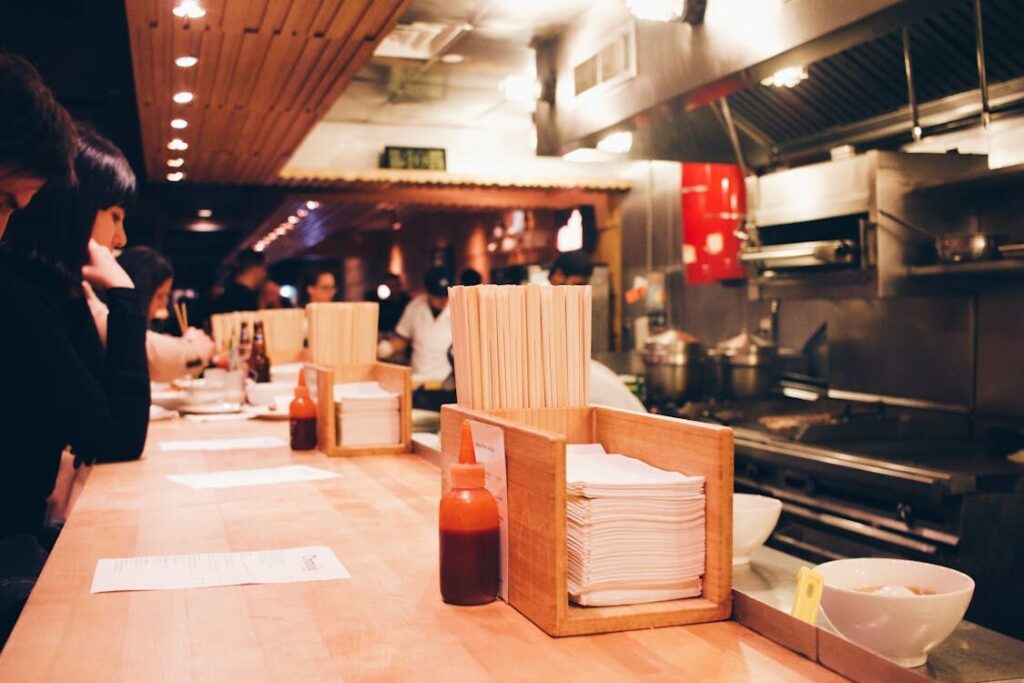
The majority of Japanese ramen shops are organized around counter seating. A row of seats runs around the kitchen and customers sit facing into it. There is no table between customers facing each other. The design does not encourage conversation between neighbors.
Once seated, the customer watches the craftsperson in motion directly in front of them. Soup is ladled from a large pot. Noodles are dropped into boiling water. After a fixed interval, a basket is lifted and the water is shaken off — an action called yu-giri, the draining of the hot water, which drives out excess moisture while incorporating air into the noodles, performed at angles and speeds that differ by craftsperson. Soup is poured into the bowl, the noodles are lowered in, toppings are placed, and the bowl is complete. The entire sequence is finished in somewhere between thirty seconds and one minute.
A French restaurant is designed as a space for enjoying conversation. Service takes time. Explanation accompanies each dish. Glasses are raised and talk continues. Food is a vehicle for sociability. The ramen counter is at the opposite end of that spectrum. The customer faces the bowl and concentrates on finishing before the noodles absorb too much liquid and soften. There is a time limit. Conversation with the person next to them is not anticipated. This enforced period of focused attention may be at the core of what the ramen experience is.
Why a Dish Without Prestige Does Not Stop Evolving
Soba has traditions that are to be preserved — whether the noodle is made from pure buckwheat or a blend, whether it is hand-cut or machine-cut, how the stock is drawn, how the condiments are used. For each of these, a form that is considered correct exists, and pressure operates against deviation. Tempura is similar — oil temperature, the thinness of the batter, the sequence of frying. A body of technique that craftspeople are expected to master is present.
Ramen has none of these constraints. There is no authority anywhere that can definitively say this is the correct ramen. Tomatoes can be added to the soup. Cheese can be melted in. The soup can be foamed into an espuma. Butter can be introduced, curry mixed in, citrus squeezed over — and no one can rule that any of this is not the real thing.
Ramen therefore continues to change. A bowl made with Nordic ingredients has appeared. Vegan-compatible soups have been developed. Something that is neither Japanese nor Chinese has materialized inside the bowl. The definition carried by the word ramen continues to expand outward. Some say that within this dish there is a freedom — a space where Japanese people can experiment without the weight of prestige. Whether this is true cannot be confirmed. That the evolution has not stopped is, however, a fact that can be observed.
— Detour —
a little further to walk
- Notes on Japanese Tonkotsu Ramen
- Notes on the History of Japanese Tonkotsu Ramen
- Notes on the Overseas Path of Japanese Tonkotsu Ramen