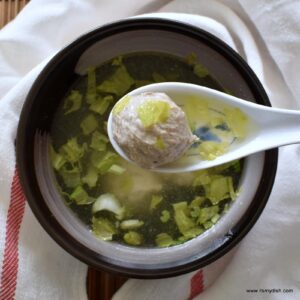
Notes on Gongwan Soup in Taiwan
In Taiwanese lunch shops, gray pork balls drift quietly in clear broth beside more assertive dishes. They look soft enough to collapse, but the first bite meets a springy resistance before breaking with a sharp snap.
In Taiwanese lunch shops, gray pork balls drift quietly in clear broth beside more assertive dishes. They look soft enough to collapse, but the first bite meets a springy resistance before breaking with a sharp snap.
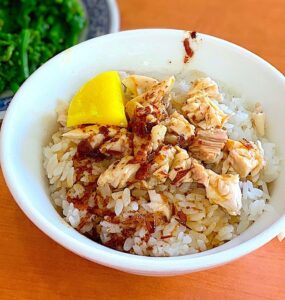
In Chiayi, a bowl labeled chicken rice may be topped with shredded turkey, while farther north the same name usually means chicken. The rice, oil, sauce, and meat remain recognizably the same even as the bird changes.
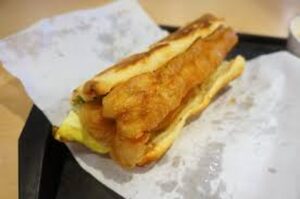
Before sunrise, Taiwan’s breakfast stalls put a fried strip of dough inside a flaky baked one, then serve the bundle with soy milk. The result is a meal built from wheat, oil, and almost no moisture.
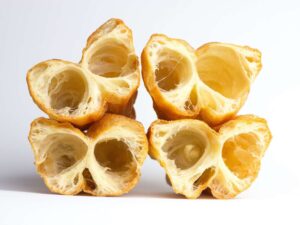
At a Taiwanese breakfast shop, youtiao may arrive as little more than a hot, hollow strip of fried dough beside a bowl of soy milk. Its crisp shell changes almost immediately once it meets the liquid, and the breakfast around it is built to catch that moment.
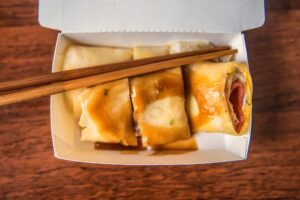
At a Taiwanese breakfast counter, dan bing may arrive on a paper plate with a soft, elastic skin—or a crisp wrapper that fractures at the edge. The egg is familiar in both, but the bite and the sauce can change noticeably from one city to the next.
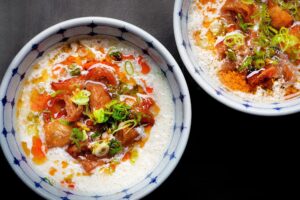
At Taiwanese breakfast stalls, hot soy milk is given just enough vinegar to stop being a drink without becoming tofu. The bowl trembles with pickled vegetables, dried shrimp, scallions, and torn youtiao, held together by a texture that can easily slip out of balance.
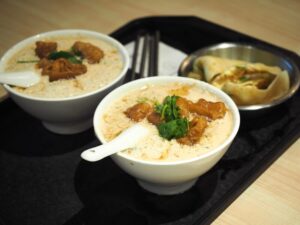
At a Taiwanese breakfast shop, soy milk arrives in a bowl rather than a glass, with vinegar leaving it soft and loose instead of liquid. Beside it, a hollow stick of fried dough changes weight and texture as it soaks.
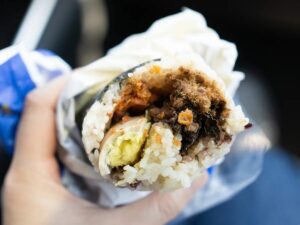
At a Taiwanese breakfast stall, a rice roll that resembles onigiri is built around a dry, twice-fried stick of dough rather than a filling of fish or vegetables. Wrapped tightly in plastic, it can sit in one hand while the morning moves on.
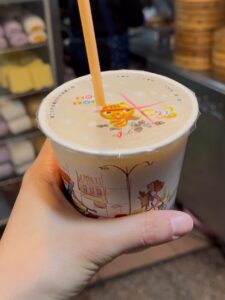
At a Taiwanese breakfast counter, a sweet white drink arrives beside fried dough, flaky flatbread, or an egg crepe, often ordered with no pause. It can be hot, cold, or merely left at room temperature, but it remains the quiet constant in a meal built around oil and wheat.
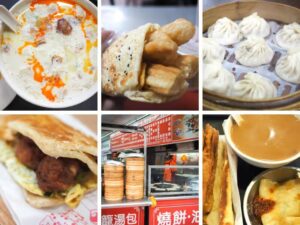
A Taiwanese breakfast menu can place a rice ball, a hamburger, a radish cake, and French toast within the same crowded frame. Even the drinks—soy milk, coffee, black tea, and milk tea—leave no clear boundary between one tradition and the next.