The birth and evolution of a clouded white broth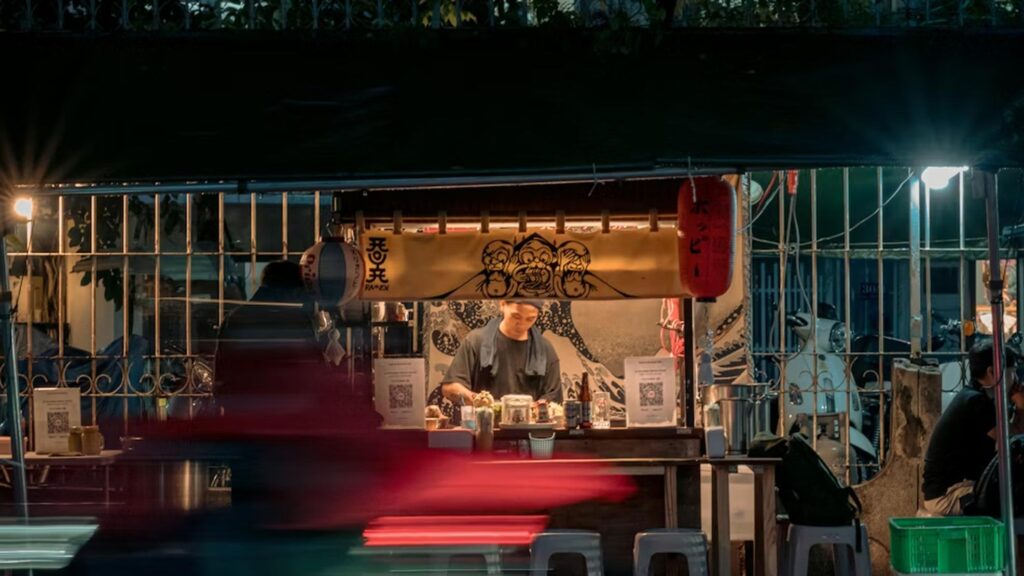
In Japan’s dashi tradition, transparency has long been held as a mark of quality. Broth drawn from dried bonito and kombu maintains a clear, unclouded color. The earliest soy sauce ramen existed as an extension of this sensibility. The soup was expected to be translucent, ideally clear enough to see the bottom of the bowl. Cloudiness indicated impurity — something introduced by careless cooking or insufficient preparation, treated as evidence of failure. Against that standard, tonkotsu ramen (pork bone ramen) appeared strange. White as milk, opaque enough to conceal the bottom of the vessel entirely. It chose opacity within a culture that valued clarity. The question of why this form was not merely tolerated but embraced with intensity is where the history begins.
The Tonkotsu Lineage within Japanese Ramen
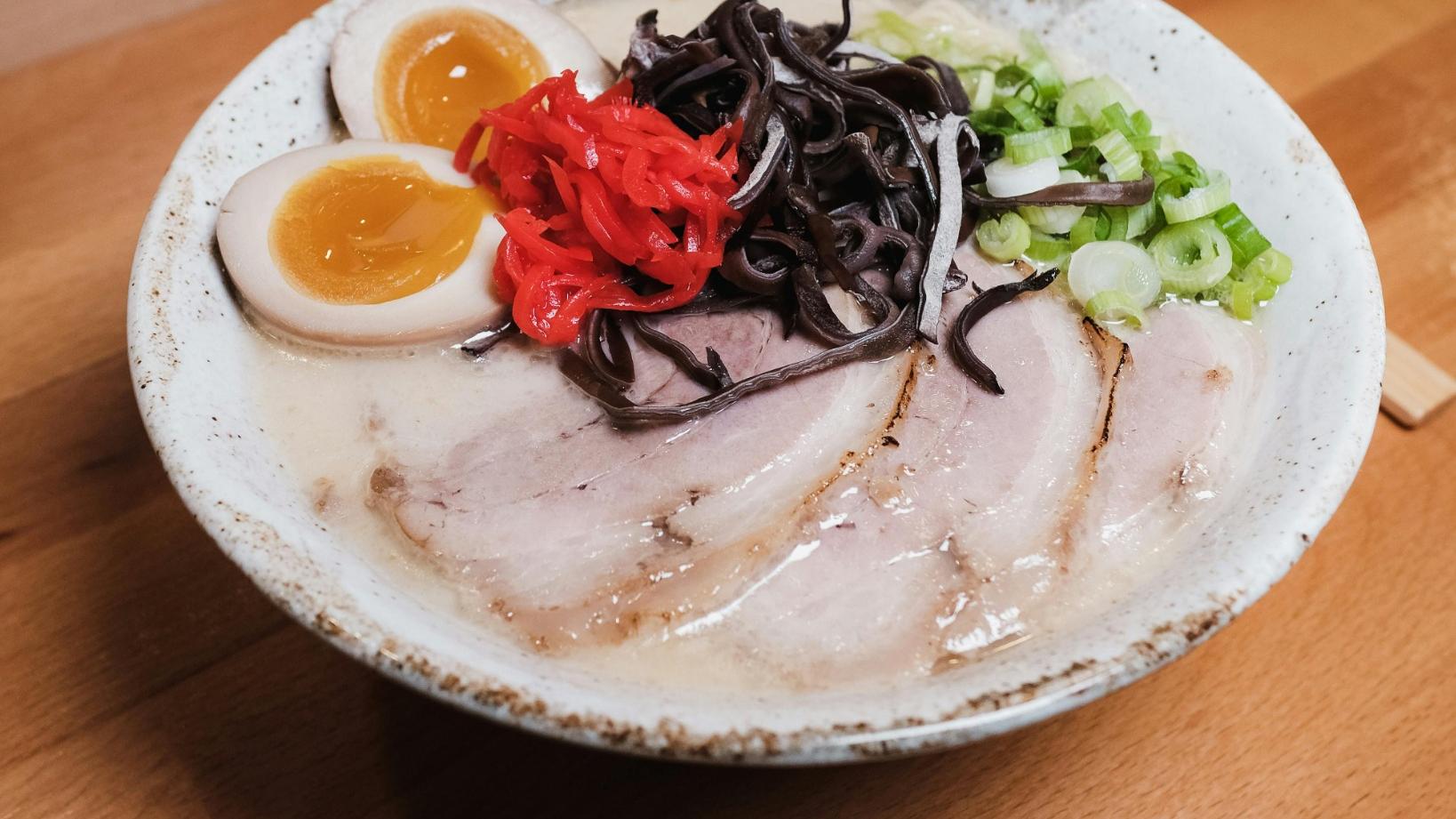
Tonkotsu ramen belongs to one current within the broader flow of Japanese ramen. It is the lineage that pushes animal-based broth to an extreme, alongside soy sauce, salt, and miso. Where most ramen has been built on a foundation of transparent stock, tonkotsu carries turbidity from the outset. The material is pork bone — not the meat, but the bone itself, simmered at length to draw out fat and dissolved matter. What results is a white, opaque liquid, the direct opposite of a clear broth in appearance. The direction of flavor is also different: weight over delicacy, density over aroma. Within Japanese ramen culture, tonkotsu has consistently occupied the position closest to the body. It developed as the lineage that prioritized nourishment and fullness above all else.
Beginnings in Kurume, Close to Clarity
The birthplace most commonly cited for tonkotsu ramen is Kurume city in Fukuoka Prefecture. The stall called Nankin Senryo is frequently referenced in this account. The soup of that period, however, bore little resemblance to what is known today. It was not white. What is recorded suggests that the broth, simmered over low heat, was only slightly clouded — closer in appearance to the clear soy-seasoned soups of the time. The completed form known as tonkotsu ramen had not yet arrived. Behind it was the role of food for laborers: using cheaply available pork bones to fill the stomach. The influence of Nagasaki champon — a noodle dish built on animal-based broth — is also said to have reached the region at the same time. The idea of using such broth was already present in the surrounding area. The bowl that appeared in Kurume seems less a radical invention than a practical product adapted to its environment.
The Pot Left Boiling
The turning point came in 1947, at a shop in Kurume called Sanku. One day, the owner left the kitchen and left the heat management to his mother. She forgot to lower the flame, and the pot continued to boil at high heat for an extended period. When the owner returned, the liquid he found was unlike anything he had seen before. The soup had turned white and the fat and water had merged together. Under ordinary circumstances, such a result would have been discarded as a failure. A taste was taken instead. The richness of the bone marrow had been drawn out with unusual force, and the concentration was unlike anything produced before. The accidental overheating had triggered emulsification — fat and water had bonded, and the white opaque broth had appeared. This was the first appearance of what would become the defining form of tonkotsu soup. It did not arise from a calculated technique. It began as a mistake.
Transformation through City and Market
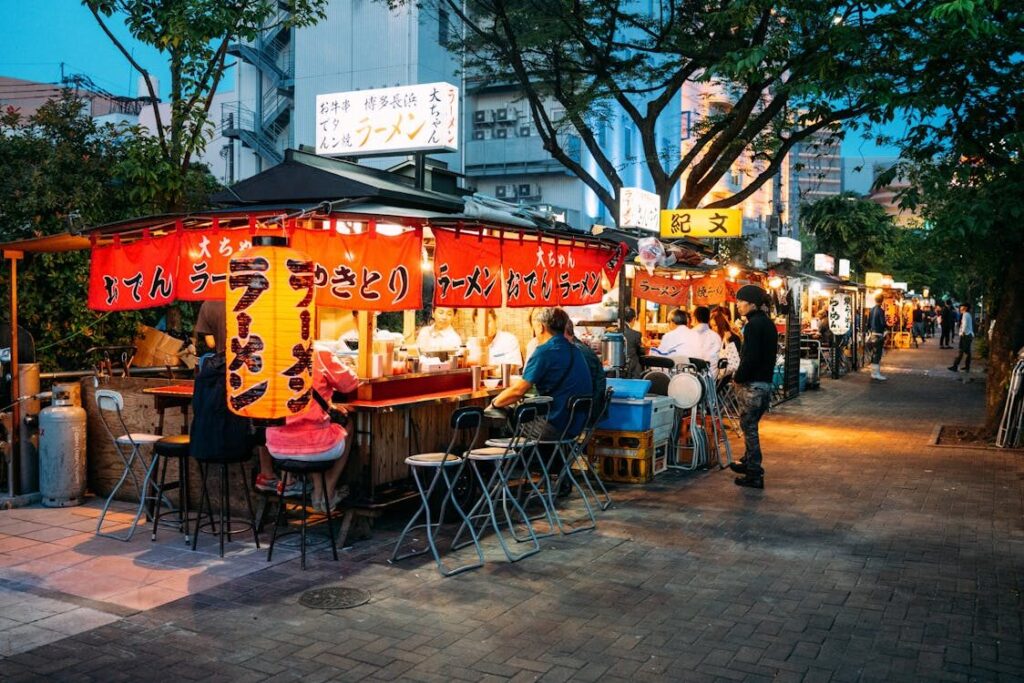
The white broth did not remain in Kurume. It traveled to the larger city of Hakata, and from there spread to the area around the Nagahama fish market. There the environment changed everything. At the market, the time available for eating was extremely short. Workers needed to fill their stomachs between auction rounds. Speed became the first priority. In Kurume, the noodles had maintained a relatively standard thickness. In Hakata, to reduce cooking time to a minimum, the noodles became extremely thin. Alongside this, the kaedama system was developed — rather than increasing the quantity at the start, a portion of freshly boiled noodles would be added partway through the meal. The concentration of the soup was inherited from Kurume. The speed of the noodle was refined in Hakata. These two elements combined, and the basic form of contemporary tonkotsu ramen took shape.
Friction in Tokyo
In the late 1980s, tonkotsu ramen moved into Tokyo. The shop Nandenkanden, which appeared along the Kanjana highway loop, became the symbolic presence of this expansion. Tokyo’s mainstream at that time was soy sauce ramen — clear broth and restrained aroma were the standard. Into that context arrived a tonkotsu soup with an intense animal smell. The odor spread far, and complaints came from nearby residents. It was reported in some cases as a nuisance incident. But the collision also functioned as an attraction. In the heat of the bubble economy, young people drove to the shop late at night. The concentrated fat and aggressive smell were consumed as stimulation, experienced as something close to addiction. At this moment, tonkotsu ramen transformed from a regional staple into an element of urban youth culture. A practical food from a provincial city had become a marker of a subculture.
The Process of Refinement
For a long time, tonkotsu ramen carried a coarse reputation. The strong animal smell. The grease left on the floor. Its identity as food for working men. What changed that were two shops that appeared in the 1980s: Ippudo and Ichiran. Ippudo began with the space itself. Jazz played in the interior. Wood-toned finishes were used. An atmosphere was constructed that differed from street stalls and mass-market diners. Simultaneously, the treatment of the soup changed. Methods for thoroughly eliminating the unwanted smell from the bone were introduced. The concentration was maintained, but the roughness was removed. The result was a shop that a woman dining alone could enter without hesitation. Tonkotsu ramen had moved from practical food into urban consumer culture. Ichiran reconfigured the act of eating itself. Customers sat in partitioned seats and faced their bowls in a structure designed for concentration. Separated from the gaze of others and from conversation, the meal became a kind of experience. A red sauce made with chili peppers was added, introducing variation into the flavor. A layer of stimulation was placed over a broth that might otherwise become monotonous midway through, and customers progressed through the bowl adjusting it to their own preference. Through these two directions, tonkotsu ramen was repackaged. Its raw energy was preserved, but only the surface was refined.
Reinterpretation Overseas
From the 2000s onward, tonkotsu ramen spread internationally. Ippudo and Ichiran were again at the center of this movement. The style that became dominant abroad was neither soy sauce nor salt, but tonkotsu. The reason appears to lie in accessibility of understanding. Japan’s dashi tradition is built on subtle differences. Grasping the layering of kombu and bonito without prior experience is difficult. The white opaque tonkotsu soup, by contrast, is received in a different frame. Potage. Bisque. It connects to existing sensibilities around thick, rich liquid. The weight in the mouth and the smoothness of the fat are understood immediately. The addition of noodles allows it to be received as a new form rather than an unfamiliar one. The animal smell that once provoked reactions had been moderated through advances in preparation technique. Intensity remained, but discomfort was removed. The description that settled into place was rich and creamy. What had once been characterized as rough was absorbed into the vocabulary of refinement. The price range also changed. A bowl at roughly twenty dollars was accepted. It was no longer daily food but a dish one goes out deliberately to eat. Tonkotsu ramen had been redefined as the work of a craftsperson.
A Different Species Born of Mixture
The evolution of tonkotsu did not only occur abroad. It also spread in different directions within Japan. In 1974, a new combination was attempted in Yokohama. The pork bone broth of Kyushu was joined with the soy sauce tradition of Tokyo. This eventually became the lineage known as Iekei ramen — white opaque soup carrying the saltiness of soy sauce, with chicken oil added for aroma. The flavor became more defined and assertive. Thick noodles were paired with it. Nori and spinach accompanied it, and it was eaten alongside rice. The soup moved closer to a side dish than a drink in its own right. This combination was taken up by factory workers in the industrial zones. It provided both staying power and stimulation simultaneously. From this point, tonkotsu branched into numerous forms. The concentrated dipping noodle style, with fish powder added. The style associated with Jiro, piled with vegetables and back fat. Tonkotsu was no longer a single independent genre. It had become something closer to a base that supports other elements — capable of receiving any ingredient and lending it weight. It began to function as the foundation beneath the stomachs of a nation.
The White Sediment Left by Accident
If the flame had been lowered in that Kurume kitchen on that particular day, this entire sequence might not exist. The white opaque broth was not a planned invention. It was the result of a failure compounded by overheating. The hunger of laborers was layered on top of it, and the conditions of a city were added. Accident and necessity accumulated in succession. Today, fine particles of bone sometimes remain at the bottom of the bowl. They are felt as a slight grit on the tongue. They seem like evidence of how thoroughly the material was broken down — a trace of a liquid that was once destined to be thrown away and has come this far. In the history of tonkotsu ramen, the failure came before the refinement. That accident remains in the bowl, still white.