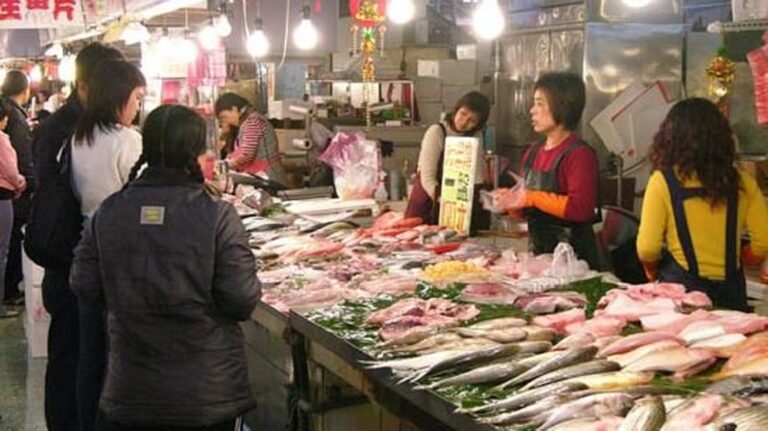
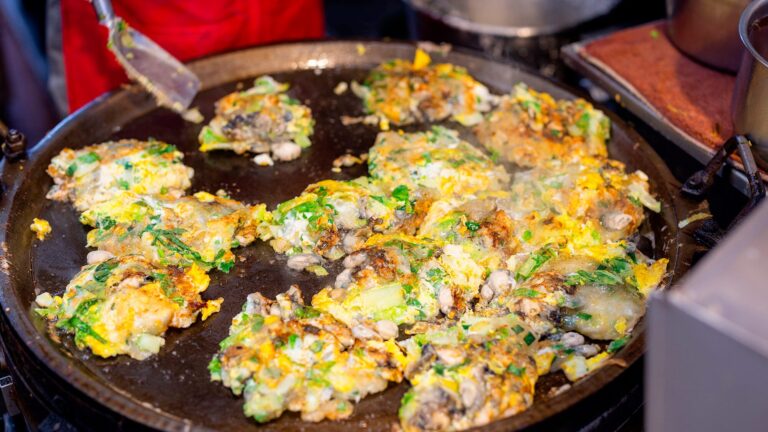
On a Taiwanese night-market griddle, the oyster omelet moves slightly as it cooks. It is neither crisp like Bangkok’s hoi thod nor nearly liquid like or suan, but suspended in a soft middle of starch, egg, and oysters.
Prologue: a viscosity called doubt
Oyster omelet, or o-a-chien, sits on a griddle in a Taiwanese night market.
It moves a little, as if breathing.
It is not crisp.
It is not liquid.
Everything is held inside a texture called Q.
I often think about this hesitation.
What if history had turned a little differently.
What if, in the Tainan lagoon, a different starch had been chosen.
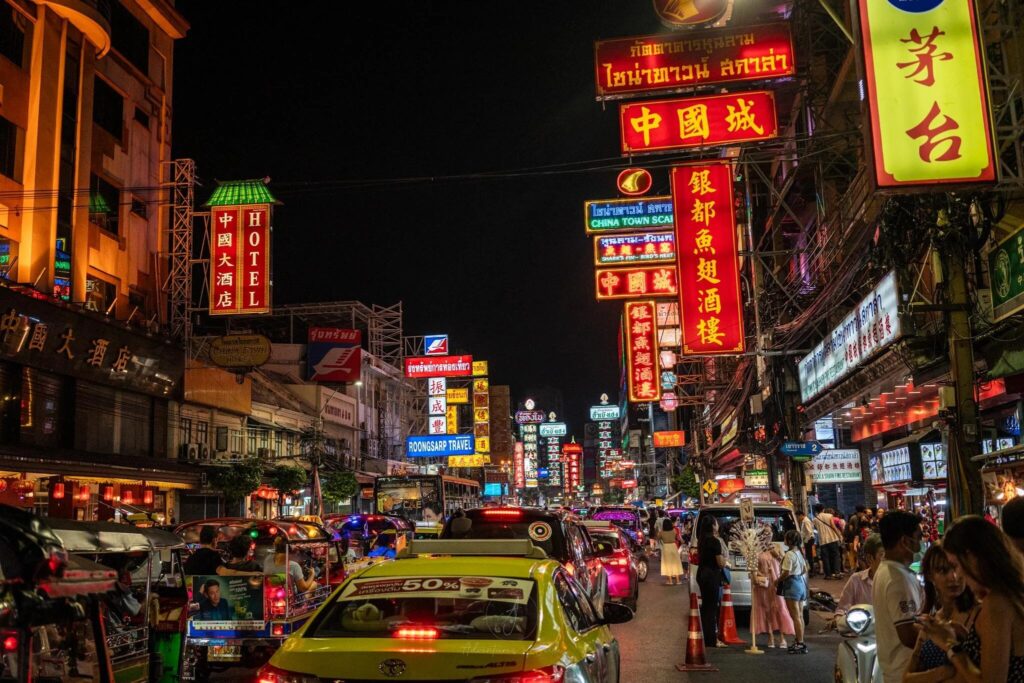
In Bangkok’s Yaowarat, among charcoal smoke and metal trays, that thought becomes clearer.
This dish seems to be looking across the sea, toward a scene it did not become.
A fork in its evolution.
Two futures on Yaowarat
At Nai Mong Hoi Thod, two forms sit side by side.
One is hoi thod.
Dry and loud.
Oil snaps.
The batter shatters like a snack.
There is no doubt here.
No need for softness.
Only sound and smell.
The other is or suan.
Starch is increased.
The boundary between liquid and solid disappears.
It can almost be poured.
Neither fully food nor fully drink.
There is a calm in that decision.
On this street, two possible futures of this dish exist without comment.

The middle that remained
Back in Taiwan, the omelet did not choose either.
Perhaps it did not need to.
On this island, food was first required to last.
Not to entertain.
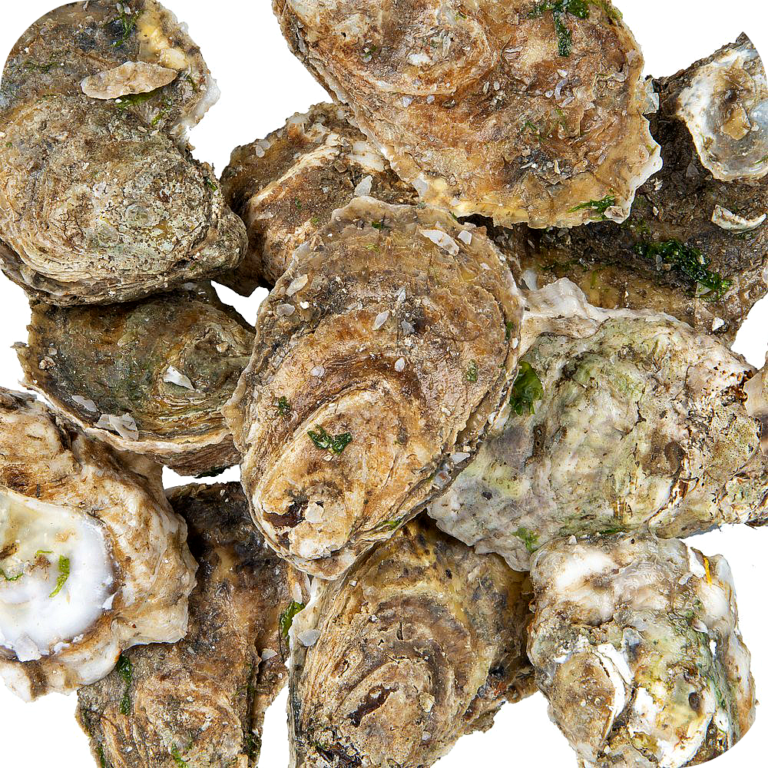
In 1661, during the siege of Tainan, oysters were plentiful.
Rice was not.
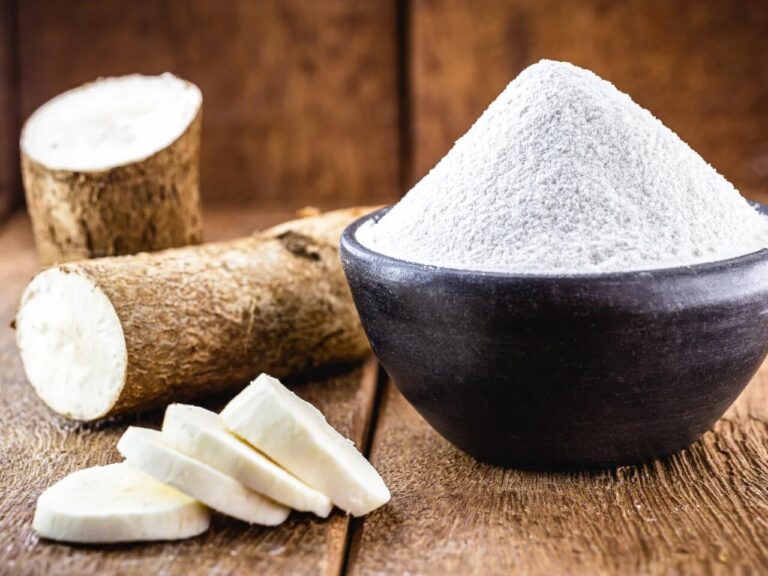
Sweet potato starch was added.
It swelled with water.
It filled the body.
It was not a recipe.
It was a system.

Why that texture stayed
In Thailand, oil and heat lead to pleasure.
Here, water and starch lead to duration.
The batter holds.
It does not break.
It does not flow away.
Crisp food dies when it cools.
Liquid food cannot travel.
This one survives.
It can be cooked in batches.
It can be carried.
It can still be a meal after time passes.
That softness is not indecision.
It is a design for difficult conditions.
Epilogue: waking in Taipei
I sit again on a plastic chair.
The plate moves slightly.
Yaowarat is not here.
Only humidity, wind, and the weight of the city.
Perhaps this dish dreams of another street.
A lighter life.
Then it wakes,
coated in starch and sweet sauce,
standing again on a Taiwanese griddle.
— Detour —
a little further to walk
- Notes on the Origins of Taiwanese Oyster Omelet
- Notes on Oyster Omelets in Taiwan
- Notes on Why Taiwanese Oyster Omelets Do Not Dream of Mayonnaise