A Small Dough That Accepts Everything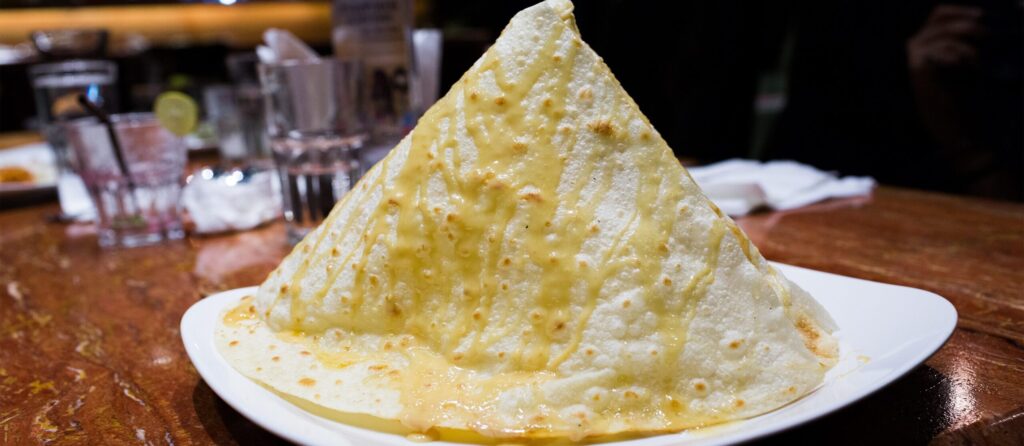
Roti canai is one of the most common items in a Malaysian morning.
The plain version, roti kosong, is only the beginning.
In front of the hot griddle at a mamak stall, a customer’s preferences become the menu.
Something is wrapped. Something is mixed in. The shape is changed.
Wheat dough accepts almost anything, like a blank surface that does not refuse additions.
In this shop, roti shifts from meal to dessert as if it were natural.
It looks less like invention than variation, produced through repetition.
Evolving as a meal
Roti canai works as breakfast not because it is light.
It seems to function as a way to settle the stomach with oil and flour.
On its own, the bread is thin.
But once something is added, weight appears.
Roti telur
This is the most common form of evolution.
With an egg inside, the dough gains thickness.
The surface stays dry and crisp, but the center holds moisture.
When you bite, it moves closer to chewiness.
It also holds curry sauce, kuah, more strongly.
If kosong is something you dip, telur is something that carries.
That density may be why it fits the morning.
It gives the body something direct, without delay.
Roti bawang
Rough-chopped purple onion is folded into the dough.
Heat turns the onion sweet, but sometimes a sharp crunch remains.
It adds rhythm to a flavor that can become too uniform.
The aroma is not strong.
Still, something changes while you chew.
Morning food has to be quick.
But it cannot be too flat.
This version feels like a small adjustment between those needs.
Roti sardin
Canned sardines are broken apart and folded in, with their tomato sauce.
It is heavy with oil and iron, and the taste is loud.
This is no longer a snack.
It carries the weight of a full meal.
Calling it fuel for dock workers might be too much.
But on a day when lunch will come late, something like this makes sense.
Turning into a sweet
Roti begins as a companion to curry.
But when the same dough turns toward sweetness, it shows another face.
From here, it moves away from hunger and closer to desire.
Roti tisu
This plate escapes the category of food and enters something closer to construction.
The dough is stretched as thin as possible and fixed into a cone.
When you break it with a spoon, it cracks with a dry sound.
The sweetness of sugar and condensed milk is simple.
What supports that simplicity is the thinness, and how quickly it disappears.
At this point, roti stops being a tool for eating.
It becomes a display of shape and sound, existing only briefly on the griddle.
Roti bom
If tisu moves toward thinness, bom moves toward compression.
It is shaped thick, like a spiral, and cooked through with large amounts of margarine and sugar.
When you bite, oil and sweetness seep out at once.
It does not melt in the mouth.
It feels more like the mouth is being melted.
As the name suggests, it is a block of calories.
Some people probably come here for this alone.
It is sweet, but not light.
The sweetness has weight.
Crossing borders: roti pisang and Thai roti
Roti pisang is a clear example of roti moving in a sweet direction.
Sliced banana is wrapped inside and cooked.
Heat makes the banana softer and more acidic.
It turns into a thick paste.
The smell is strong, and when it mixes with oil, its outline becomes blurred.
In Malaysia, it still wears the face of a side item at a curry shop.
It has not fully abandoned the role of staple bread.
From here, it is easy to look north, to Thailand.
The roti that travelers see there is almost entirely built for sweets.
Roti gluay is shallow-fried in plenty of oil, covered with condensed milk in a grid, cut into small pieces, and eaten with a skewer.
The roots are similar, but the role changes across the border.
Malaysian roti keeps its identity as bread that lives with curry.
Thai roti separates from curry and develops as a street dessert.
Even with the same dough, the environment changes the purpose.
Roti does not resist that change.
Teh tarik beside the roti
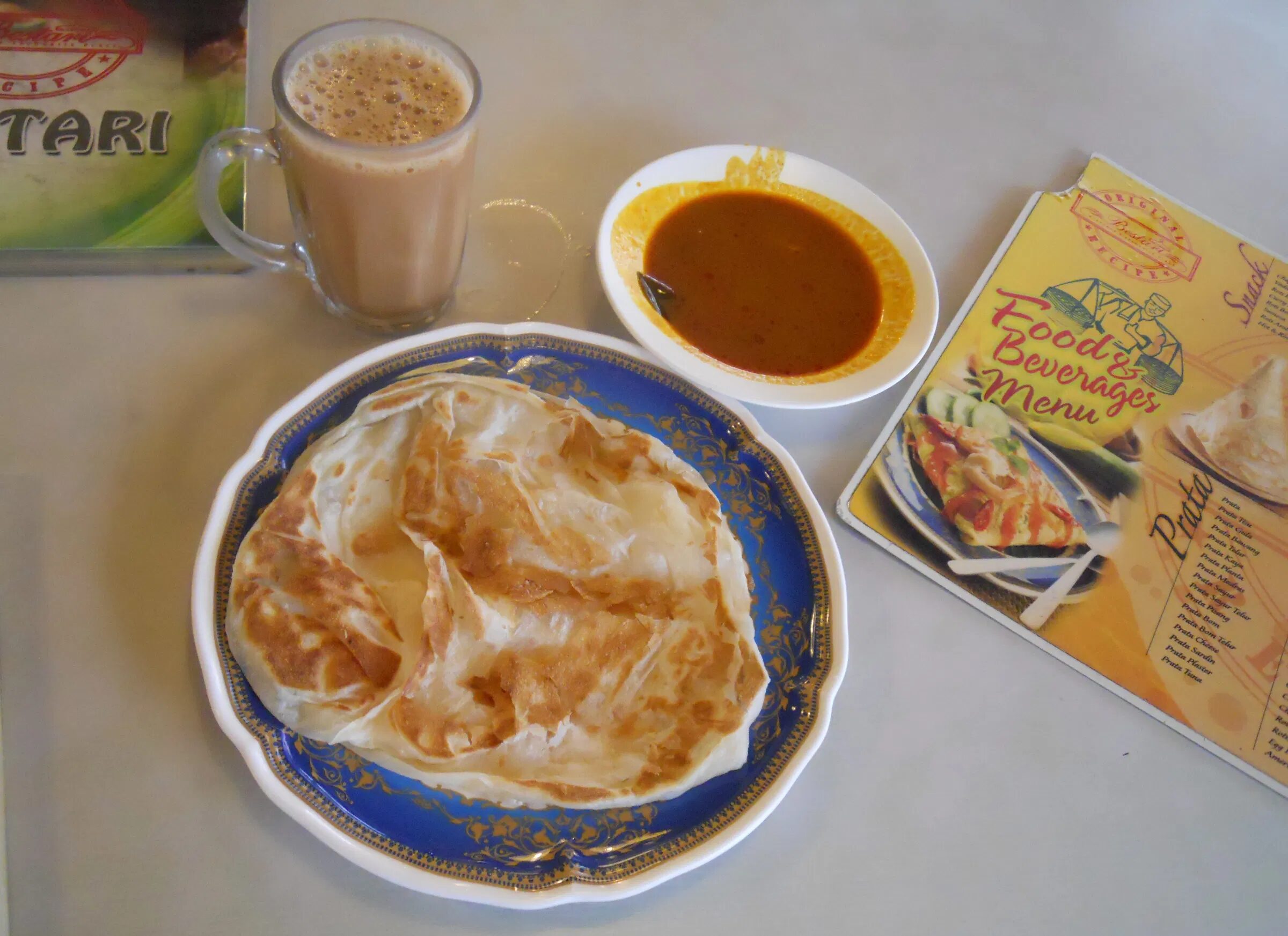
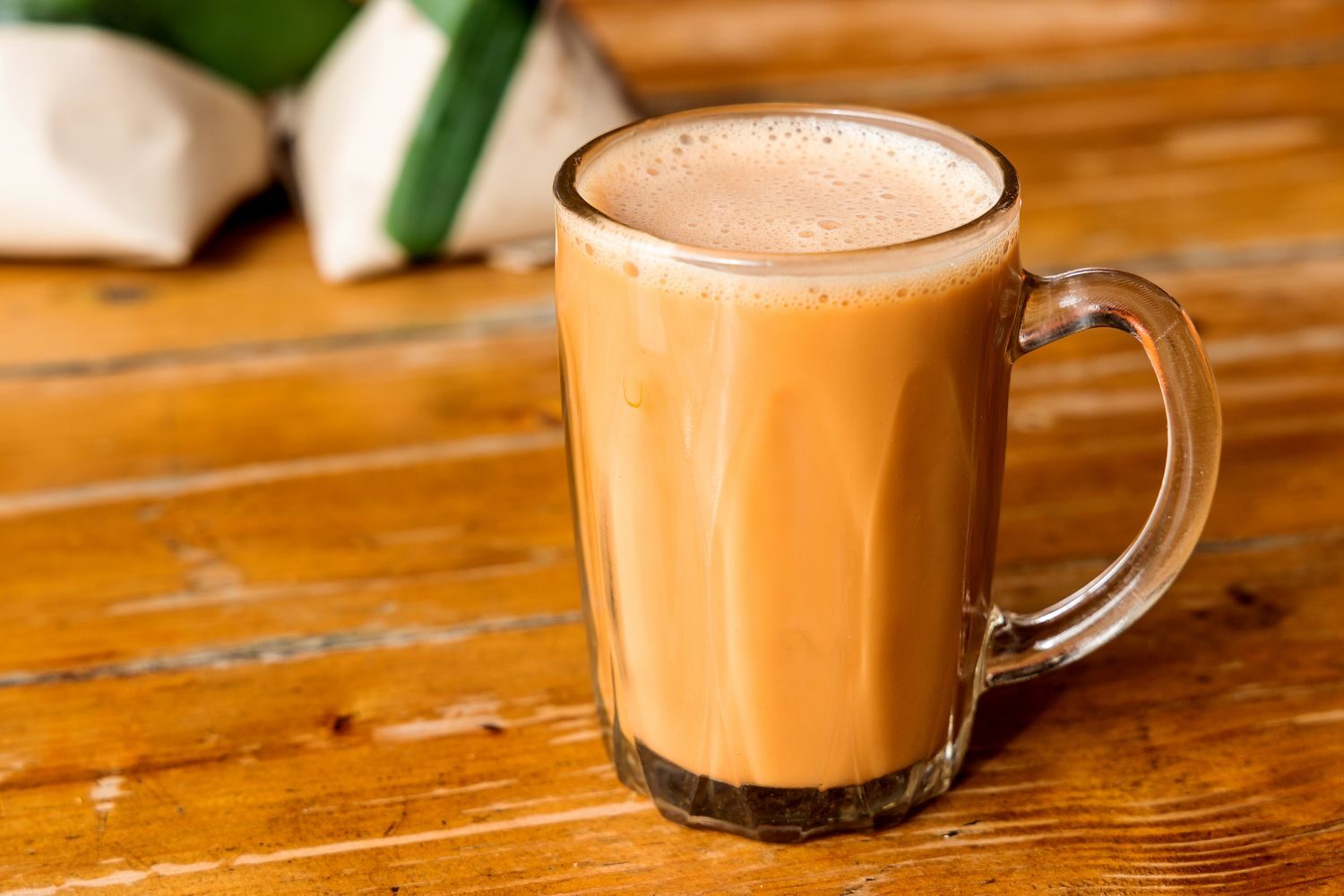
Next to roti canai, there is usually teh tarik.
It is not just a sweet milk tea.
It is a partner for oil.
The tannins in the tea tighten the looseness left by the bread.
The mouth regains its outline.
Then caffeine.
Then sugar.
It becomes fuel that can start the morning.
If roti is a mass of flour and oil,
teh tarik is what turns it into breakfast.
Shaped to fit desire
In the end, roti canai is a small unit of flour and oil, made flexible enough to meet many kinds of appetite.
To fill the stomach.
To want something sweet.
To enjoy texture.
To drop something heavy into the body.
To put something light in the mouth.
That desire does not appear in the same form every day.
Roti changes to match it.
You listen to the sound of dough hitting the griddle and decide which variation to choose today.
That hesitation may be the correct way to enjoy a mamak stall.