The yellow sign that appears everywhere
Walking through a Taiwanese city,
I notice the same colors again and again.
Yellow and red, as frequent as 7-Eleven.
The sign reads Bafang Yunji.
It is not a tourist destination.
There are no long lines, no reputation to chase.
Yet at lunchtime, students, office workers, and homemakers drift inside without hesitation.
This is less a dumpling restaurant than a secondary kitchen.
A place to enter without thinking.
A place to calculate hunger against the contents of one’s wallet.
In Japan, it might resemble a casual gyoza chain.
But here, it sits closer to daily life.
Food as fuel, chosen quickly.

Potstickers that refuse to close
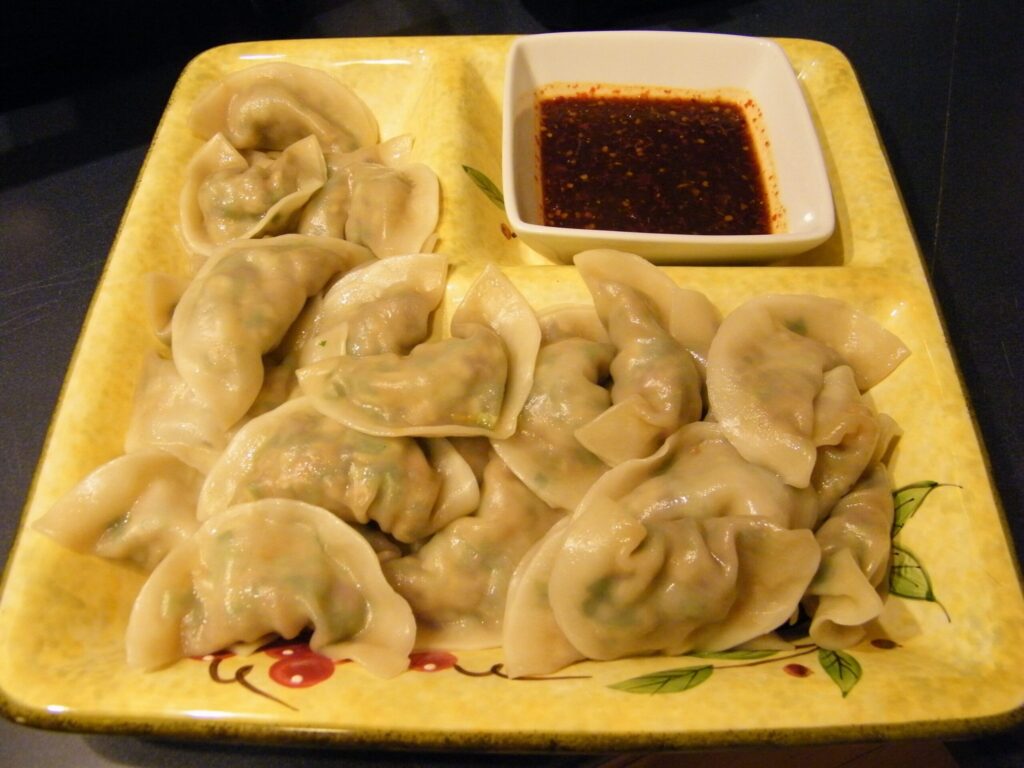
The main item is guotie, pan-fried dumplings.
They look unfamiliar to anyone used to Japanese gyoza.
Japanese gyoza are half-moon shaped.
The skins are thin.
The edges are sealed tight, designed to trap juices inside.
Bafang Yunji’s guotie are different.
Long and narrow.
Both ends left open.
As if they were never meant to be closed.
At first, this feels like a mistake.
Something unfinished.
But the shape is deliberate.
Open ends allow heat to pass through quickly.
The skin is thicker, elastic, with a clear Q texture.
The bottom crisps against the griddle.
This is not a dumpling built to hold soup.
It is a dumpling built to be chewed.
Meat flavor and skin texture take precedence.
Ordering by number
Another difference appears when ordering.
There are no preset portions.
No “six per plate.”
You order by the piece.
You write a number on the slip.
5
12
That is all.
Mixing flavors is expected.
Five standard.
Three kimchi.
Two curry.
Ten in total.
Each dumpling costs a few coins.
You buy exactly what you need.
This flexibility feels natural.
A small expression of Taiwanese pragmatism.
Soup as a necessary partner
Dumplings are rarely eaten alone.
A soup follows.
Most people choose hot and sour soup.
Thick, filled with ingredients, sharply acidic.
Oil from the dumplings is washed away by the sourness.
Back and forth, bite and sip.
Only then does the meal settle.
Some choose sweet soy milk instead.
Dumplings with soy milk, not soda.
The pairing feels ordinary here.
Dumplings that keep changing
The dumplings themselves keep evolving.
Not only the fillings, but the skins.
Yellow for curry.
Red for kimchi.
Corn appears often.
Sweet, soft, favored by children and women.
The goal is not perfection.
It is repeatability.
These dumplings are not treated as a finished dish.
They are adjusted, expanded, updated.
Food meant to be eaten often.
An existence like air
Bafang Yunji is not a treat.
It does not aim for excellence.
It aims for consistency.
The same, acceptable level.
Everywhere.
If travel grows tiring,
if famous restaurants feel heavy,
the yellow sign offers something else.
Not a destination.
Just an ordinary lunch, exactly as it is eaten every day.