A white surface that conceals heat
When the bowl is set down, the first thing I see is white.
Fish paste shaped into dumplings and simmered in a clear broth.
Slightly misshapen ovals.
Stacked in two uneven layers, like a small snowman.
The surface looks smooth and soft.
They are not perfect spheres like pork balls.
There is little sense of industrial precision.
But this whiteness is deceptive.
If I bite without care,
hot juices burst out from inside.
A small accident happens in the mouth.
Among Taiwanese soups,
fish ball soup requires the most caution.
A Trojan horse on the table
In Taipei, the common form is known as Fuzhou-style fish balls.
The outer layer is fish paste.
Mild, airy, and pale in flavor.
At the center, however,
there is a filling of seasoned pork.
Fish on the outside.
Meat hidden within.
I think I am drinking soup,
and suddenly it becomes a meat dish.
It is a Trojan horse on the table.
What the eyes expect
and what the mouth receives
do not align.

A taste carried from Fuzhou
As the name suggests, the roots lie in Fuzhou.
Along the Fujian coast,
a culture of fish paste developed early.
There is a story
that meat was pounded into paste
for the First Emperor of Qin, who disliked fish bones.
Whether this is true is not important.
What matters is simpler.
Migrants from Fuzhou
brought this taste with them to Taiwan.
Dry noodles and fish ball soup.
This pairing settled quietly
into Taipei’s everyday food landscape.
Handmade, or not
Pork balls became uniform through mechanization.
Wherever I eat them,
the shape and bounce are the same.
Fish balls are different.
Some shops still make them by hand.
The difference is easy to see.
Factory-made ones are perfectly round,
their surfaces flawless.
Handmade ones are slightly uneven.
Finger marks or spoon impressions remain.
The texture also changes.
Handmade fish balls hold air,
closer to fish cake or marshmallow.
When bitten, they seem to dissolve.
That fragility is the mark of human labor.

A north–south split
In the south,
I encounter another kind of fish ball.
Milkfish balls.
Nothing inside.
Pure fish.
They are firmer,
their flavor direct and linear.
By contrast,
Taipei’s fish balls are layered.
A mild exterior.
Fat hidden within.
For everyday eaters,
the Fuzhou style remains the standard.
Dry noodles as a counterpart
Fish ball soup does not stand alone.
Beside it,
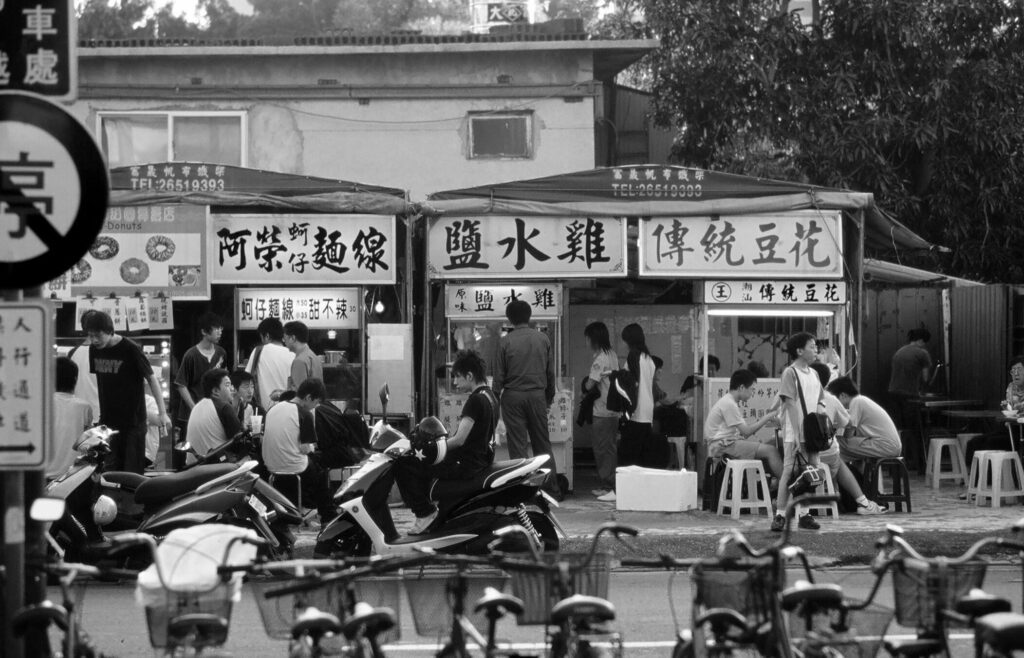
there is almost always a bowl of dry noodles.
Plain noodles,
dressed only with black vinegar and chili oil.
The white soup washes away the sharpness.
Then the juices inside the fish ball
restore a sense of fullness.
Noodles.
Soup.
Fish balls.
This back-and-forth
forms the basic shape of a Taipei lunch.
A bowl with two faces
If pork balls are about resistance,
pushing back against the teeth,
fish balls are about softness,
and concealed fat.
They look white and calm,
yet burn hot inside.
That duality
is the true nature of fish ball soup.