A Factory Called the Kitchen
When people eat at a Formosa Chang location, many assume they are in a place where cooks prepare food in a kitchen.
You place an order.
You sit down.
A bowl arrives.
The sequence looks like an ordinary restaurant.
If the viewpoint shifts slightly, another outline appears.
What happens in the back of the shop is closer to a final assembly stage than to cooking from scratch.
The essential components are produced elsewhere, in large volume.
They arrive already complete in their core form.
At the shop, they are reheated, plated, and served.
Seen this way, the store is less a place of cooking than a site of assembly and delivery.
What the Mustached Logo Signals
There is a restaurant known as Formosa Chang, a nationwide chain built around lu rou fan.
It began in 1960 as a small street stall in Taipei.
Today, it is often treated as a reference point within Taiwanese food culture.
Inside, the lighting is bright.
The floors are dry.
Air-conditioning runs steadily.
Staff move in uniform.
The flow from ordering to serving is clear.
The dish comes from the world of street cooking.
The environment, however, feels corporate.
For many people, the name signals a meal unlikely to deviate far from expectation.
It may be one of the places that gave a stable outline to a dish once defined by variation.
Yet what is notable is this:
The presence of Formosa Chang does not end at the restaurant door.
Lu Rou Fan as Taiwanese Everyday Life
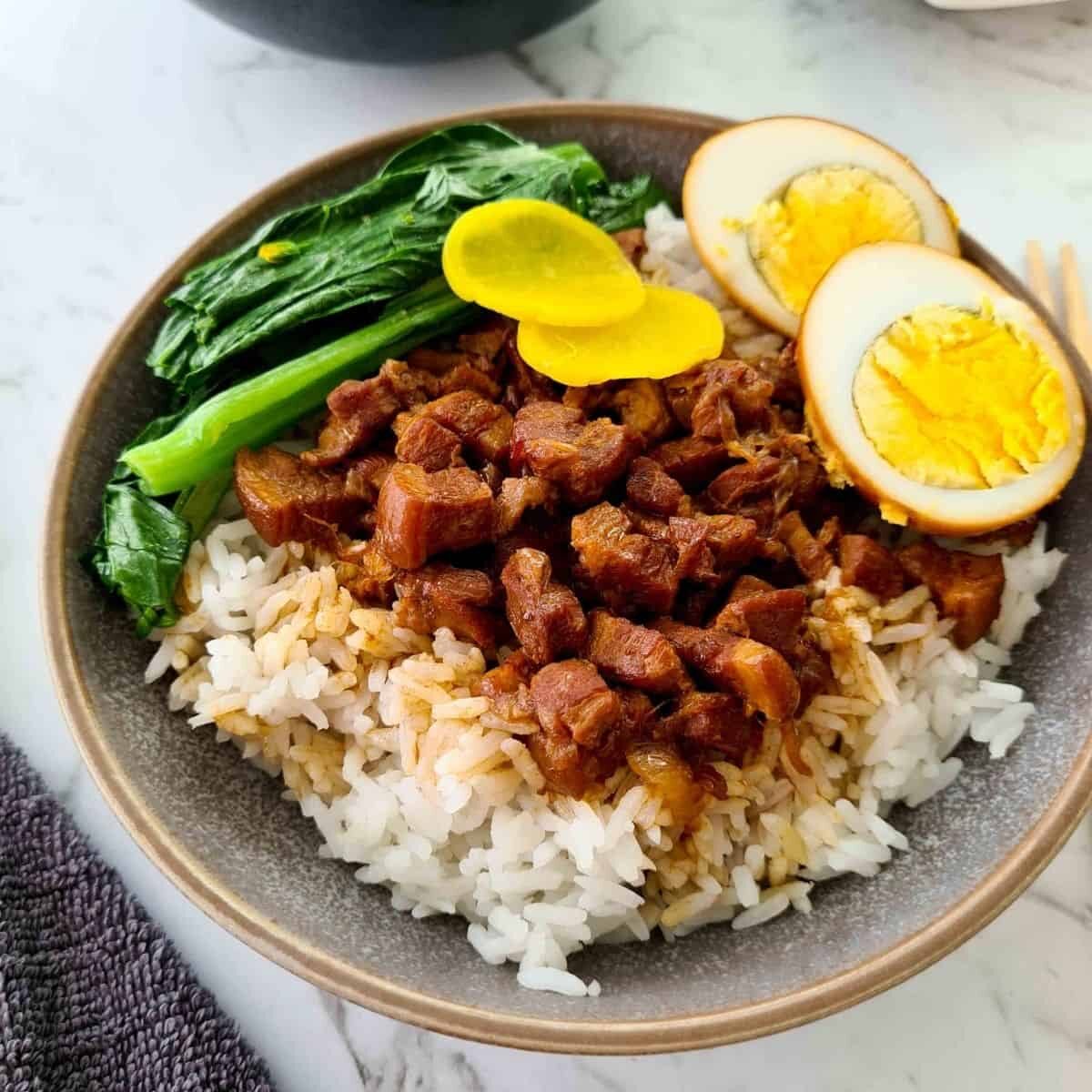
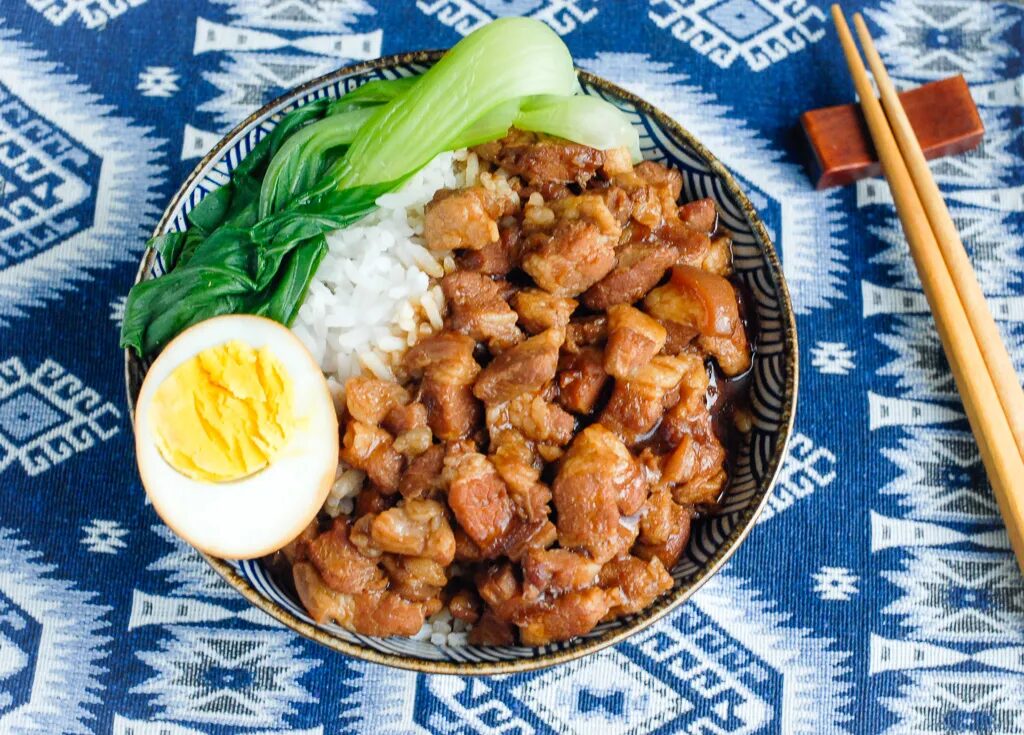
Lu rou fan is often described as a national dish of Taiwan.
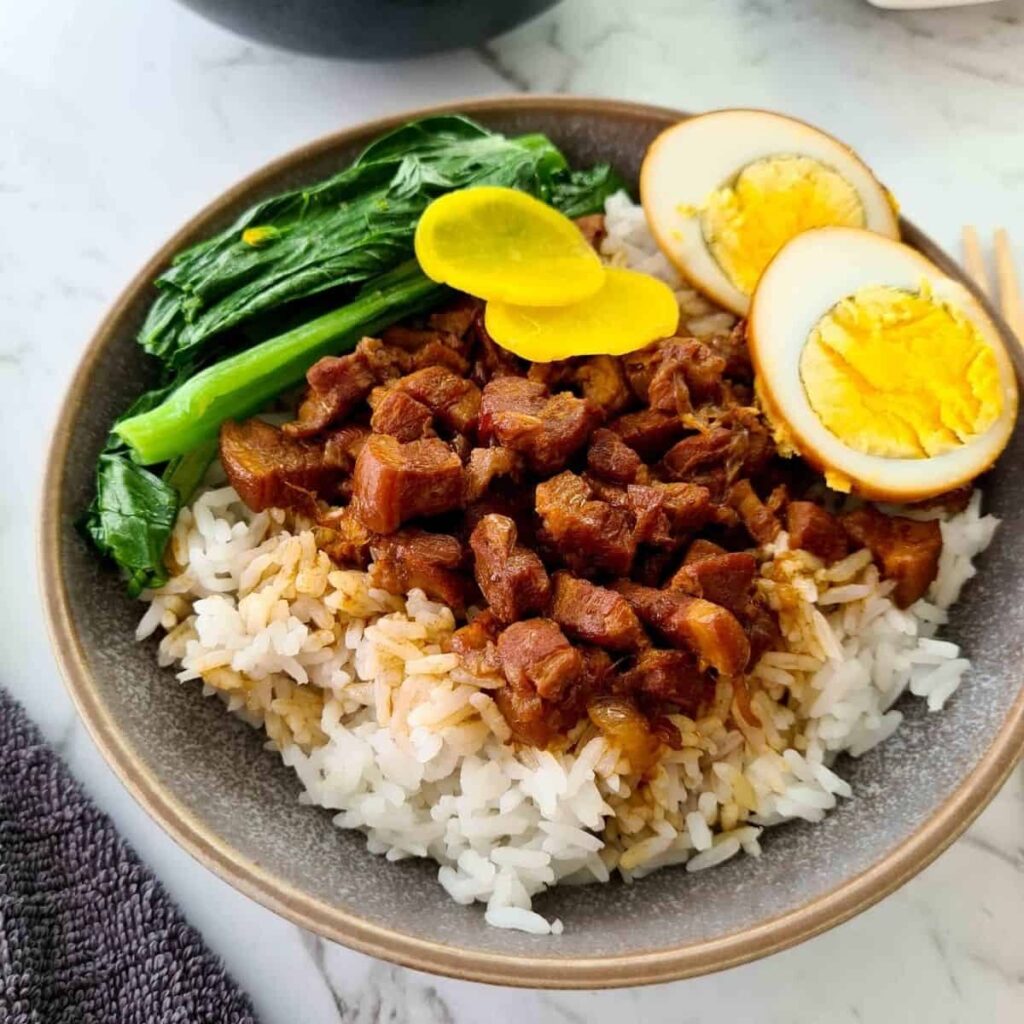
Finely chopped pork is simmered in a soy-based sauce with a restrained sweetness.
It is then poured over white rice.
The structure is simple.
Differences between shops remain visible.
The ratio of fat to lean meat shifts.
Sweetness rises or recedes.
Sometimes star anise lingers at the edge.
Even so, most people picture roughly the same bowl.
The portion is modest.
The price is usually restrained.
Some finish it alone.
Others add greens or soup and let it become a full meal.
In Taiwan, this bowl rarely marks an occasion.
It sits closer to a baseline —
something that quietly supports the rhythm of ordinary days.
The Heart in New Taipei’s Industrial Zone
West of Taipei, in Wugu District of New Taipei City, lies the chain’s core.
Within the New Taipei Industrial Park stands the central kitchen, established in 2008 and later expanded.
Inside, the scene differs sharply from what the word “kitchen” usually suggests.
Meat-cutting lines.
Large-scale braising tanks.
Rapid-freezing equipment.
Laboratories for quality inspection.
Here, products for every store across Taiwan are made.
So are items for supermarkets and even components for airline meals.
Flavor is managed in this single location.
Individual shops are only one of many destinations for finished goods.

ISO as a Shared Language
How can flavor be maintained at this scale.
Formosa Chang moved away from operations centered on individual craftsmen.
In their place came international standards:
ISO 9001, ISO 22000, HACCP.
Pot temperatures.
Salt concentration.
Braising time.
Cooling speed.
Everything is recorded and reproduced numerically.
Phrases such as “a pinch of salt” or “until ready” are not used here.
Through this translation, the system no longer depends on skilled intuition.
With equipment and procedure alone, the taste can be approximated.
Street sentiment is set aside at this stage.
What replaces it is industrial stability.
Another Factory in Japan
A question naturally follows.
Where are the Formosa Chang retort products sold in Japan made.
Where is the bowl served at the Ishikawa location prepared.
Not all of it comes from Taiwan.
In fact, there is a dedicated production site in Nomi City, Ishikawa Prefecture.
Manufacturing there is handled by Busshien, a social welfare organization focused on employment support for people with disabilities.
This is not a simple outsourcing arrangement.
The same recipes, hygiene standards, and control metrics used in Taiwan are applied.
The steady supply of products in Japan rests on the presence of this careful facility.
Retort and Frozen: A Two-Layer Structure
The product lineup divides into two main forms.
One consists of shelf-stable retort items.
These undergo pressure heat sterilization and are often used as gifts.
The other consists of frozen products.
Rapid freezing preserves the condition achieved at the factory.
Frozen distribution requires a cold chain that links factory, store, and home.
Possessing such a logistics network already places the company beyond the category of a typical restaurant.
The Day the Pot Was Set Aside
At the beginning, the founder is said to have stayed close to the stall’s pot.
He focused on the simmering,
sometimes without time even to shave.
The present company set that pot aside.
In its place stand large stainless steel tanks.
Some may find this loss of romance.
Yet because of that decision, something close to the same bowl can now be recreated
two thousand kilometers away in a Japanese household,
or ten thousand meters above the ground inside an aircraft cabin.
The kitchen became a factory.
And the bowl learned how to travel.