A quiet divide between flour, egg, and morning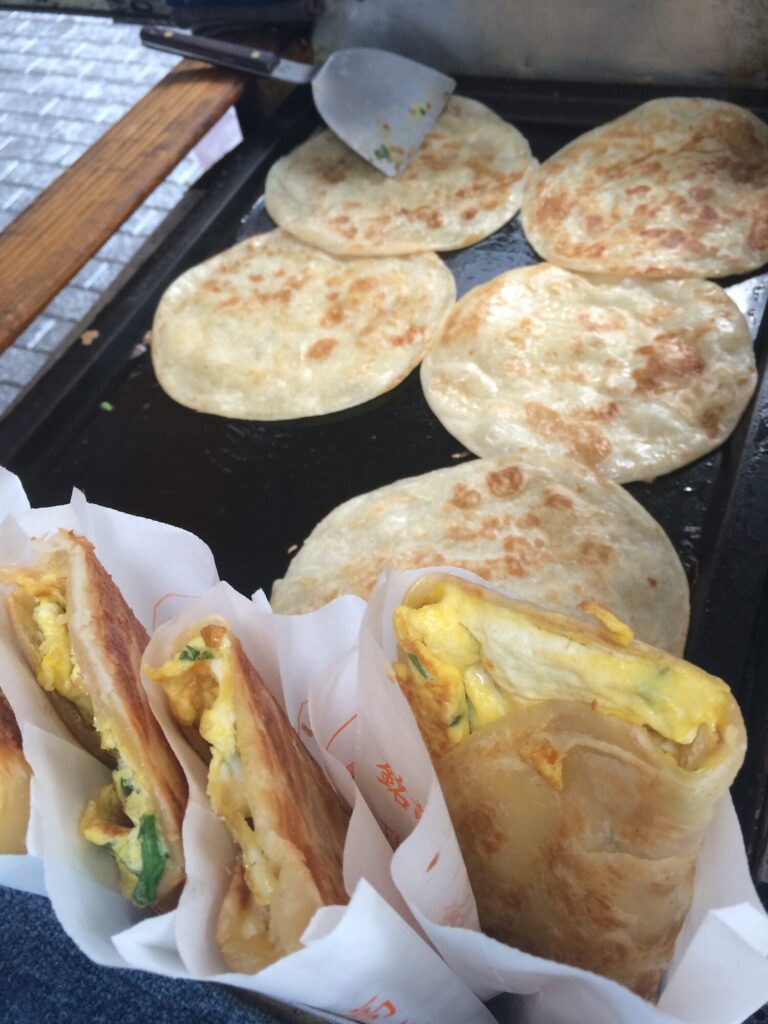
The Taiwanese scallion pancake, cong you bing, and the egg crêpe, dan bing, appear side by side on many breakfast menus.
Both use wheat flour.
Both include eggs.
Both are scattered with chopped scallions.
From a distance, they look like variations of the same thing.
Many visitors seem to order one while expecting the other.
At the griddle, the confusion grows.
A thin sheet of dough.
An egg broken on top.
Green onions dropped across the surface.
A spatula turns it over.
From a few steps away, it is not clear which name applies.
Yet when it reaches the mouth, something shifts.
The first resistance of the teeth.
The way the surface gives.
How the oil leaves the palate.
These are not small differences.
They belong to different families.
What is kneaded and what is poured
Seen as structures rather than flavors, the gap becomes clearer.
This flatbread begins as a mass of wheat flour and water.
The dough is pressed, stretched, brushed with oil, and folded.
Layers are formed.
They are rolled, flattened, and folded again.
Inside, air is trapped between thin sheets, much like pastry.
When it is cooked, the outside breaks cleanly.
The inside has a mild spring.
The smell of wheat and fat rises slowly.
The other one begins in a different state.
Flour is mixed with water into a thin batter and poured onto the hot plate.
In many shops today, a factory-made wrapper is used instead.
Either way, there is no folding.
No layers are built.
What comes off the griddle is a single smooth skin.
It behaves like a crêpe or galette.
It is meant to hold fillings, not to express itself.
1949 and a longer road
These structures reflect different pasts.
The first arrived with people who crossed the sea after 1949.
They carried the habits of colder regions, where wheat was food.
In the military villages, they kneaded, folded, and fried as they had before.
The second followed a wider, older path.
Across China, there were always thin batters cooked on hot plates.
They needed no careful folding.
They could be made quickly between other tasks.
Rather than one evolving into the other, they seem to have traveled in parallel.
How one of them changed
The thinner one adapted as cities grew.
In older markets, a ladle still spreads liquid batter across iron.
The result is soft and uneven.
Later, chains and convenience stores favored sheets that were easier to store.
Uniform thickness.
Predictable cooking time.
Less waste.
This shift made the two dishes look more alike.
It also made their differences harder to see.
Morning food and something that lasts longer
They also live at different times of day.
The layered one appears in the morning and again in the afternoon.
It is often held in paper and eaten by hand.
Its salt and scallion are enough.
The wrapped one belongs almost only to breakfast.
After noon, it fades from the griddle.
It is eaten with chopsticks.
Sauce is expected.
The skin is a vehicle.
Between two mornings
When someone wants to feel wheat and oil, this flatbread waits.
When someone wants to wake gently, the wrapped form is there.
They share ingredients.
They share a counter.
They do not share a past.
Between them, the same morning takes on a different weight.