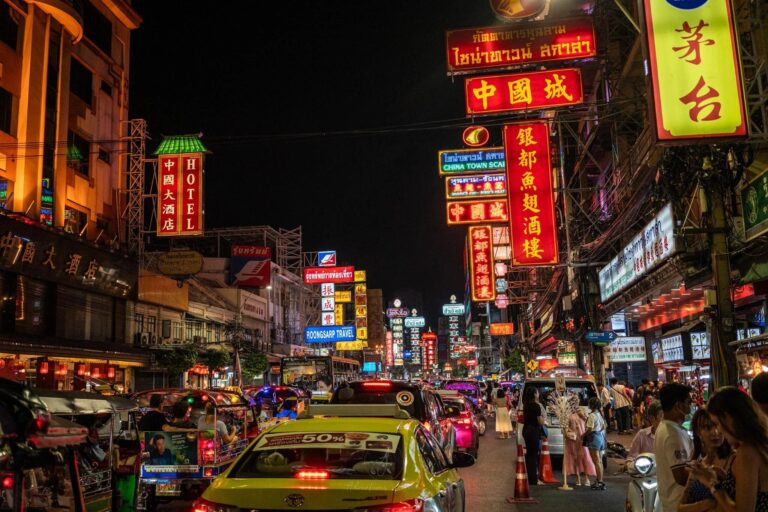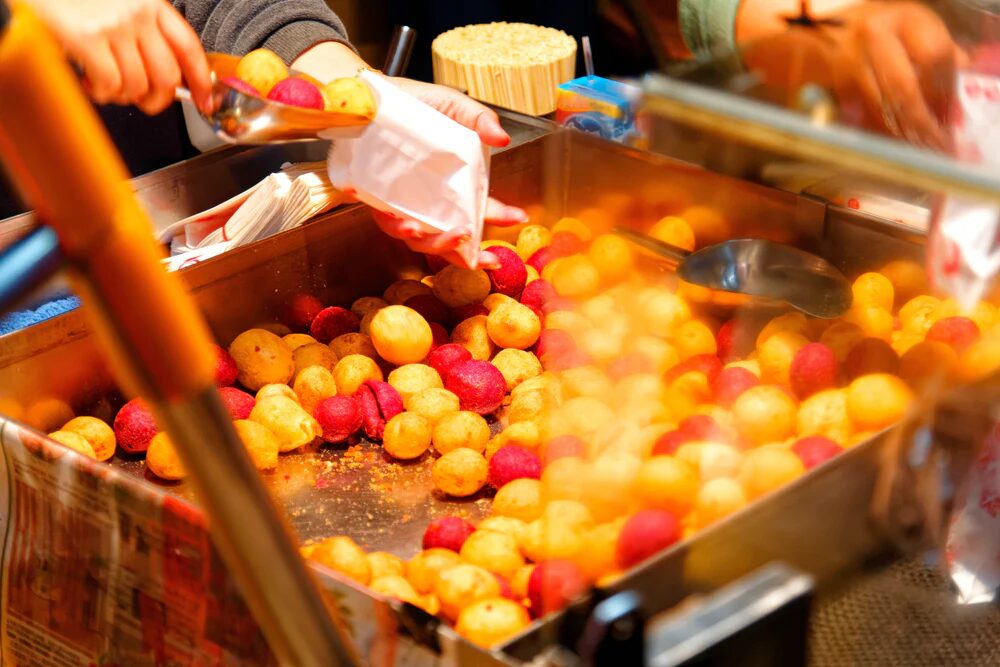
At the edge of a Taiwanese night market, a vendor presses golden and purple sweet potato balls against the wok until they seem ready to collapse. Instead, the spheres grow larger, their surfaces tightening around an empty center.
Sweet potato balls, known locally as digua qiu, are the reason a small crowd gathers at the edge of the night market.
Inside a large wok, golden and purple spheres keep moving.
Oil drains with a rough sound.
Metal scrapes against metal.
What holds the eye is the vendor’s motion.
With a wide ladle, the balls are pressed hard against the side of the wok.
They should be crushed.
Instead, they continue to grow.
Visitors watch this strange breathing,
and soon find themselves standing in line.
When Pressure Creates Expansion
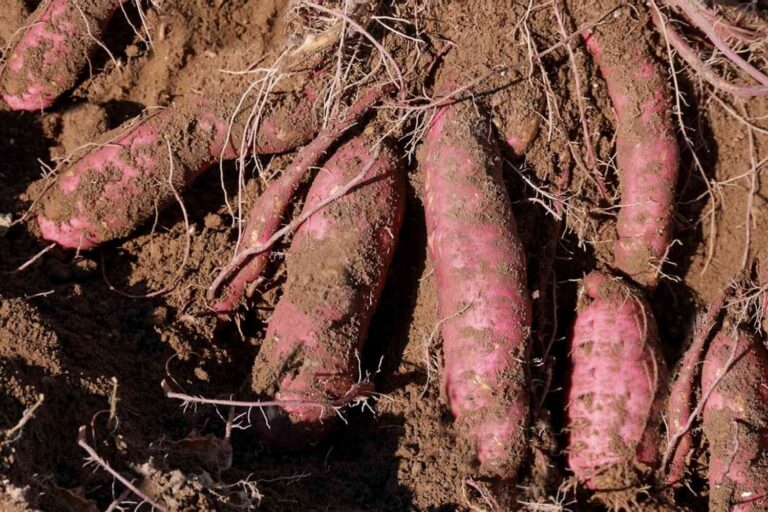
This snack is made by mixing steamed sweet potato with starch and sugar,
then frying the dough in oil.
Most fried foods are left untouched so the surface can set.
This one is handled again and again.
Heat turns moisture inside into steam.
Pressing spreads the air evenly.
Pressure builds.
When released,
the surface expands like a sponge.
By repeating this,
small pieces become the size of ping-pong balls.
The technique is sometimes called letting air in.
It is learned by experience.

Three Layers in One Bite
A fresh piece breaks with a dry sound.
Then the teeth sink in.
The center is hollow.
Just inside the skin, a thin layer resists.
It stretches and holds.
The mixture of sweet potato paste and starch
creates this tension.
Crisp on the outside.
Elastic just beneath.
Empty at the core.
These three layers form a small map
of the textures people here prefer.
From Surplus to the Street
The exact origin is unclear.
It is said to come from rural kitchens,
where excess roots were mashed, mixed with flour, and fried.
What began as a home snack
and a soft food for older people
shifted shape in the night market.
Larger.
Lighter.
More elastic.
Through this quiet competition,
the hollow form became standard.
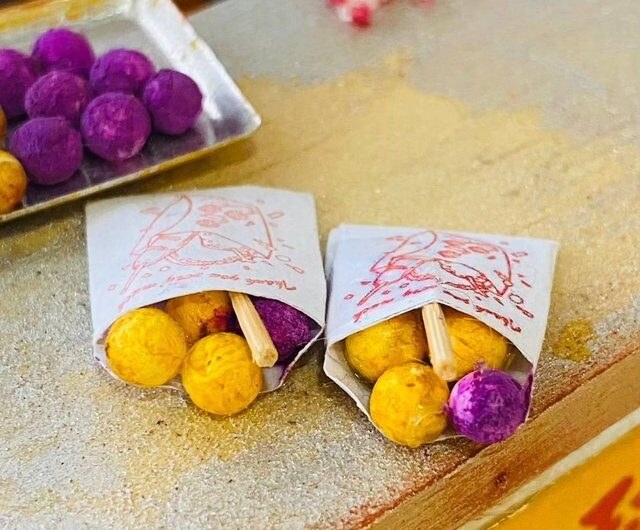
Now, purple varieties are often mixed in.
A Structure Without Filling
Sesame balls in Japan or donuts in the West
hold something inside.
They ask you to eat what is there.
This one works differently.
It offers texture and air.
It is not designed to fill the stomach,
but to occupy the mouth.
Calories matter less than how it feels when bitten.
In that choice,
a local starch culture becomes visible.
Buying Sweet Air
A paper bag fills with these spheres.
They look heavy.
They feel light.
When the bag is empty,
the stomach remains much the same.
What stays is the scent of sweet potato
and the memory of elasticity.
For a small price,
a short moment of play is exchanged.
The golden shapes expanding in oil
move in a way that resembles the night market itself.
— Detour —
a little further to walk
- Notes on Sweet Potatoes in Taiwan
- Notes on the Birth of Taiwanese Tapioca
- Notes on Oyster Omelets in Taiwan