At Taiwanese street stalls, two scallion flatbreads often begin as nearly indistinguishable rounds of dough, scallions, and oil. One leaves the griddle as a firm, even disc; the other is struck open with spatulas until its layers buckle and catch the air.
Scallion pancakes, known locally as cong you bing and cong zhua bing, appear side by side at many Taiwanese street stalls.
They look similar at first.
Both begin with wheat dough, chopped scallions, and oil.
The ingredients hardly change.
Yet the signs keep the two names apart.
The reason seems to lie in the final moments before the heat is turned off.
One stays flat.
The other is broken apart.
That last movement of the spatula decides the texture.
A shared northern memory
Both forms trace back to the same place.
The wheat-based food culture of northern China.
Dough is rolled thin.
A paste of lard and flour is spread across it.
The sheet is then coiled into a spiral, creating layers.
Up to this point, there is no difference.
The split happens only at the end.
The stillness of the flat form
In the flatter version, the dough is left to cook in one piece.
It becomes a wide, calm disc on the griddle.
When it is done, it is often cut into wedges, like a pie.
The surface remains even.
The layers stay packed inside.
When bitten, there is weight.
The wheat resists slightly.
Oil and scallion rise slowly.
It feels closer to a meal than a snack.
The motion of the torn form
The other path is more physical.
Just before it is finished, two spatulas strike the dough.
They lift, press, and pull it apart.
Metal hits metal.
The sound travels across the stall.
The layers are forced open.
Air moves between them.
The finished piece is no longer flat.
It becomes crumpled and uneven.
The texture grows lighter.
More edges turn crisp.
Sauces and fillings cling more easily.
It feels closer to something eaten while walking.
A name that points elsewhere
Many signs call this second form Tianjin style.
Yet Tianjin itself is known for a different kind of flatbread.
The name seems less like geography and more like branding.
A way to suggest an origin.
What stands on the griddle, however, looks more like a local evolution.
A version adjusted to the rhythm of Taiwanese stalls.
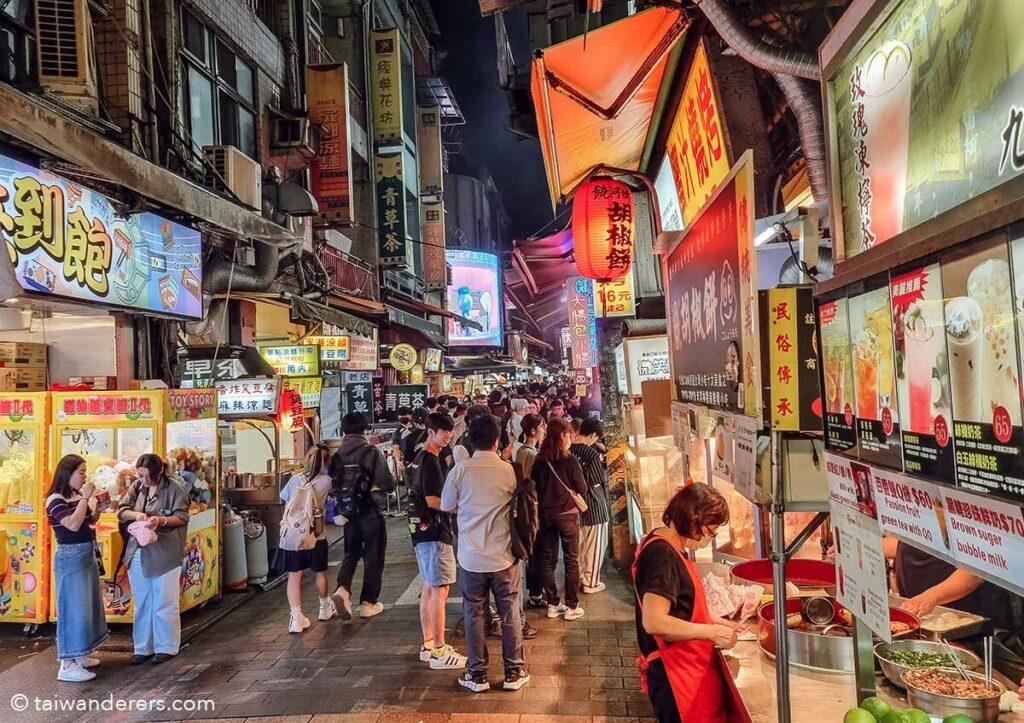
Shaped by the night market
There is no clear record of how this style emerged.
But the form offers some hints.
Air between the layers makes contrasts sharper.
Crisp and soft become easier to tell apart.
That suits a place where food is eaten quickly, often while standing.
The folds also hold fillings better.
Eggs, cheese, and ham slide into the gaps.
The dough itself becomes a set of pockets.
Oil paste between the layers lets them separate cleanly.
This matches the fast hands of vendors and the crowded paths around them.
Between weight and lightness
When someone wants to feel the strength of wheat,
the flatter form waits on the counter.
When a lighter bite is enough,
the torn version answers.
The single word zhua, to pull, marks that choice.
It signals how air is invited in,
and how one dough takes on two different lives.
— Detour —
a little further to walk
- Notes on Scallion Pancake and Egg Crêpe in Taiwan
- Notes on Taiwanese Scallion Pancakes
- Notes on Dan Bing and the Thin Egg of the Morning in Taiwan