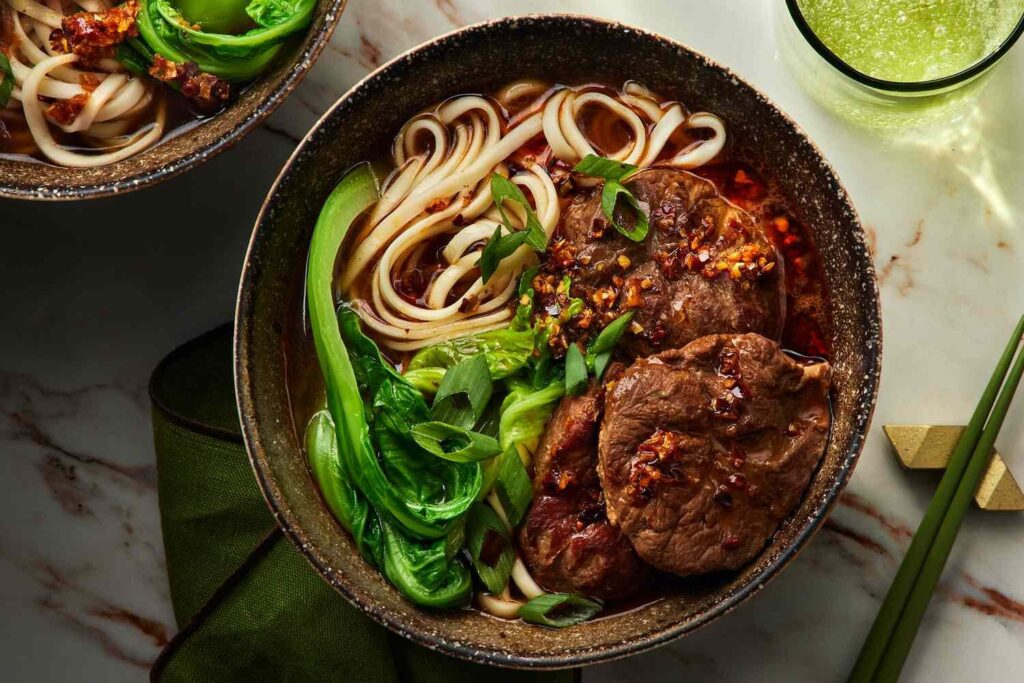
At a Taiwanese beef noodle shop, the order may continue after the broth is chosen: knife-shaved, flat, pulled, thin, or glass noodles, followed by pickled greens, chili beef fat, or garlic at the table. Under the same name, the bowl keeps splitting into different versions.
Taiwanese beef noodle soup (niurou mian) carries a specific smell.
Star anise, dark soy, and the heavy edge of beef fat.
It does not stay inside one shop.
It leaks into side streets, markets, and the corners of late-night intersections.
This dish is often treated as something special.
At the same time, it is so common that it is rarely explained.
It looks like noodles in soup.
But inside the bowl, many versions branch off.
The color of the broth, the cut of meat, the thickness of noodles, the jars on the table.
Under one sign, several worlds run in parallel.
A dish made by social change
For a long time, eating beef was not ordinary in Taiwan.
Cattle were labor.
They were part of daily work, not daily meals.
The atmosphere shifted after the war, as society moved.
After 1949, many people arrived from mainland China.
They were placed across the island and formed military dependents’ villages, known as juancun.
What they brought was not only recipes.
They brought a structure.
The heat of chili bean paste.
The weight of soy.
The thick layering of spices.
And the habit of simmering meat, then letting flavor accumulate.
There was another factor, quieter but decisive.
Wheat flour.
Postwar Taiwan saw wheat flour spread through American aid programs.
A rice island received large amounts of noodle material.
With flour, noodles could be made.
With noodles, soup had a place to land.
Homesickness and supply chains met over the same pot.
This bowl stands on that coincidence.
It looks less like an invention than an outcome.
Not a single moment of genius, but a pile of practical decisions.
Brown broth and clear broth
To understand this dish, the first split is color.
Brown and clear.
Menus often place two names side by side.
Hongshao is built on soy sauce and chili bean paste.
The broth turns dark.
Oil floats on the surface.
Spices form a thick layer, and sweetness sometimes lingers.
Qingdun is clear.
Beef bones and salt set the base, and aromatics draw the outline.
It looks light, but the scent has density.
The smell of meat is not hidden.
Even under the same name, these feel like separate dishes.
Many shops serve both.
People choose by mood.
Red today.
Clear tomorrow.
What is notable is that the city does not demand one correct answer.
Heavy and light exist side by side, both treated as daily.
Tomato as a third line
In recent years, another branch has become visible.
Tomato.
It does not fully belong to either red or clear.
The acidity cuts the weight of fat and leaves a cleaner finish.
At the same time, it adds depth rather than thinning the bowl.
This does not feel like novelty.
It feels like adjustment.
People want richness, but not too much heaviness.
Acidity does that work.
Some newer shops blend red broth with tomato.
Brown spice and red sourness share the same space.
This dish is not fixed.
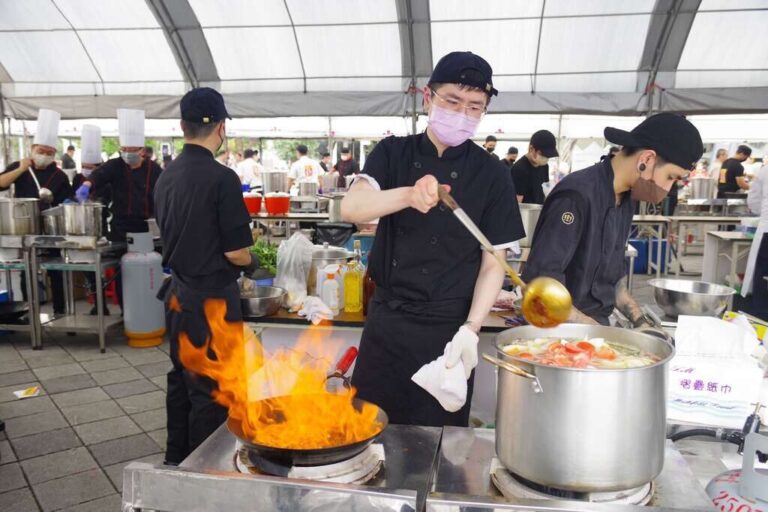
Some people point to the Taipei International Beef Noodle Festival (台北國際牛肉麵節)
as one factor behind the recent mainstreaming of tomato beef noodle soup.
In a setting where it is hard to stand out with only hongshao and qingdun,
variations like tomato and herbs are pushed forward.
And little by little,
the city seems to have gained more options as a result.

A separate path without broth
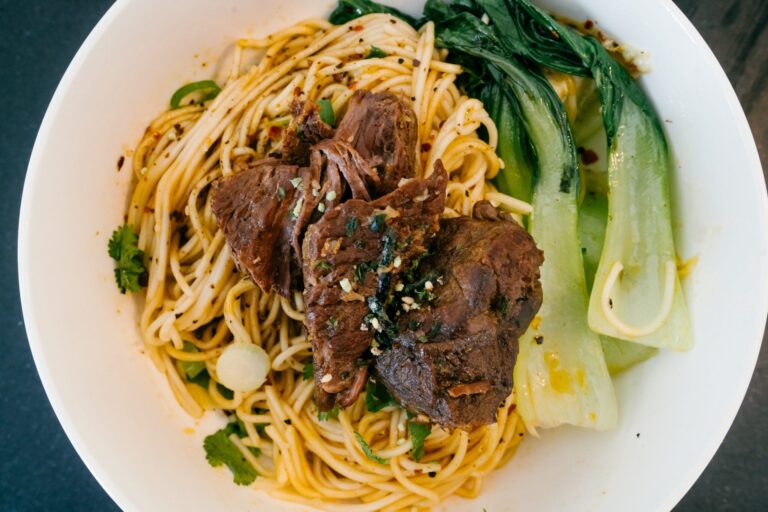
There is also a dry version.
A bowl without soup, often called ban mian.
A thick sauce sits at the bottom.
Noodles and meat are mixed into it.
Sometimes soup arrives on the side.
This is not a lighter copy.
Removing broth shifts the structure.
It becomes a dish for chewing.
Not for drinking.
The same name can hold different functions, depending on the day.
Meat served as a block
One difference stands out when compared to Japanese ramen.
The meat is not thin decoration.
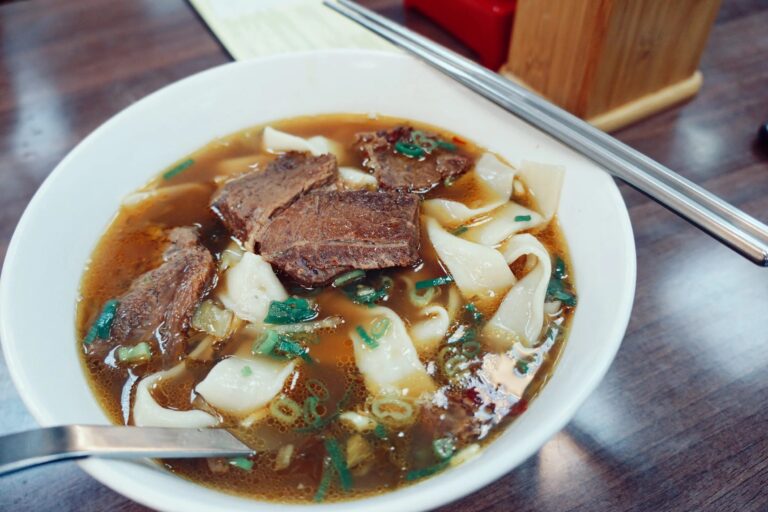
A large chunk sits on top.
The meat is placed at the center of the bowl’s structure.
Shank and tendon-adjacent cuts are common.
There is lean meat, but also translucent gelatin where tendon remains.
This dish does not chase softness alone.
It holds two textures at once.
The meat breaks.
The tendon resists.
Then both settle in the mouth.
Some people order half meat, half tendon.
It is a deliberate pairing.
Not protein, but texture design.
Noodles are often a choice
In many shops, a question comes mid-order.
Which noodles?
It may not be written.
But the staff asks as if it is obvious.
Customers answer the same way.
Knife-shaved noodles.
Flat wheat noodles.
Pulled noodles.
Thin noodles.
Glass noodles.
It looks like preference.
But it shapes how the broth is lifted.
Where chewing begins.
How much elasticity is felt.
Noodles act like a steering wheel for taste.
Pickled mustard greens as punctuation
On the table, small containers line up.
Among them, pickled mustard greens sit in a special place.
They smell of fermentation.
They bring sourness, salt, and crunch.
Many people start with a plain sip.
Then they add it.
Some wait until the second half and pour in more.
The broth stretches.
Oil becomes lighter.
The bowl shifts into another stage.
This is not a garnish.
It functions as a structural part.
Chili beef fat and raw garlic
Some shops offer chili beef fat.
A spoon changes the bowl quickly.
Heat rises.
Richness thickens.
The broth becomes something else.
Some places also bring garlic.
People bite it with the skin still on.
Spices and raw sharpness collide.
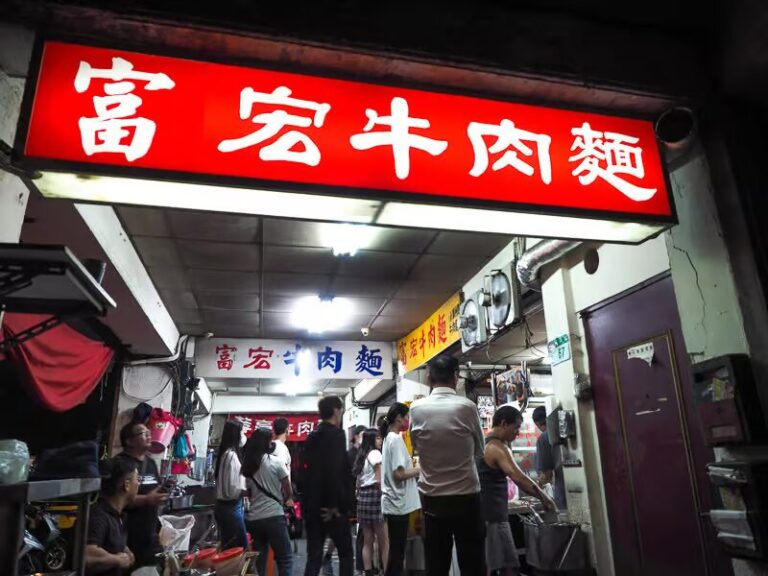
It is rough, but it fits the late hours of the city.
This dish is not finished only by the shop.
It is finished by habit, at the table, through small choices.
What this bowl is
By the time you look closely, the dish is less a single recipe than a bundle.
Broth color.
Meat cut.
Noodle type.
Table condiments.
None of it is fully fixed.
Choice remains on the customer’s side.
It began from postwar conditions.
Mainland memory, wheat flour, and simmered beef overlapped.
Then it spread, and kept simmering in many corners of the city.
People call it a national dish.
But it is also too ordinary to explain.
Inside the bowl are noodles, beef, and soup.
Around it are routines, adjustments, and the smell of the street.
It remains, holding all of that at once.

— Detour —
a little further to walk
- Notes on the History of Taiwanese Beef Noodle Soup
- Notes on Tomato Beef Noodle Soup in Taiwan
- Notes on Dry Beef Noodles in Taiwan