Before sunrise, roadside tables in Malaysia fill with small green tetrahedrons folded from banana leaves. Their contents stay hidden until the packet is opened, but coconut, sambal, and something salty have already begun to escape.
In early morning Malaysia, the city has not fully woken up yet.
The sky is not bright enough. There are few cars.
Only the roadside tables are already in operation.
On top of them, small green pyramids are stacked in rows.
More precisely, they look like regular tetrahedrons.
The folds of banana leaves form edges and hold the shape.
They are sold still wrapped.
The contents are not visible.
Only the smell escapes before anything is opened.
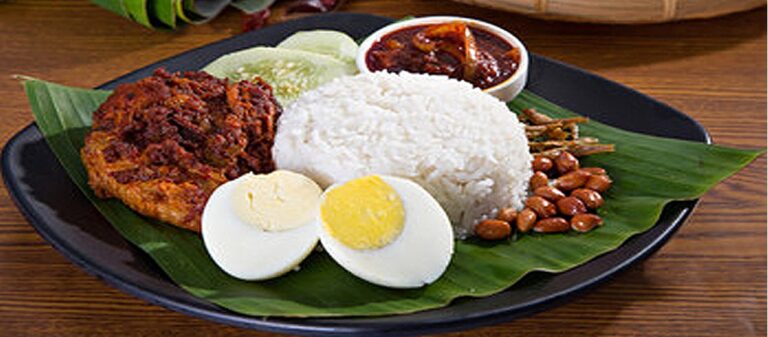
This is coconut rice wrapped for takeaway, nasi lemak bungkus.
One packet costs about one or two ringgit.
It feels like the smallest switch that starts the morning.
There are also lunch versions served on a plate, with more toppings.
But what stands out first is this original form.
A shape designed to be carried begins to look like a finished system.
What This Dish Is
Nasi lemak is a simple phrase.
Nasi means rice. Lemak points to fat, or something creamy.
If translated directly, it becomes “fatty rice.”
In practice, it refers to rice cooked with coconut milk.
Its aroma moves in a different direction from plain white rice.
When it enters the mouth, a sweet scent rises first.
Coconut comes forward, and the green sweetness of pandan leaf follows.
Then the heat collides with it.
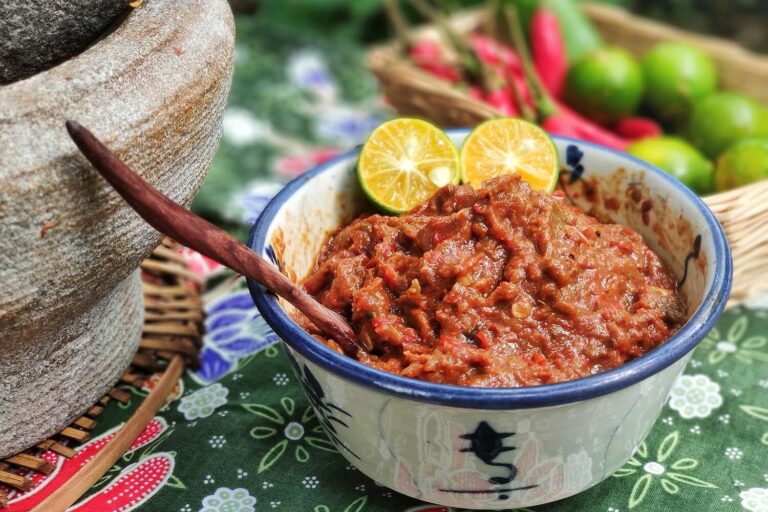
The main force here is sambal.
It carries the smell of fermented shrimp and does not soften itself.
The sweet rice is chased by sharpness.

Five Basic Parts
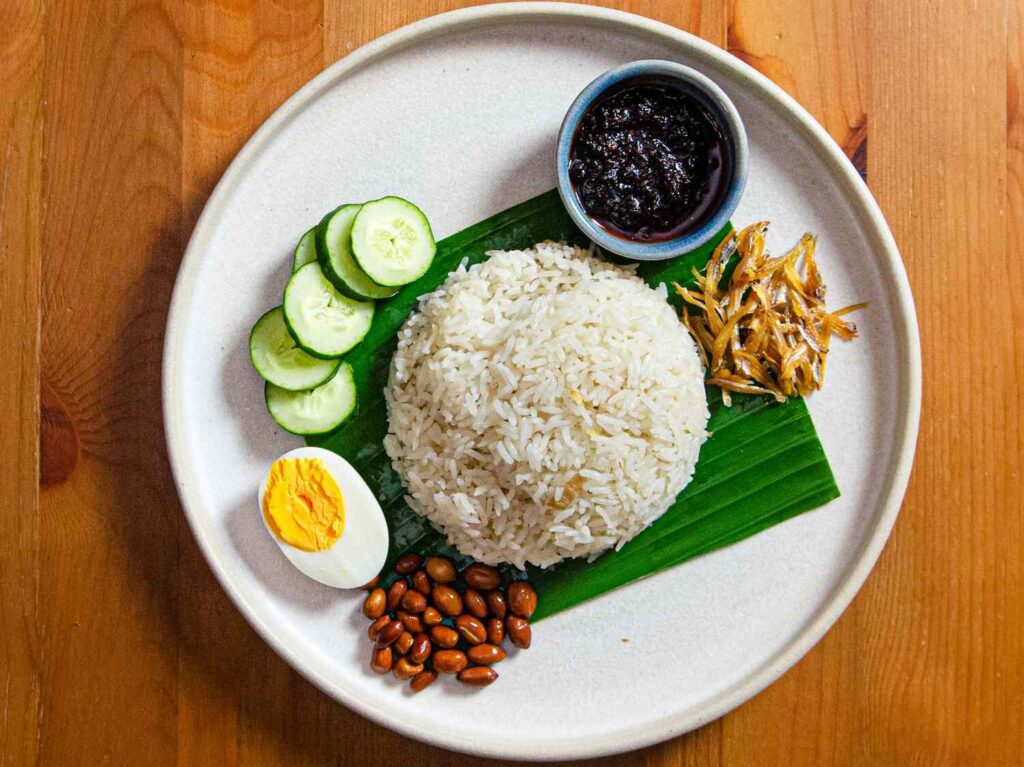
This dish has a standard layout.
Even when the shop changes, the structure appears in roughly the same form.
Coconut rice
Sambal
Ikan bilis and peanuts
Cucumber slices
A hard-boiled egg
These are not optional toppings.
They are closer to components.
If one is missing, it becomes something else.
The ikan bilis are small fried anchovies.
They are dry and salty, and they oppose the wetness of the chili paste.
Peanuts add aroma and fat.
Cucumber brings water back into the mouth.
The egg stands as a neutral wall.
The structure is simple, but the roles are clear.
Convergent Coconut Rice
Cooking rice with coconut milk is not unique to Malaysia.
In places where coconuts grow, similar answers appear again and again.
It resembles convergent evolution in food.
When climate and ingredients match, dishes begin to rhyme.
In Indonesia, there is nasi uduk.
Many spices enter at the cooking stage.
Clove and cinnamon settle inside the rice itself.
The aroma becomes more layered than in nasi lemak.
In Thailand, there is khao man.
It is often eaten with sweet things like mango.
The rice leans toward sweetness as sweetness.
In Colombia, there is arroz con coco.
Coconut milk is reduced until it browns into oil, then cooked into the rice.
It turns toward the direction of caramel and toasted notes.
Among these siblings, what draws the outline here is the collision with sambal.
Sweet rice is struck with intense heat and the smell of fish fermentation.
The dish stands on contrast.
A Note From 1909, and a Working Morning
The exact birthday is unclear.
But in 1909, it is already recorded as part of Malay daily life.
It began as food to carry out at dawn.
Farmers, fishermen, rubber plantation workers.
Function came before presentation.
It needed to last until noon.
It needed to stay edible when cold.
It needed calories that could survive hard labor.
Those conditions seem to have shaped the form.
The packets stacked in the morning market remain as that trace.
Why It Took This Shape
The shape does not look accidental.
It feels like an answer to materials and climate.
First, there is moisture.
The long-grain rice common in Malaysia dries easily.
When it cools, it becomes firm.
Here, fat is introduced.
Coconut milk coats the grains and slows evaporation.
Even when cold, it stays soft.
Then there is the wrapping.
Bungkus means to wrap, and it also names the form itself.
Why banana leaf.
It is said to contain polyphenols and mild antibacterial properties.
It also breathes.
Hot rice can be wrapped without sealing everything shut.
It works as packaging that lets steam escape,
and delays spoilage by avoiding trapped moisture.
And then there is the chili paste.
Sambal is not only heat.
It carries salt, oil, and the memory of cooking.
In an ideal batch, the oil separates out.
This is called pecah minyak.
Water is driven off, the mixture is sterilized, and an oil film remains.
That film becomes a lid.
Spice is stimulation, but it also leans toward preservation.
What Often Sits Beside It
This dish can stand on its own.
But when other elements join, it takes another shape.
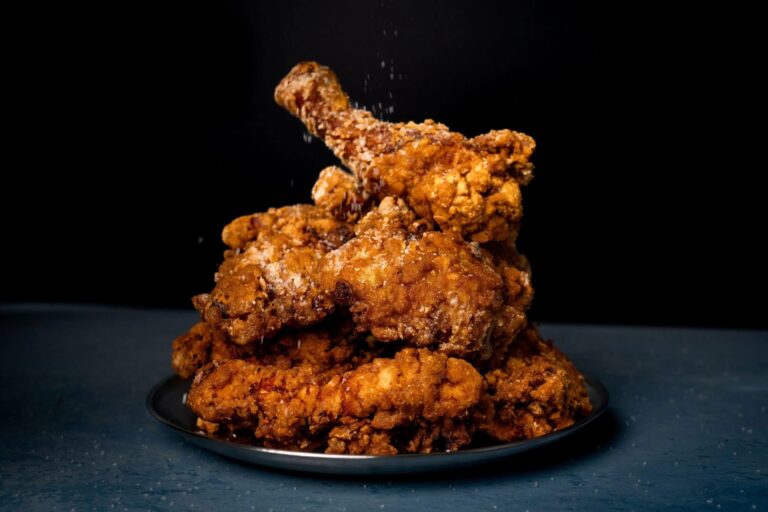
Ayam goreng is one common partner.
Its role is close to hard against soft.
It adds chewing and protein that rice and chili alone do not supply.
The spiced coating is dry.
It absorbs the fat of the rice.
Oil does not collide with oil. It disperses.
Teh tarik is another.
It is placed as sweet against heat.
Condensed milk resets the tongue with sugar and fat.
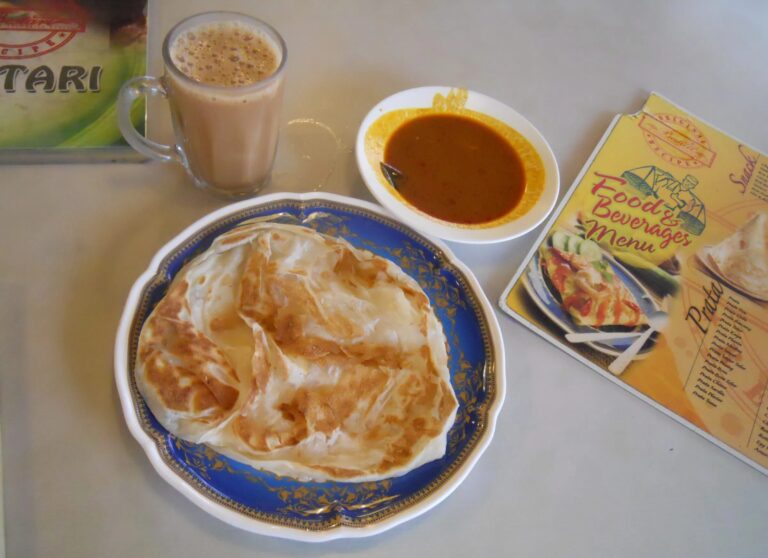
Eating, then drinking, begins to look like a morning ritual.
Open the packet.
Take in the heat.
Return with sweetness.
This back-and-forth moves the tropical morning forward.

A Common Language
Malay, Chinese, Indian.
Different religions, different languages.
Different habits of living.
Still, when the packet is opened, the gesture looks the same.
The leaf is unfolded.
Steam is released.
The position of the chili paste is checked.
Inside a small packet, there is adaptation to climate.
There is the logic of keeping food safe.
There is a simple format that many groups can share.
The small green tetrahedrons are lined up again today.
The shape does not change.
That alone is enough to wake the country.

— Detour —
a little further to walk