Notes on Din Tai Fung and Its Global Expansion
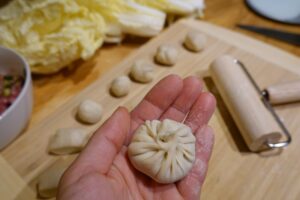
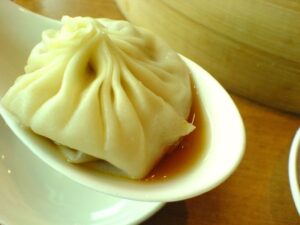
A Michelin-starred restaurant that once drew four-hour queues in London asks every dumpling to weigh 21 grams and carry 18 folds. In Dubai and Jakarta, the same ritual appears without pork.
In a supermarket freezer, xiaolongbao sits beside ordinary frozen foods, ready to cross borders in a plastic bag. The same soup-filled dumpling appears in bamboo steamers at restaurants thousands of miles away, but the names attached to the two versions are rarely the same.
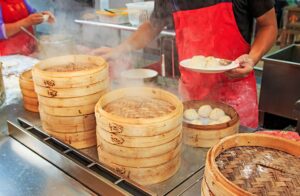
For a time, Din Tai Fung’s storefront held two businesses at once: peanut oil measured by weight and bamboo steamers sending xiaolongbao into the street. The first baskets came from a man living and working inside the oil shop, not from its owner.
On January 17, 1993, a Taipei xiaolongbao shop appeared in The New York Times beside grand dining rooms in Paris, London, and Hong Kong. Din Tai Fung’s entry in the list stood out for what the room around it did not have: chandeliers, ceremony, or any obvious claim to luxury.
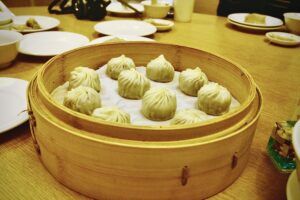
At a Din Tai Fung table, a steamer basket arrives with a spoon, shredded ginger, a sauce ratio, and a prescribed order of movements. The sequence is familiar enough to seem like the natural rulebook for xiao long bao itself.
At airports, station malls, and tourist streets, Taiwanese food brands appear beside local chains with almost no national fanfare: a Din Tai Fung sign, a cup of bubble tea, a pineapple cake in a paper bag. Their presence is easy to overlook precisely because it feels so ordinary.
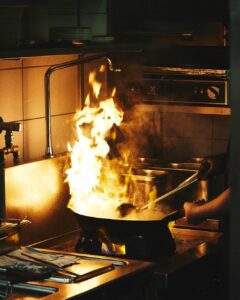
At Din Tai Fung, the dish that keeps appearing at local tables is not the famous basket of xiaolongbao but a plate of unusually white fried rice, topped with a soft, boneless pork chop. It looks almost too restrained to compete with a wok specialist’s version, yet the same quiet plate returns across the room.
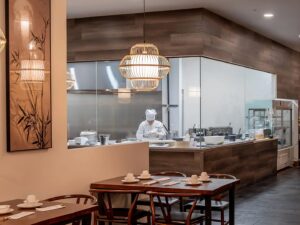
At Din Tai Fung in Taipei, steamers arrive in a steady stream and the queue keeps moving; the room feels built for lunch, not ceremony. The restaurant has a Michelin Bib Gourmand, while its Hong Kong branch once held a star.
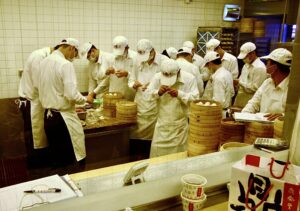
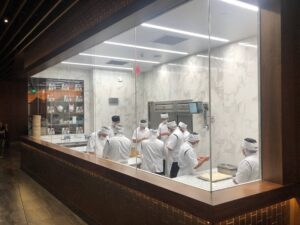
Behind Din Tai Fung’s glass kitchen, dough is cut, rolled, filled, and folded by people who rarely leave their stations. The room is quiet enough that the eighteen folds of a xiaolongbao seem to matter more than the hands making them.
In 2009, Michelin’s star landed not on Din Tai Fung’s Taipei flagship but on a branch inside Hong Kong’s Tsim Sha Tsui shopping district. The restaurant served xiaolongbao at roughly 1,000–2,000 yen per person, placing a globally prestigious distinction beside an ordinary mall meal.