Notes on the Entertainment of Xiaolongbao
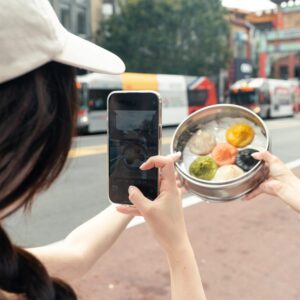
The bamboo steamer opens, steam rises, and a smartphone appears before the chopsticks do. On the screen, the dumpling’s trembling skin and sudden spill of soup matter before anyone has tasted it.
The bamboo steamer opens, steam rises, and a smartphone appears before the chopsticks do. On the screen, the dumpling’s trembling skin and sudden spill of soup matter before anyone has tasted it.
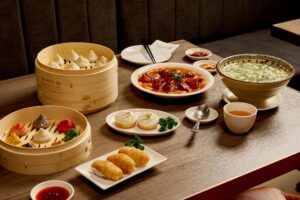
Across Din Tai Fung locations, from Taipei to London, the same small dumpling arrives with the same pleats, spoon, ginger, and lifting ritual. Behind the glass, even the hands making it seem to follow a shared script.
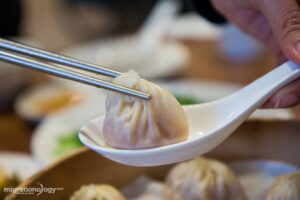
In Taiwan, xiaolongbao may arrive as a delicate dumpling whose skin trembles around hot soup, or as a soft, fermented bun at a breakfast counter. They share a name and a steamer, but not quite the same experience.
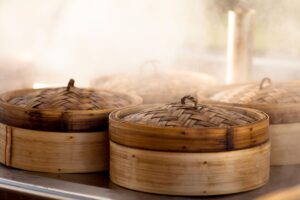
At Taipei’s airports, department stores, and tourist streets, xiaolongbao arrive in nearly identical bamboo baskets, their thin wrappers holding the same small pool of broth. The dish most readily read as a symbol of Taiwan is usually traced to Nanxiang, outside Shanghai.
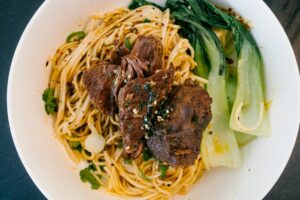
The bowl arrives almost bare: steaming noodles, a few heavy pieces of beef, and a shallow pool of dark sauce where the broth should be. A clear soup may sit beside it, turning one familiar noodle dish into two separate movements at the table.
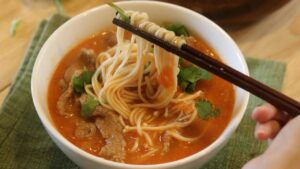
On a Taipei noodle menu, the familiar choice between dark soy-braised broth and clear broth sometimes has a third answer: tomato. The bowl arrives red, neither brown nor transparent, and increasingly unremarkable among the city’s everyday lunches.
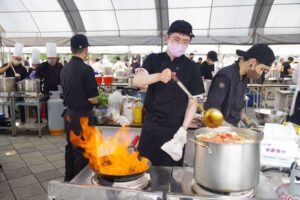
At Taipei’s International Beef Noodle Festival, bowls can arrive with wagyu, gold leaf, and truffle under the lights of a judging stage. In neighborhood shops, a much quieter bowl is still carried to a table beside the television, with no medal in sight.
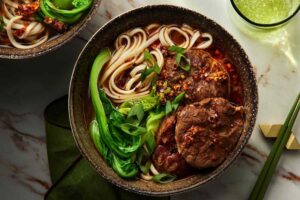
At a Taiwanese beef noodle shop, the order may continue after the broth is chosen: knife-shaved, flat, pulled, thin, or glass noodles, followed by pickled greens, chili beef fat, or garlic at the table. Under the same name, the bowl keeps splitting into different versions.

In a Taiwanese diner, 猪 appears on the menu beside pig’s feet, blood, and ordinary cuts of pork. To a Japanese reader, the character briefly suggests something from the mountains; what arrives is the familiar animal raised close to the kitchen.
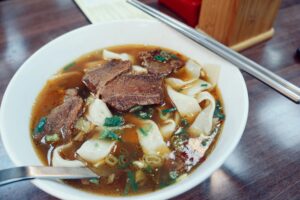
At the counter, ordering red-braised beef noodle soup is not quite finished when the bowl is named. The staff still needs to know whether the noodles should be thick, thin, flat, round, or made from starch—a small choice that changes what reaches the mouth first.