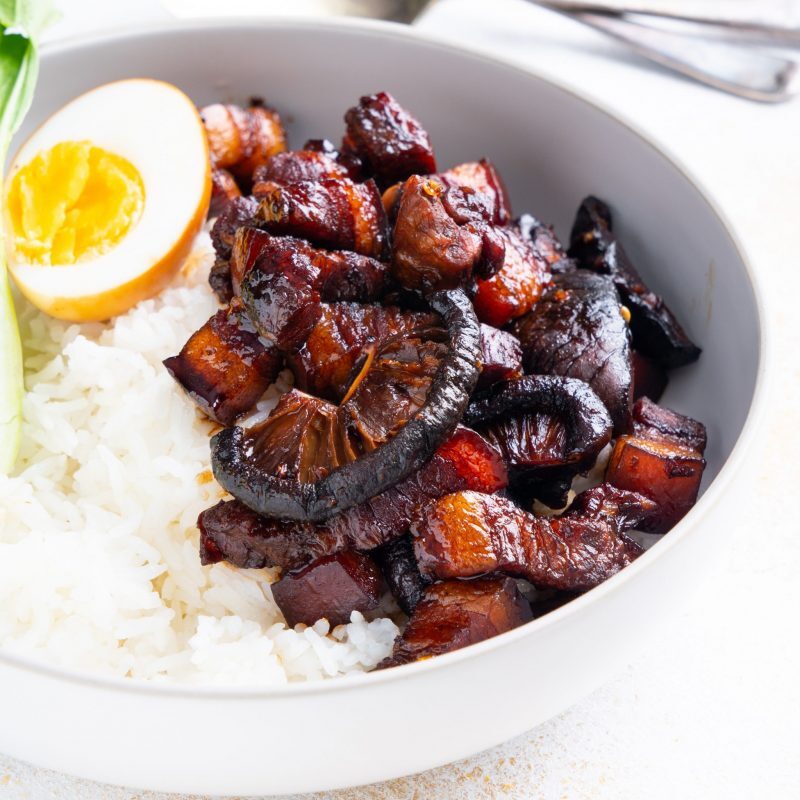
In Taipei, finely chopped braised pork over rice is called lu rou fan. Cross the Zhuoshui River and a nearly identical bowl is more likely to be rou zao fan, while lu rou fan may arrive as a slab of pork belly.
Try lu rou fan (魯肉飯) for the first time in Taiwan, and it’s probably in Taipei.
White rice, topped with finely chopped pork in a dark soy sauce. Some versions are fattier, others leaner. It comes in a small bowl, alongside a marinated egg, greens, maybe bamboo shoots.
Learn this dish, then head south, and the naming gets confusing. Order something close to Taipei’s lu rou fan in Tainan or Kaohsiung, and the menu usually calls it rou zao fan (肉燥飯) instead. Order “lu rou fan,” and you might get a thick slab of pork belly. The common rule of thumb: the naming splits somewhere around the Zhuoshui River (濁水溪).
That split is never clean. In Taichung, some shops serve finely chopped pork under the name lu rou fan; others serve big chunks. Some carry rou zao fan and kong rou fan (爌肉飯) as separate items. Still, as a rule of thumb for travelers, the Zhuoshui River line isn’t a bad one.
Dig deeper, though, and the real question isn’t where the line falls. Why do north and south use different names at all? More specifically: why does Taipei call finely chopped pork over rice lu rou fan?
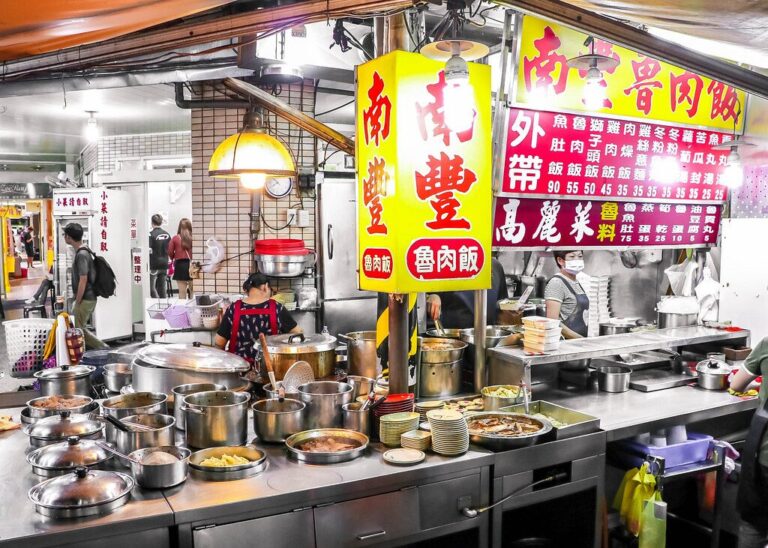

Rou Zao Fan Is a Straightforward Name
Start with the word rou zao (肉燥) itself. In Hokkien, it’s bah-sò. It refers to finely chopped pork, cooked down. It goes on rice, but also on noodles, or into other dishes as a seasoning.
It resembles Japanese soboro, but isn’t quite the same. Rou zao can be braised longer and reduced further. Some shops use more fat. Some add pork skin. Some simmer it long enough to render out collagen, leaving a thick, glossy sauce. Thinking of rou zao as “dry ground pork” misses the point.
What matters is that finely chopped, cooked pork already has a name of its own: rou zao. Rou zao fan, then, reads as exactly what it sounds like — rou zao spooned over rice.
Lu rou (滷肉), by contrast, is a broader term. Lu means braising in a soy-based, spiced liquid. Lu rou is simply meat cooked that way — the word says nothing about whether it’s chopped fine or left in a chunk.
Seen this way, the southern split makes sense: fine pieces get called rou zao fan, big braised chunks get called lu rou fan. Taipei is the one that needs explaining. Why would finely chopped pork — something that sounds exactly like rou zao — end up called lu rou fan?
My first guess was cooking time. Maybe Taipei’s lu rou fan braises longer, or with a heavier hand, and that earns it the “lu rou” name instead of “rou zao.” That doesn’t hold up. Southern rou zao fan gets braised for hours too, with plenty of fat, pork skin, thick sauce. Judged by technique alone, the border between Taipei’s lu rou fan and the south’s rou zao fan is blurry.
Only the names differ.
Taipei Had Rou Zao Too
So did the word rou zao simply fall out of use up north? Formosa Chang’s history says no.
Formosa Chang (鬍鬚張) opened in Taipei’s Shuanglian (雙連) neighborhood in 1960. Chang Yung-chang, the second-generation owner, has described his father reconsidering meat quality sometime in the 1960s.
Back then, some vendors collected scraps and sinew that households wouldn’t buy, ground them together with other cuts, and sold the mix. Chang Yung-chang describes those vendors as being in the business of “zuo rou zao” — making rou zao.
So the word rou zao was in ordinary use in 1960s Taipei. Chang Yan-chuan’s own product, meanwhile, was sold as “Shuanglian lu rou fan.” The word rou zao didn’t disappear from the north and get replaced by lu rou — both words existed side by side.
Formosa Chang later stopped using pre-ground pork altogether, switching to whole cuts bought and chopped in-house. Better meat didn’t turn the dish into something served over large chunks. They bought good pork, then deliberately cut it small. By the 1960s, at least, being finely chopped already seems to have been part of what made something Taipei’s lu rou fan.
This doesn’t explain why the dish was first called lu rou fan. If anything, it points the other way: the word rou zao was right there, in ordinary use, and Taipei still built a habit of calling finely chopped meat over rice lu rou fan.
Vocabulary alone doesn’t explain the split.
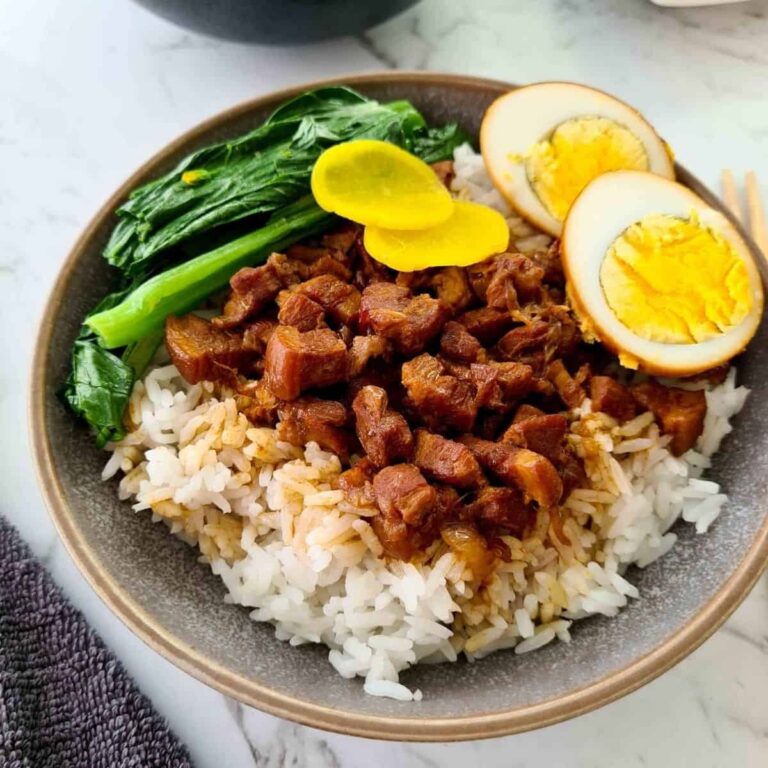
Lu Rou Fan Was Never One Recipe
Look closely at Taipei’s own lu rou fan, and there’s a fair amount of range inside the name itself.
Later recollections about the old shops at Jiancheng Circle (建成圓環) describe Long Feng Hao’s lu rou fan as fattier, and San Yuan Hao’s as leaner. Both were lu rou fan. Shops today range from something close to ground meat to small diced cuts to thin strips — fattier here, leaner there, pork skin more or less prominent.
The sauce varies. So does the color. So does the sweetness. Beyond “finely chopped,” there isn’t much holding the category together.
Maybe the question needs reframing. Was lu rou fan ever a single, fixed recipe? Or did it become, in Taipei, a market category — a name that gathered a range of finely chopped, braised-pork rice dishes under one label?
Which shop first called finely chopped pork rice “lu rou fan” isn’t clear. The usage might predate the war. It might have spread from one shop at Jiancheng Circle. It might have no deep origin at all — just a name that happened to stick in the market. What is clear: by the 1950s and 60s, multiple Taipei shops were selling “lu rou fan” as a product, and it wasn’t the same dish from shop to shop.
Once customers recognized the name “lu rou fan,” later shops had a reason to use it too. The fat-to-lean ratio could differ. The cut could differ slightly. The sauce could run thick or thin. Write “lu rou fan” on the menu, and customers still knew roughly what they’d get.
Dishes that resembled each other, without being identical, started gathering under one name. The dish didn’t come first, with a name attached after — at some point, it looks more like the name itself started defining the category.
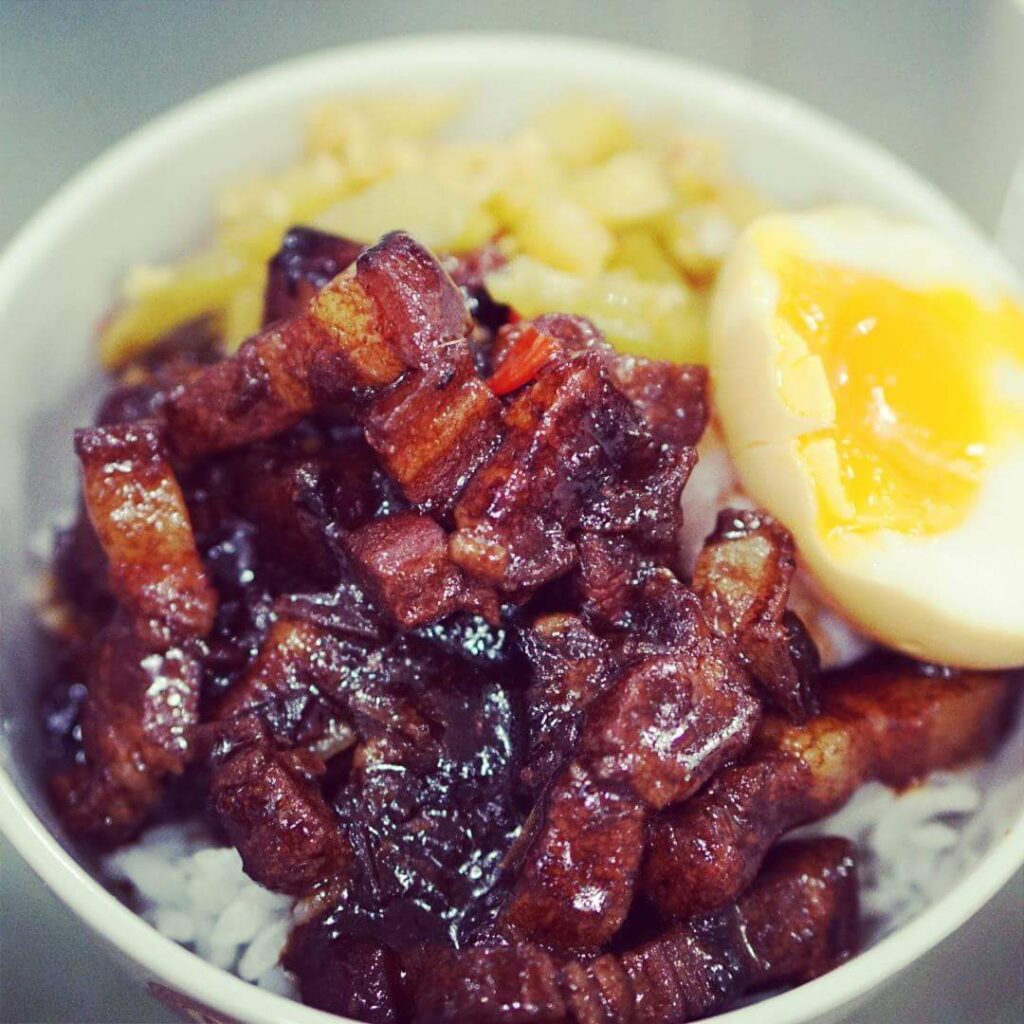
In the North, Lu Rou Fan Became the Umbrella. In the South, Rou Zao Fan Did.
From this angle, the north-south split looks a little different.
In Taipei, shops varied in meat ratio, cut, and sauce, and all of it still gathered under the name “lu rou fan.” In the south, dishes varying in leanness, fat, cooking time, and sauce volume line up under the name “rou zao fan” instead — at least in today’s market, rou zao fan appears to play a similar role.
So the finely chopped dish probably didn’t just swap names between north and south. It looks more like two separate market categories seem to have taken shape to organize similar dishes — one on each side.
Taipei: lu rou fan. The south: rou zao fan. Each name became an umbrella, gathering slightly different dishes underneath.
Looked at this way, Taichung’s confusion stops looking like an exception. Some Taichung shops serve big chunks under “lu rou fan.” Others serve fine pieces. Some carry rou zao fan as a separate item. Kong rou fan shows up too. Treat the Zhuoshui River as a hard border, and Taichung looks like nothing but exceptions.
But if north and south really did build separate naming systems, Taichung may simply be where the two overlap. The Zhuoshui River was never a border. Crossing it doesn’t flip every dish’s name at once. Still, this is roughly where the naming starts to wobble — which, as a rough marker, isn’t a bad one.

A Name Can Reshape a Dish
None of this is unusual, linguistically speaking. A broad term, when repeatedly used for one particular type in a region, can gradually come to evoke that type above all others. English corn followed a similar path: it once meant grain in general, but maize became so dominant in North America that “corn” came to mean maize almost exclusively. Something similar may have happened to Taipei’s lu rou fan.
The word lu rou doesn’t specify a cut size on its own. But once Taipei’s market kept using “lu rou fan” for finely chopped pork, the finely chopped version became the type people pictured. Shops that strayed too far from that picture risked confusing customers. So the name didn’t just gather dishes together — it started shaping them. Formosa Chang buying good meat and cutting it small can be read as one instance of that.
Was it chopped fine because it was called lu rou fan? Or did it stay chopped fine to keep fitting the lu rou fan category? In practice, the two probably can’t be cleanly separated. The name and the dish likely shaped each other as the category took form.
Still, the First Reason Is Unknown
So why did Taipei settle on “lu rou fan” instead of “rou zao fan” in the first place? That part is still unclear. An early, influential shop might have used the name first. It might have spread from a specific market, like Jiancheng Circle. The usage might reach back further north than anyone’s traced. The record stays foggy on this one point.
The first reason is unknown. What happened after the name stuck, though, is a little clearer.
Chasing “where was this dish invented” doesn’t seem to get you closer to understanding Taiwan’s lu rou fan. It looks less like one person invented the modern dish, and more like the category “lu rou fan” took shape as many shops and customers kept using the same name.
In Taipei, that name gathered up the finely chopped dishes. In the south, rou zao fan appears to have played a similar role. Cross Taiwan north to south, and the same three characters cover different ground.
In Taipei: fine pieces. Head south, and a similar dish gets called rou zao fan. Lu rou fan can arrive as a large chunk. In Taichung, it depends on the shop.
Remember it as “north and south use opposite names,” and that’s useful enough for a trip. Underneath, though, it may be the words, more than the dish, that have moved over the decades.
Three characters on a menu don’t tell you what’s actually coming to the table. Eat your way through Taiwan’s lu rou fan, and the surest approach hasn’t changed.
Look at the meat, not the name.