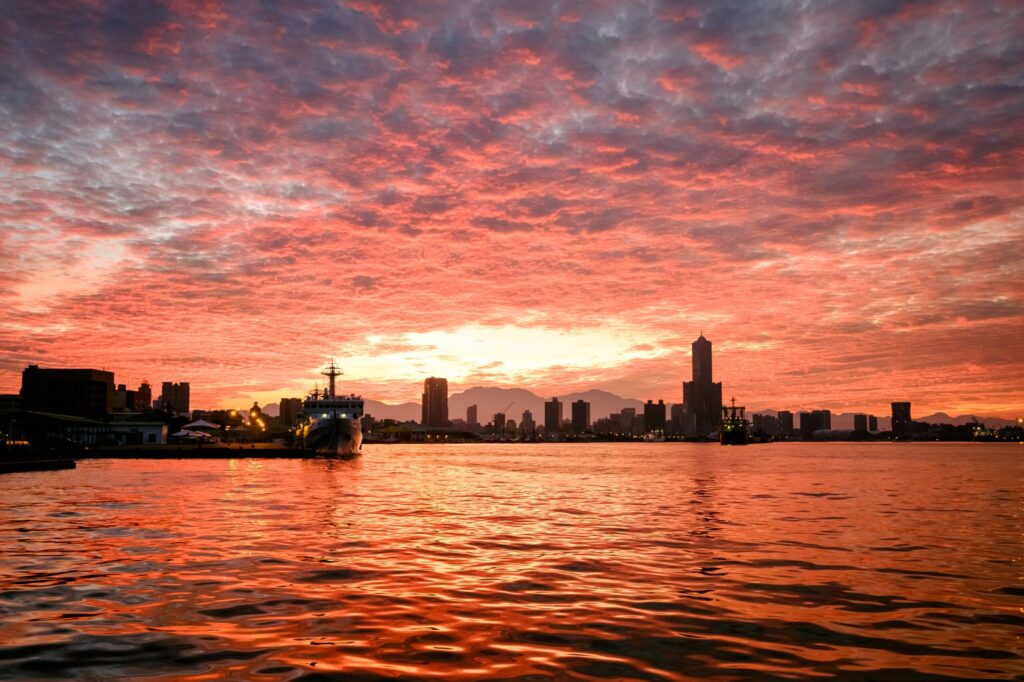
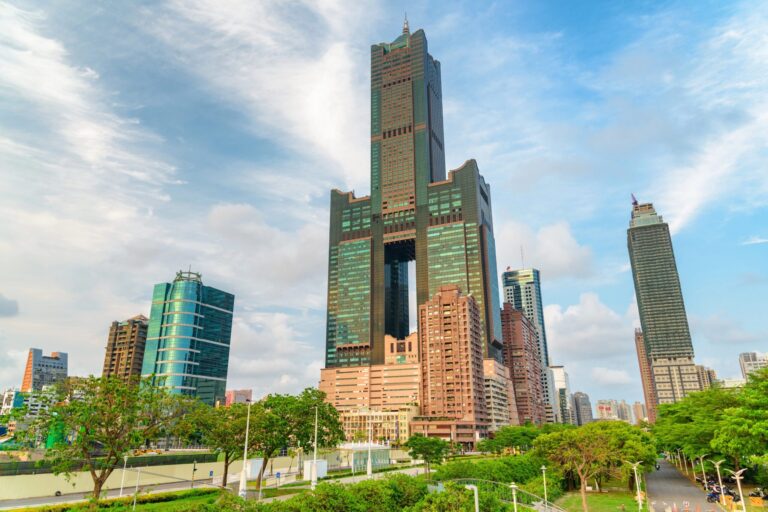
Kaohsiung’s 85 Sky Tower still holds a hotel, restaurants, banquet halls, and an observation deck, but the commercial floors that once made it a vertical city have largely emptied out. Next door, the site reserved for an even taller tower remains a parking lot.
Kaohsiung’s 85 Sky Tower (高雄85大樓) was completed in 1997. Passenger traffic at the city’s airport hit a record, and next door a development plan that included a 103-story tower, taller than 85 Sky Tower, was moving ahead. It was a year when Kaohsiung itself seemed set to grow much larger. The same year, a currency crisis that began in Thailand spread across Asia.
From today, the story connects easily. A giant building went up in a bubble, the Asian financial crisis hit, and the plan fell apart. Judging only by how the tower looks now, that explanation does not sound wrong.
In reality, the tower changed shape bit by bit over more than 20 years. The shops disappeared early. The hotel kept operating through several changes of owner. Small units called taofang (套房) passed to many owners, and a market for renting them out by the day grew up around them. On the city side, new centers of transport and commerce grew somewhere else. 85 Sky Tower was not a building that ended in a single failure.

The Asian financial crisis does not explain what came next
The Asian financial crisis reached Taiwan. Taiwan is generally said not to have fallen into a currency crisis on the scale of Thailand or South Korea. Even so, from the second half of 1998, companies in Taiwan ran into financial trouble one after another. At the time, this credit scare was called the “homegrown financial storm” (本土型金融風暴). The Tuntex Group (東帝士), which led the development of 85 Sky Tower, was caught up in it.
Tuntex had expanded into property and synthetic fibers and carried heavy debt. At the end of 1998, the 12 banks at a single meeting alone held claims totaling about NT$60 billion on Tuntex’s property arm (東雲) and related companies. Reports at the time called Tuntex the first heavily indebted group to take the blow of the financial storm.
The debt had been building up for years to fund expansion. A worsening financial climate landed on top of it.
At that point, the tower was only just starting to be used in earnest. It was planned in 1988 and completed in 1997. The shops actually opened in 1999. More than ten years after the plan began, the developer’s priority had shifted from growth to selling assets and cutting debt. On the last day of 1998, Tuntex announced the sale of shares in its telecom company.
By the time the building opened, the conditions behind the future that had seemed visible in 1997 were starting to change. Even so, the tower did not shut down all at once.
The first thing to fade was the activity on the lower floors
The lower floors held Jiantai Daimaru (建台大丸), a department store run with Japan’s Daimaru, and an indoor theme park. The designer called the building a “vertical city” (垂直立體城市), and in it the lower floors mattered. Hotels and offices are places people go when they have business there. A department store or an entertainment venue draws a much wider crowd. This was the part that gave ordinary residents a reason to walk into the building, to shop or to have fun.
Those commercial uses did not last. Jiantai Daimaru opened in 1999. Daimaru pulled out in 2001, and the store closed in 2002. At the theme park, a fatal accident took place and some rides were shut down. The lower floors drew fewer and fewer people.
Looking only at this, 85 Sky Tower seems to have failed within a few years of opening. Things went differently on the upper floors.
Guests still came to the hotel, the restaurants, the banquet halls, and the observation deck. With the department store gone, people still went to the tower for weddings and banquets. Travelers stayed at the hotel and looked out over Kaohsiung from the deck. The uses stacked in one building did not weaken at the same speed. Even after the shops were gone, the tower still gave people a reason to go.
The hotel kept running as owners changed
The hotel’s history shows even more clearly why the tower’s decline cannot be explained by “people stopped coming.”
The first hotel was the Grand Formosa Kaohsiung (高雄晶華酒店). Tuntex’s finances grew worse, and Chen Yu-hao (陳由豪), who ran the group, fled abroad. In 2003, the hotel came under the control of a bank syndicate and was renamed The Splendor Kaohsiung (青雲金典酒店). The operator changed, and the business went on.
In 2007, the hotel was reported to have reached an occupancy rate of 70 percent and to be moving from losses into profit. The report was partly hearsay, but it shows the hotel had not been steadily losing guests.
In 2011, the hotel floors were sold again. Earntex Union (億大聯合) bought them for about NT$3.2 billion, and in 2013 the hotel was renamed the 85 Sky Tower Hotel (君鴻國際酒店). Ownership changed, but the hotel continued operating.
The building as a whole took on the image of a “failed skyscraper.” Inside it, one part kept operating and kept drawing guests. For the building as a whole, success and failure could no longer be separated.
The tower meant to stand next door has not been built
Outside the building, too, the future seen in 1997 did not take shape as planned.
Next to 85 Sky Tower, the Far Eastern Group’s Asia Plaza (亞洲企業中心) project planned a 103-story tower as its final phase. The first-phase shopping complex was built and opened in 2001 as a Far Eastern mall (大遠百). It is still open. The 103-story tower planned after it has not been built.
The plan itself remains. Its building permit has been extended, and it is still alive on paper. The site is still a parking lot. The skyline drawn in the 1997 plan remains unbuilt more than a quarter century later.
Next door, too, the low-rise shopping complex was built, and only the future drawn above it was left empty. In 1997, it looked as if more towers would follow 85 Sky Tower. The real Kaohsiung began to grow in other directions as well.
The flow of people in Kaohsiung shifted
On the commercial map of the 1990s, the flow of people was, if anything, moving toward 85 Sky Tower. Business moved from the old downtown around a well-known local department store (大統百貨) and Shinkuchan (新堀江) to the area around Sanduo (三多), where Shin Kong Mitsukoshi and SOGO gathered. The Sanduo shopping district took shape right at the tower’s feet.
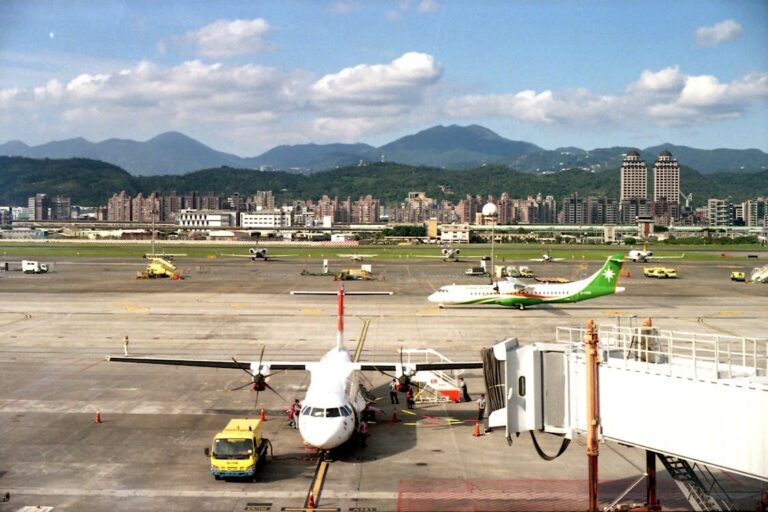
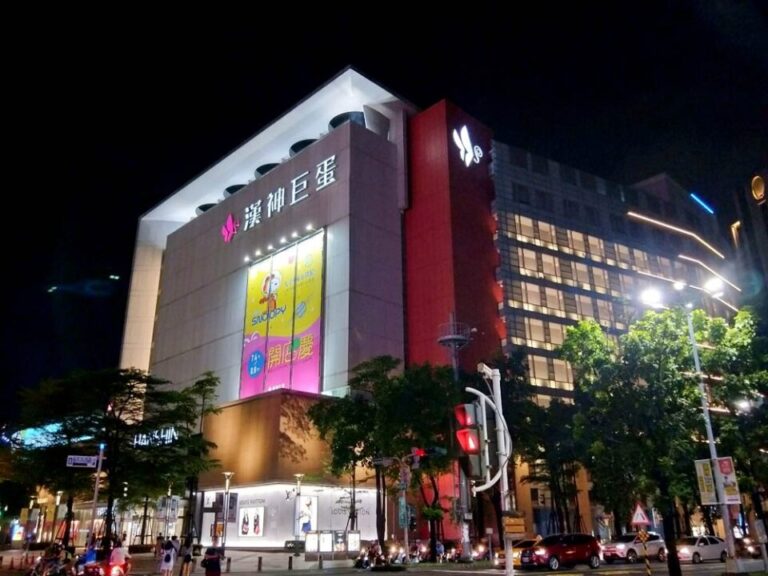
After that, other centers grew in Kaohsiung. In 2007, Taiwan High Speed Rail opened. Its Kaohsiung station was placed in Zuoying (左營), on the north side of the city. Air routes that had been a main way to travel between Taipei and Kaohsiung were quickly replaced by the high-speed rail, and domestic flights along the west coast began to disappear. The next year, in 2008, the Red Line of the Kaohsiung MRT opened. A new shopping cluster grew up around Hanshin Arena (漢神巨蛋) in the north, and Sanduo was no longer Kaohsiung’s only new commercial center.
Housing, transport, and commerce each moved at different times. In the 1990s, commerce headed toward Sanduo. In the late 2000s, other centers formed around the high-speed rail station in Zuoying and around Hanshin Arena.
When the tower was completed, people imagined a future in which the airport to the south, the Sanduo shopping district, the port, and new skyscrapers would all build on one another. Kaohsiung kept growing. The growth, however, did not gather in one place.
Many owners inside one building
Inside, too, the tower became less and less of a single block over time. From the original plan, some taofang were meant to be sold to outside buyers. The building mixed a hotel, shops, offices, and taofang, and the ways of owning them differed too.
That structure spread further. According to a 2018 report, the tower held more than 1,000 small taofang. Investors bought units and leased them to operators who rented them out by the day. A whole market had formed around them.
From outside, the building looks like one giant object. Inside, it is different. Some people own the hotel. Some own taofang. Some run businesses there. There is also a management committee that runs the shared parts. 85 Sky Tower was no longer a giant building run as one business by one owner. In 2019, that structure came to the surface in concrete form.
2019: the hotel is caught in a second owner’s financial trouble
In 2019, the upper floors that held the 85 Sky Tower Hotel went to court auction. At the first round in February, the minimum price was NT$8.5 billion, and no one bid. The second round, at NT$6.8 billion, also failed. At the third round in March, the minimum price had fallen to NT$5,440,258,000, and Kaide Tang (凱德唐) won with a bid of NT$5,440,268,000, just NT$10,000 higher.
Ownership changed hands in May. In July, the 85 Sky Tower Hotel decided to stop operating and dissolve the company. It later said it would keep offering rooms until the end of September and food and drink until the end of July.
This was not the first time the hotel floors had been caught up in an owner’s financial trouble. In 2003, problems on the Tuntex side put the hotel under a bank syndicate, and it kept running under a new name. This time, financial trouble on the Earntex side sent the hotel floors to auction. Between the two, there was a time when the hotel was reported to have reached 70 percent occupancy. It is hard to see the hotel’s closure in 2019 simply as a case of “people stopped coming.” The problem also spread beyond the hotel.
Owned in pieces, but water and power run through one building
In the summer of 2019, a dispute over the handover (點交) of the hotel floors was still going on at 85 Sky Tower. In August, when the court tried to inspect the site for the handover, it was blocked by several hundred people brought in by the former owner’s side. Meanwhile, the hotel side was reported to be more than three months behind on its management fees.
The two cannot be linked by simple cause and effect. In the same summer, a dispute over the transfer of ownership and unpaid management fees overlapped.
In September, the management committee was reported to have cut off water and electricity in response to the unpaid fees. The impact did not stop at the hotel. Other units that were still operating were caught up in it, and more than 30 workers were put on unpaid leave. With the power out, the elevators stopped, and workers climbed the stairs from the ground-floor emergency exit to the 37th floor. Food in the refrigerators went bad.
This was not a case of “too many owners, so no one could manage the building.” The management committee worked. It responded to unpaid fees by actually cutting off water and power. Because the tool it used was shared infrastructure, the effect did not stay in one unit.
Inside 85 Sky Tower, owners, contracts, and businesses are divided. The water, the electricity, and the elevators run through the same building. A building that had come to be used in separate pieces economically was, physically, still one building to the end. The events of 2019 showed that obvious fact in a rough way.
The future did not vanish; it did not arrive in the same form
Trace how 85 Sky Tower reached its present state, and the search for one “cause of failure” stops holding up.
Tuntex’s financial trouble was serious. It still cannot explain why the hotel went on operating for more than a decade afterward. The department store vanished early. People still came to the hotel and the observation deck. The hotel was caught up twice in its owners’ financial trouble. The taofang found other owners and a separate market.
On the city side, the Sanduo shopping district really did grow, and later other centers formed around the high-speed rail in Zuoying and around Hanshin Arena. The 103-story tower planned next door has still not been built.
The growth the tower anticipated did arrive, in a different form. Kaohsiung kept getting bigger. New shopping areas emerged, transport got better, and new urban functions gathered in other places. But the future pictured in 1997, with skyscrapers and international business piling up one after another in one corner of south Kaohsiung, did not happen.
Inside the tower, too, the functions once layered into a single “vertical city” went their separate ways over a long period.
The building remained, and Kaohsiung kept growing. What was lost was the future in which the two would grow in the same shape.

— Detour —
a little further to walk
- Notes on the Long Road to Reviving Kaohsiung’s 85 Sky Tower
- Notes on the Birth of Kaohsiung’s 85 Sky Tower
- Notes on Why Kaohsiung Did Not Extend South