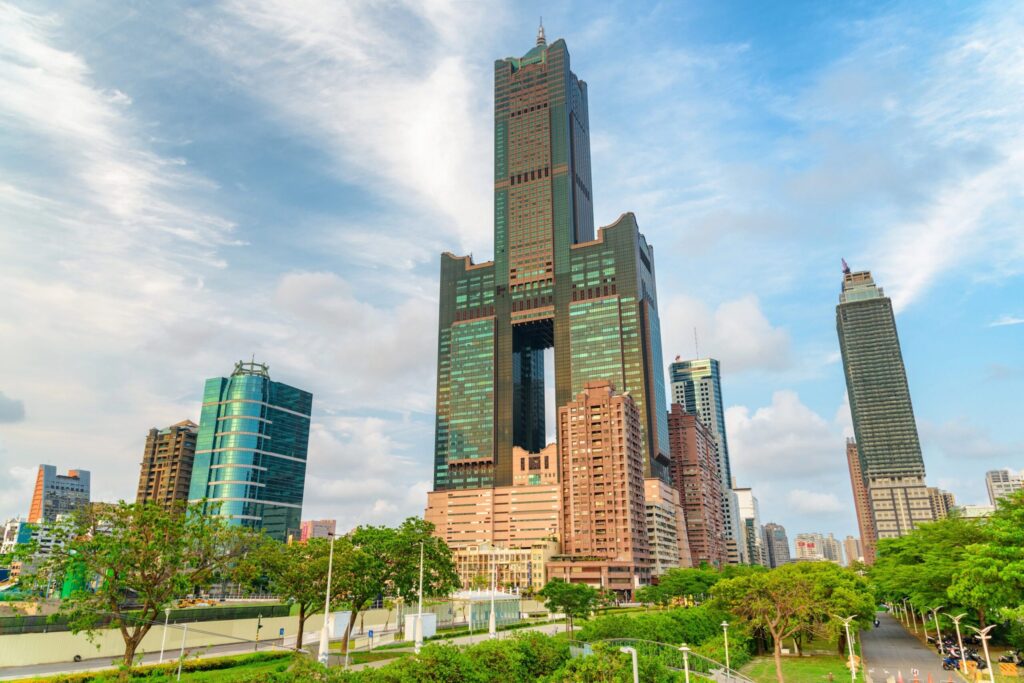
At 347.5 meters, Kaohsiung’s 85 Sky Tower rises above a harbor district that still feels unexpectedly open around it. Its shops, offices, hotel, observation deck, and planned indoor attractions were packed into one vertical address before the surrounding city had fully caught up.
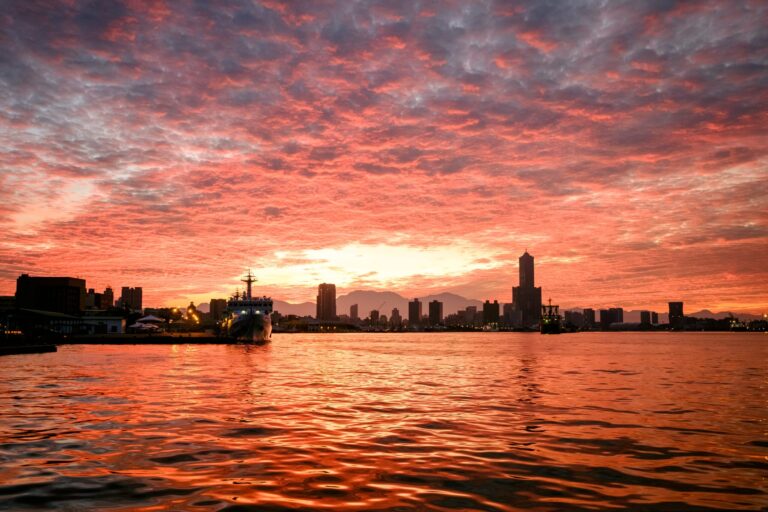
Kaohsiung’s 85 Sky Tower (高雄85大樓) stands 347.5 meters tall. It rises near the harbor, far above everything around it. At its foot are the Kaohsiung Main Public Library (高雄市立圖書館總館) and the Kaohsiung Exhibition Center (高雄展覽館), and the light rail runs a short walk away. Even so, the tower looks like a building left over from another era.
From that image, the past is easy to imagine. Someone put up a giant tower in a place that was not yet much of a city, riding the momentum of a bubble. Later, it was left behind.
Go back to Kaohsiung in the late 1980s, when the tower was planned, and the picture changes.
At the time, today’s Sanduo (三多) shopping district did not yet exist in its current form. The strongest shopping areas were around a well-known local department store (大統百貨) and Shinkuchan (新堀江). Sanduo became a commercial center a little later. Still, at the corner of Zhongshan Road and Sanduo Road, the Far Eastern Group had opened Kaohsiung’s first shopping center in 1986. New commercial investment had already begun.
One of Taiwan’s largest ports lay right beside the site, and the airport lay to the south. Skyscrapers were starting to rise over the city.
85 Sky Tower did not appear out of nowhere. It stacked the future, in advance, on top of a city that looked set to grow.
South Kaohsiung was gaining reasons to draw people
Kaohsiung International Airport, in Xiaogang (小港), began as a military airfield. It switched to civil aviation in 1965. International cargo started in 1969, and passenger flights to Hong Kong in 1972. Cargo came before passengers. The airport grew as part of the transport network of an export city built on its port and its factories, not as the gateway to a tourist city.
In the late 1980s, Taiwan’s aviation market changed. Deregulation came in 1987, and traffic at the Kaohsiung airport rose. Many people flew between Taipei and Kaohsiung. In 1997, the year passenger numbers peaked, about three-quarters of travelers were on domestic flights.
Seeing the airport only as “the gateway to international Kaohsiung” misses what it was. Its strength was more practical. On the south side of the city sat an airport that large numbers of people used to move quickly between northern and southern Taiwan. Along Zhongshan Road, the axis leading from that airport into the city, commercial development around Sanduo moved forward.
In 1988, when planning for the tower began, the area was not yet a finished downtown. What it had instead were several reasons to expect more people and more business.
Look at a map from where the tower stands today and ask why anyone would build on the harbor side, and the choice is hard to read. Look at the same map from the point of view of someone arriving from the airport, and it reads differently. At the end of the line running from the airport into the city lay a shopping district that was about to grow.
Kaohsiung’s skyline was rising before 85 Sky Tower
Seen on its own, the figure of 347.5 meters looks abrupt. Kaohsiung had been building upward before it.
In 1992, the Chang-Gu World Trade Center (長谷世貿大樓) was completed. It stood 222 meters. When finished, it was the tallest building in Taiwan. Its architect was C.Y. Lee (李祖原), who also designed 85 Sky Tower. Today it is easy to overlook in the taller tower’s shadow. Yet at a time when a 200-meter building was the tallest in Taiwan, work was already underway on a tower more than 100 meters higher.
Behind this was the momentum of a city that had grown around its port. In the 1990s, the Port of Kaohsiung handled some of the largest cargo volumes in the world, and the city ran on economic activity from shipping, manufacturing, and logistics.
Planning for 85 Sky Tower began in 1988. Construction started the next year.
The Taiwanese government put forward its plan to make Taiwan an Asia-Pacific Regional Operations Center (亞太營運中心), with international economic roles for Kaohsiung as well, only later, in the mid-1990s. 85 Sky Tower was not built to follow that policy.
The private megaproject came first. While it was under construction, a national plan to turn Taiwan into an economic hub for Asia began to overlap with it. There was never a single finished master plan from the start. Even so, by the mid-1990s, efforts that had begun separately looked as if they were pointing the same way.
There was a big port, airport traffic was growing, and shops were starting to gather around Sanduo. A skyscraper of more than 200 meters already stood. On top of that came talk of turning Kaohsiung into an even more international business city. In the middle of all this, 85 Sky Tower was under construction.
Stacking a future city inside one building
85 Sky Tower was more than a tall building. It held shops, offices, and a hotel, and the plans also included an indoor theme park and exhibition space. There were small units called taofang (套房), sold to outside buyers, and on the upper floors was an observation deck looking out over Kaohsiung.
Work, shopping, lodging, entertainment, exhibitions, and views were all to be layered inside one building.
The office of C.Y. Lee, who designed it, describes 85 Sky Tower as a “vertical city” (垂直立體城市) built for the life of the future. The floor plan was split into eight cores so that the shops, the hotel, and the offices could be managed separately without getting in each other’s way. The phrase “vertical city” came from the designer’s own office.
The city itself already existed. Around Sanduo, shops had begun to cluster. What 85 Sky Tower set out to build ahead of time was probably not the city itself, but the functions that city would need once it grew larger.
Rather than a department store, an office block, or a hotel alone, the plan was to stack many urban uses into one building nearly 350 meters tall and to build vertically for the Kaohsiung that was expected to emerge.
From today, knowing how things turned out, it looks as if far too much was packed into one building. To the people who planned it, it may have looked the other way around. If Kaohsiung was going to keep growing, it would need a building on this scale. The tower’s size was also the size of the future people imagined for Kaohsiung at the time.
More of the future was planned around the tower
Other projects pictured the same future. Close by, the Far Eastern Group was pushing another large development, called Asia Plaza (亞洲企業中心). Its final phase included a 103-story tower, taller than 85 Sky Tower. A groundbreaking ceremony was held in July 1997. The first thing built was a low-rise shopping complex. The 103-story tower itself did not start construction then. Still, the plan included a building even taller than 85 Sky Tower.
That is hard to picture from today’s skyline. Now 85 Sky Tower looks like a single tower standing apart from everything around it. Put the plans of the late 1990s side by side, and it does not look as if the tower was meant to stand alone forever.
The 222-meter Chang-Gu World Trade Center was already there. Next came the 347.5-meter 85 Sky Tower. Next door, a development that included an even taller tower had been announced. The future skyline still had more to come.
1997: Kaohsiung’s future takes shape
85 Sky Tower was completed in 1997, nine years after planning began and eight years after construction started.
The same year, a new international terminal opened at the airport. Annual passengers reached about 12.15 million, the airport’s peak. Most of them flew domestic routes. Even so, the city now had an airport to the south handling more than 12 million people a year, a shopping district growing around Sanduo, and the tallest building in Taiwan on its skyline. Next door, a groundbreaking had even been held for a plan that included a still taller tower.
Looking back, 85 Sky Tower seems far too big. Seen from Kaohsiung in 1997, it would have looked different. What people expected to grow was Kaohsiung itself.
Beyond the finished tower, another building was still to come. Airport traffic kept rising. A new shopping district was growing, and plans to make Kaohsiung more international were moving forward. The future seemed to be finally taking shape.
But that summer, something else had already started in Asia.
It would later be remembered as the Asian financial crisis.


— Detour —
a little further to walk
- Notes on the Decline of Kaohsiung’s 85 Sky Tower
- Notes on Why Kaohsiung Did Not Extend South
- Notes on Hanshin Arena, Kaohsiung