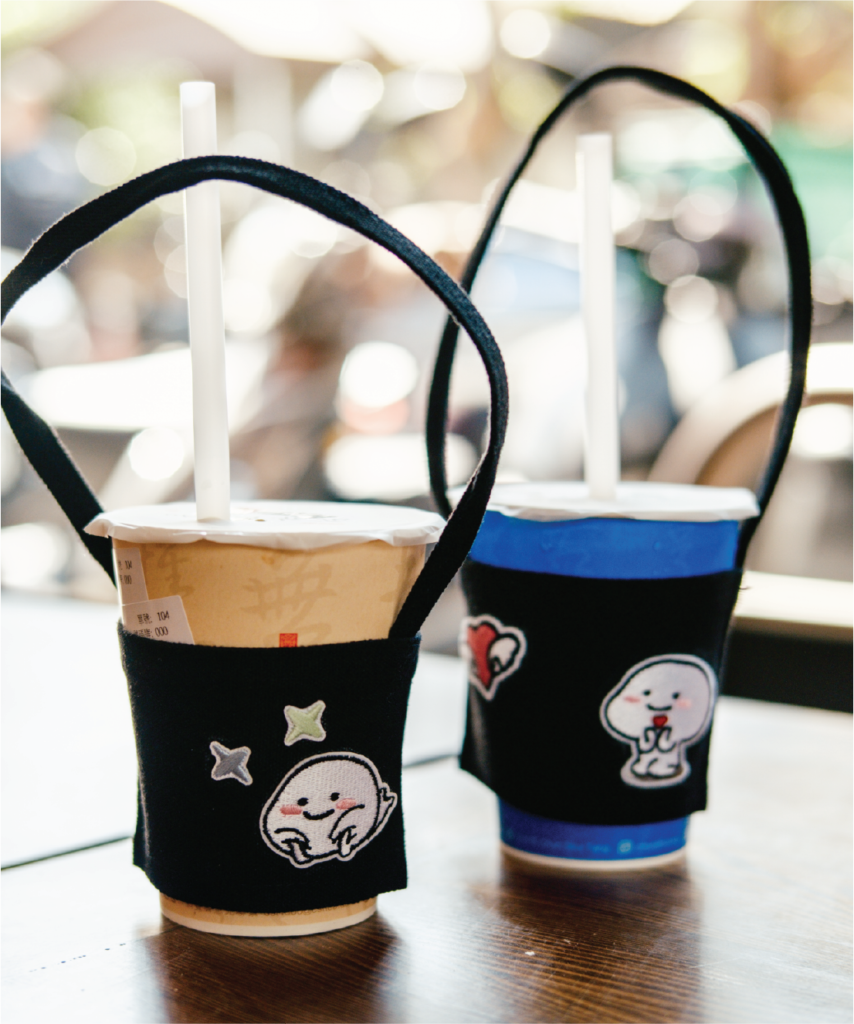
Across Taiwan, a takeaway drink can hang from someone’s wrist without a bag beneath it. A narrow fabric ring grips the tapered cup halfway down, leaving the bottom completely exposed.
Walk around Taiwan with a drink and you will see people who are not gripping their cups. The cup sits in a narrow strip of fabric that hangs from the wrist. The fabric does not wrap the cup, and it has no bottom. It is a ring around the middle of the cup with a handle rising from it. Push the cup in from the top and it stops partway down. Lift it, and it stays put.
As bags go, it uses very little material. Much of the work may be done by the cup rather than the bag.
How a Bottomless Holder Stays Up
The cups used by Taiwan’s drink shops are wide at the top and narrow a little toward the base. Slide a ring smaller than the rim over one, and it catches where the cup widens. The ring holds the cup by its sides. Nothing has to support it from below.
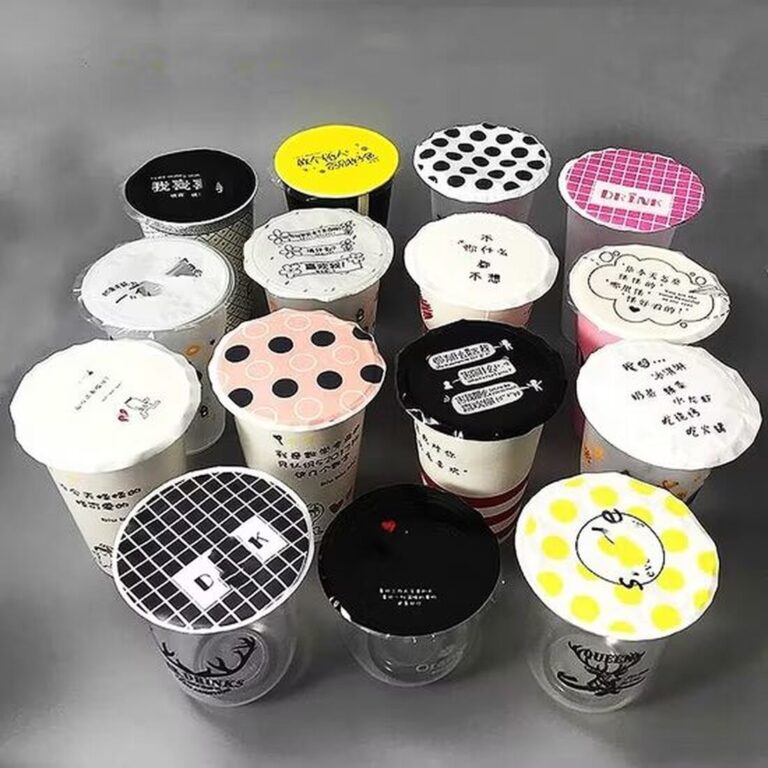
A second feature suits this well: the film sealed over the top. At shops selling hand-shaken drinks (手搖飲), a thin plastic film is commonly heat-sealed over the mouth of the cup. With the top closed, the drink is unlikely to spill even if the cup tilts a little as it hangs.
Utility model filings for drink-cup carrying bags from the mid-2000s treat this pairing as ordinary shop practice. Bubble tea (珍珠奶茶) and foam black tea (泡沫紅茶), black tea shaken with ice until frothy, go into tapered cups, and the tops are sealed with film. The long, narrow bags used for takeaway had to be wide enough to let a cup in. That left room for the cup to shift inside, and the bags used more material.
The bottomless shape follows from these conditions. The cup stops where its outer diameter matches the inner diameter of the ring. The film keeps the drink inside while it is carried. With the container doing this work, the carrier only needs a part that grips the cup and a handle to lift it by. It is closer to a carrier reduced to what a drink needs than to a bag with its bottom cut away.

Taiwan Did Not Invent the Principle
Treat the structure as a Taiwanese invention, and the dates stop fitting.
The idea of holding a tapered cup partway down, without supporting its base, is old. A US patent from the early 1930s describes a cup holder open at the bottom, made of flexible material, that receives a tapered drinking cup and has tabs that form a handle. By the 1980s, US patents describe carriers cut from a sheet with openings: tapered cups are pushed in, held partway down, and carried several at a time.
Their uses and shapes differ from today’s drink holders in Taiwan, and there is no evidence that the 1930s design is an ancestor of the Taiwanese product. Still, the principle that a tapering cup can be held by a ring with no bottom was not unique to Taiwan. It appeared in the United States decades before the earliest Taiwanese example found here.
The filings that describe Taiwan’s drink shops do not present the structure as Taiwan’s alone. A 2007 filing for a bottomless drink bag lists several Taiwanese utility models as prior art, alongside cup carriers from the United States and Britain.
The difference lies in how the principle was used. The US patents mentioned here are carriers for taking several cups at once from places such as fast-food restaurants. The filings that describe Taiwan’s drink shops assume a different way of selling: one hand-shaken drink, sealed, carried away by the customer. In Taiwan, the same physical principle entered a different kind of trade.
Single-Cup Drink Bags in Taiwan
The oldest Taiwanese example found here is among the earlier filings listed in the 2007 document: a 1998 utility model titled 飲料手提塑膠袋改良結構, roughly “an improved structure for plastic drink carrying bags.” Filings for similar structures followed in the 2000s.
This does not show that the design was invented in Taiwan in 1998. Older examples may turn up, and no direct line to overseas designs can be traced. What it shows is that by the late 1990s, at least, people in Taiwan were filing improvements to this structure as a single-cup drink bag.
The background is the business of drink shops. In the trade the filings describe, a drink goes into a tapered cup, the top is sealed with film, and the customer takes it away as a single cup. An ordinary bag leaves too much slack, and the cup moves around. Holding the cup by its body and hanging it solves both problems.
In the 2007 filing, the applicant explains that the design uses less material than a bag with a bottom, and presents this as a matter of the environment as well as cost. Today’s cloth holders look as if the idea of environmental protection (環保) was added later. By 2007, the argument for using less plastic was already attached to this shape.
If there is something distinctly Taiwanese here, it is less the mechanism itself than the several improved designs that appeared for selling drinks one cup at a time.

It Did Not Start in 2018
Drink holders are now often sold as eco-friendly drink bags (環保飲料提袋). That makes them look like a product of Taiwan’s policy on reducing plastic.
2018 was a policy milestone. That year, restrictions on plastic shopping bags (購物用塑膠袋) were extended to more types of business, and drink shops were added. The rules did not ban plastic bags outright. They barred the businesses covered from giving them away free.
Go back through the dates, and bottomless drink bags appear in Taiwanese filings about twenty years earlier. The 2018 policy did not create this shape.
A 2017 government Q&A, written while the policy was being prepared, offers another clue. As examples of plastic shopping bags covered by the rules, it lists ordinary carrier bags and others, along with bags called 卡口式杯袋 and T-shaped bags (T型袋). These names may not refer to the same shape as today’s cloth holders. The first name, though, contains the character for “cup,” so at least one of the examples was a bag made for cups.
The chronology runs the other way. Bags for carrying drinks existed before the rules were expanded, and the expanded rules took them in. This fits the actual timeline better than the story of an eco product born from environmental policy.
What the Shop Hands Over, and What You Carry
The policy around 2018 still has some bearing on today’s drink holders. Once free plastic bags are no longer a given, the choice between taking a disposable bag with every drink and bringing your own carrier looks a little different. The government has also repeatedly urged people to bring and reuse bags.
No available figures show when, or how widely, cloth drink bags spread. There are reports that sales rose after the policy took effect, but that alone does not make the policy the cause. Nor do the sources establish a direct line from the disposable bottomless bags to the cloth holders. What is clear is that the same principle also appears in reusable cloth products that people buy and carry themselves.
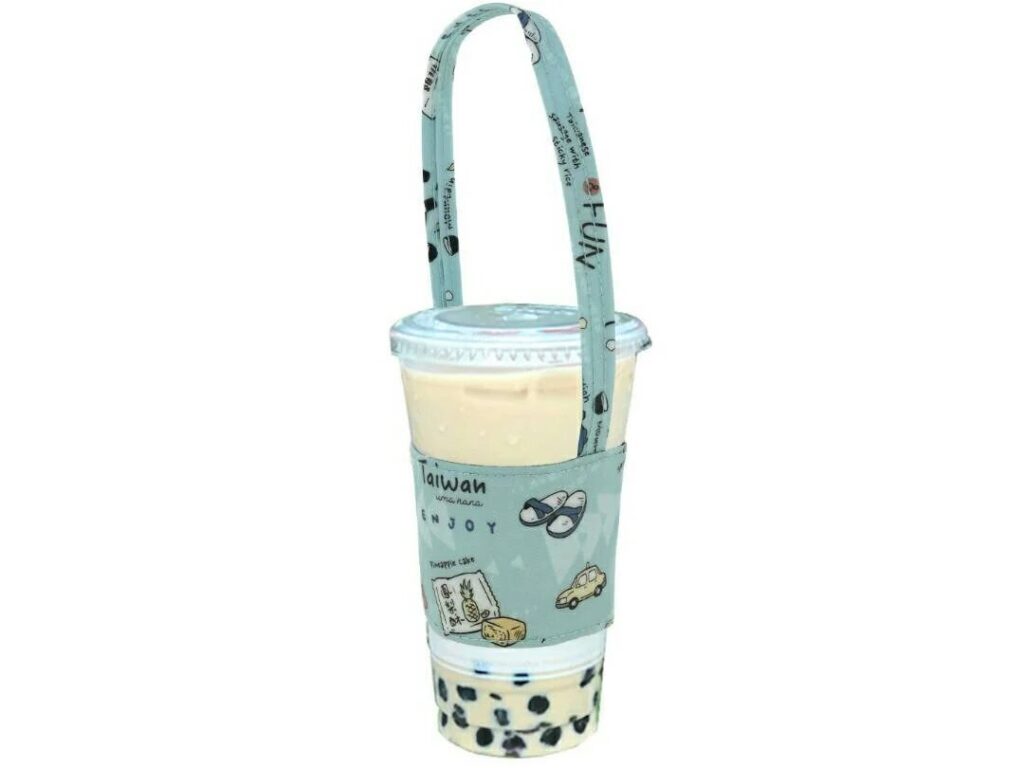
Once a tool is reused, the demands on it change. Packaging that a shop hands out with each sale only has to be cheap and use little material. Something you keep in your bag and use again and again gives you reasons to weigh durability and how small it folds, and also its material and pattern.
In Taiwan today there are plain ones, floral ones, illustrated ones, and even collaborations with drink brands and characters. At this point, it is less a bag than a small personal item.
A Small Strip of Cloth at the Wrist
Buy a drink on a street in Taiwan, and you will see a narrow strip of cloth hanging from someone’s wrist. It has almost no bottom and almost no sides, and the cup sits in it securely.
You do not need to know any of this history for the drink to stay put. Once you know it, though, you begin to see a little more of Taiwan in that small strip swinging at the wrist.

— Detour —
a little further to walk
- Notes on Sealed Lids in Taiwan
- Notes on Why Drink Shops Fill the Streets of Taipei
- Notes on Sugarcane Straws in Taiwan